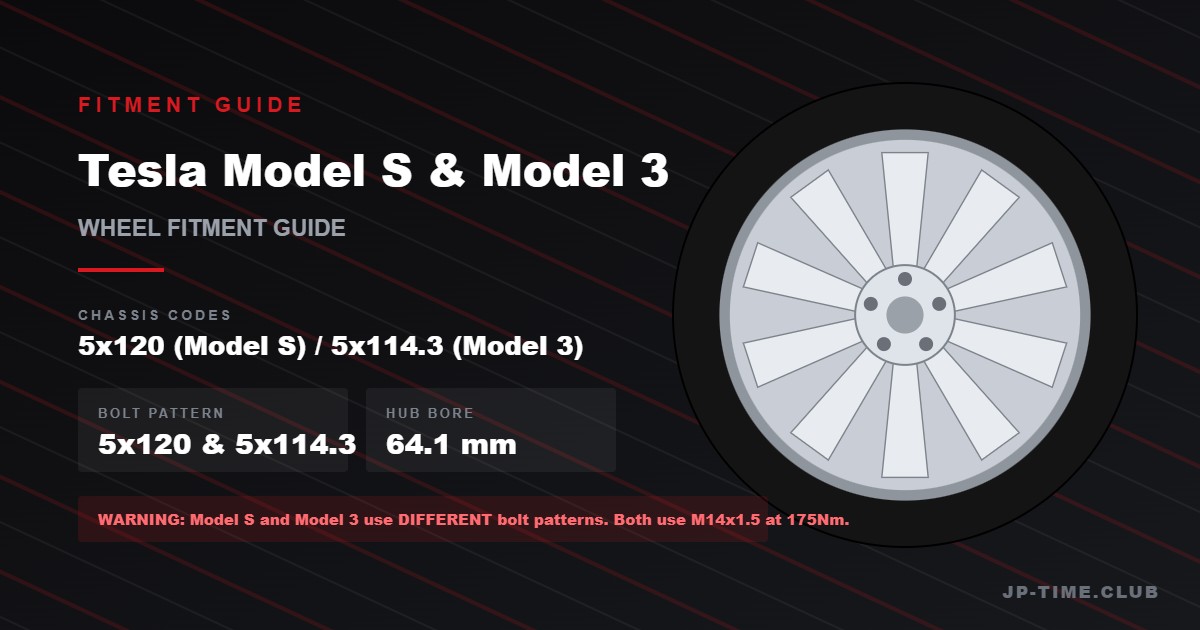
Two Teslas, one hub bore, one thread size, one torque figure — and two different bolt patterns. The Model S is 5×120. The Model 3 is 5×114.3. Nothing swaps between them.
For anyone shopping Japanese wheels, the Model 3 is the interesting one: 5×114.3 with a 64.1 mm bore puts it squarely inside the JDM catalogue — with two important caveats we will come to.
Section 1: OEM Wheel Specifications
| Model | Years | Bolt Pattern | Hub Bore | Thread | Torque | OEM Wheel / Tyre |
|---|---|---|---|---|---|---|
| Model S | 2012-2021 | 5×120 | 64.1 mm | M14x1.5 | 175 Nm | 8Jx19 ET40 / 245/45R19 8.5Jx21 ET40 / 245/35R21 |
| Model 3 Standard / Long Range | 2017-2023 | 5×114.3 | 64.1 mm | M14x1.5 | 175 Nm | 8.5Jx18 ET40 / 235/45R18 8.5Jx19 ET40 / 235/40R19 |
| Model 3 Performance | 2017-2023 | 5×114.3 | 64.1 mm | M14x1.5 | 175 Nm | 9Jx20 ET34 / 235/35R20 F 9Jx20 ET34 / 245/35R20 R |
Both cars use M14x1.5 fasteners torqued to approximately 175 Nm — substantially higher than almost every Japanese car in this series. Always confirm the figure and fastener type for your specific car and year.
Section 2: Offset Comparison & Fender Clearance Visualization
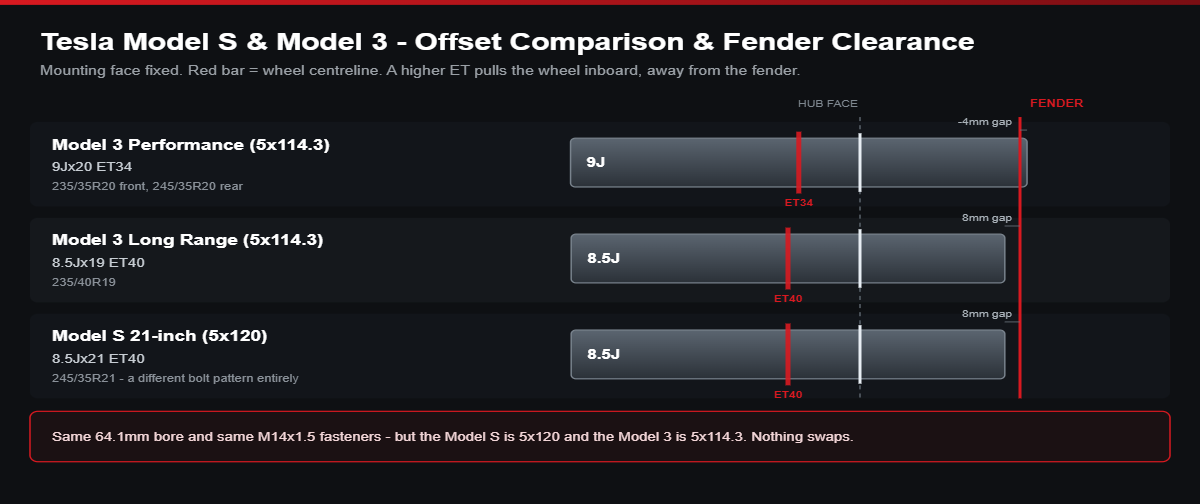
Section 3: Can You Fit Japanese Wheels to a Model 3?
Yes — and this is worth spelling out properly, because it is the most common question we get about this car.
The Model 3 is 5×114.3, the most widely produced pattern in Japan. Its 64.1 mm bore is Honda’s standard. So:
- Honda wheels (64.1 mm) match the bore exactly. NSX, S2000, Integra Type R, Civic Type R — all correct on pattern and bore.
- Nissan wheels (66.1 mm) fit with a 66.1–64.1 hub-centric ring. Silvia, Skyline, 350Z, 370Z.
- Mitsubishi Evo and Mazda RX-7 FD wheels (67.1 mm) fit with rings.
- Toyota wheels (60.1 mm) will NOT fit. The bore is 4 mm too small for the Tesla hub. Supra, Chaser, Lexus IS, MR2 — none of them.
The two caveats.
First, the fastener. Tesla uses M14x1.5 where every Japanese car in this series uses M12. The bolt holes in a Japanese wheel are usually large enough to accept an M14 fastener, but not always — and the seat geometry must match. Confirm the hole diameter with the seller before you buy, and use fasteners specified for the wheel.
Second, load rating. A Model 3 Performance weighs around 1,850 kg and a Model S over 2,100 kg. That is heavier than almost every car in this series and it is delivered through instant torque. Look for the JWL and VIA stamps and, more importantly, the published load rating per wheel. A wheel designed for a 1,300 kg S2000 is not a wheel for a Model S.
A Japanese-market Model 3 — 5×114.3 with a 64.1 mm bore puts it inside the Japanese wheel catalogue. — via @@modelplusstudio
Section 4: The Model S and 5×120
The Model S uses 5×120, which is the BMW and Lexus LS460 pattern rather than a Japanese one. Its 64.1 mm bore, however, is smaller than BMW’s 72.6 mm and 74.1 mm, which means BMW wheels will fit with rings but Tesla wheels will not fit a BMW.
For context on 5×120 elsewhere in this series, see our BMW M5 guide and Lexus LS460 guide — note that the LS460 uses 5×120 with a 60.1 mm bore, so LS460 wheels will not fit a Model S either.
Section 5: Range, Weight and Wheel Choice
One consideration unique to electric cars: wheel and tyre choice measurably affects range. Tesla’s own 18-inch aero wheels exist for this reason. Moving from an 18 to a 20, and from a 45-series tyre to a 35-series, typically costs several percent of range through added mass, rotational inertia and rolling resistance.
That does not mean you should not do it. It means the trade is real and worth making deliberately — and it makes a light forged wheel a more compelling purchase on an EV than on almost anything else. This is the one area where the Japanese forged catalogue has a genuine functional advantage to offer a Tesla owner, not just an aesthetic one.
Section 6: Realistic Fitments
- Model 3, 19×8.5 ET35–ET40 — effectively factory-equivalent. The safe forged replacement.
- Model 3, 19×9.5 ET35 / 20×9.5 ET35 — noticeably wider. Fits standard arches at stock height; watch the front at full lock on a lowered car.
- Model 3, 18×9 ET35 — the range-conscious and track-friendly choice. More sidewall, cheaper tyres.
- Model S, 20×9 ET35 / 21×9 ET40 — the common upgrade. Remember 5×120.
Below ET30 on either car you are into fender-roll territory, and on a car this heavy the extra leverage on the wheel bearing is not trivial.
Related Fitment Guides
- BMW M5 — 5×120 with a larger bore
- Lexus LS460 — the other 5×120 saloon
- Audi A7 & S7 — similar weight, similar fasteners
- Toyota Alphard & Vellfire — load rating on a heavy vehicle
Every guide in this series is built the same way: verified factory specifications, an offset diagram, and an honest account of what fits and what does not.
Buying Wheels for Your Tesla
Bolt pattern first — 5×120 or 5×114.3 — then bore, then fastener size, then load rating. The Model 3 in particular has access to the entire Japanese 5×114.3 catalogue, provided the bore is 64.1 mm or larger and the wheel is rated for the weight.
Looking for a specific set? We specialise in genuine Japanese wheels — RAYS, Volk, Enkei, SSR, WORK, BBS Japan and the rare discontinued sets that never left the country. Tell us the wheel, the fitment, the year — our team searches our networks until we find it.
Specifications in this guide reflect factory equipment. Trim levels, model years, optional wheel packages and market-specific variants can differ. Always confirm the fitment, fastener specification and load rating against your own car before purchase.