Read the RAYS corporate timeline and something becomes obvious very quickly. It is not a history of wheel designs. It is a history of forging presses.
1986: 5,500 tons. 1989: a second press. 1991: a third. 1995: an RM8000. 1999: a second RM8000. 2004: 10,000 tons. Six machines in eighteen years, listed in the official record alongside the sales offices and subsidiaries as though they were equally newsworthy events. For RAYS, they were.
This profile is built from the RAYS group’s own published corporate documents, read in Japanese.
The Short Version
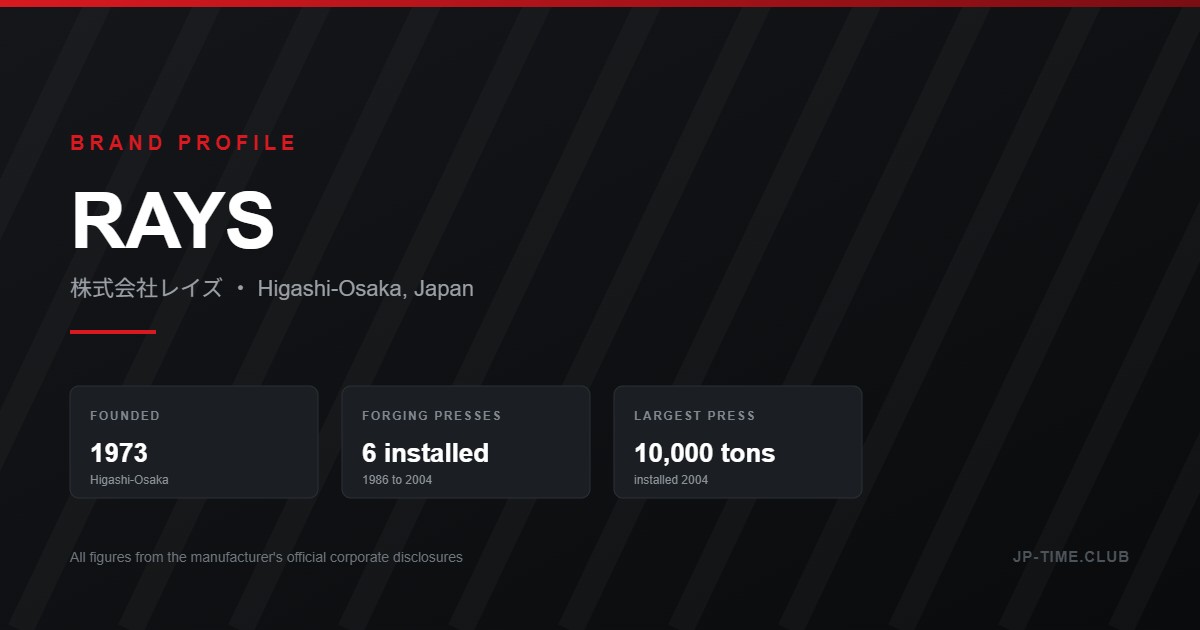
- Founded 1973 as RAYS and RAYS Engineering. Fiftieth anniversary in 2023.
- Headquarters: Nagata-nishi, Higashi-Osaka — the same district as WORK.
- President: Shotaro Shiba.
- Six forging presses installed between 1986 and 2004, the largest rated at 10,000 tons.
- Supplied wheels to Williams F1 from 2007 and to TOYOTA GAZOO Racing in WEC from 2015.
- Officially certified as a small-to-medium enterprise under Japan’s 2026 Health & Productivity Management scheme.
What the Official Record Actually Says
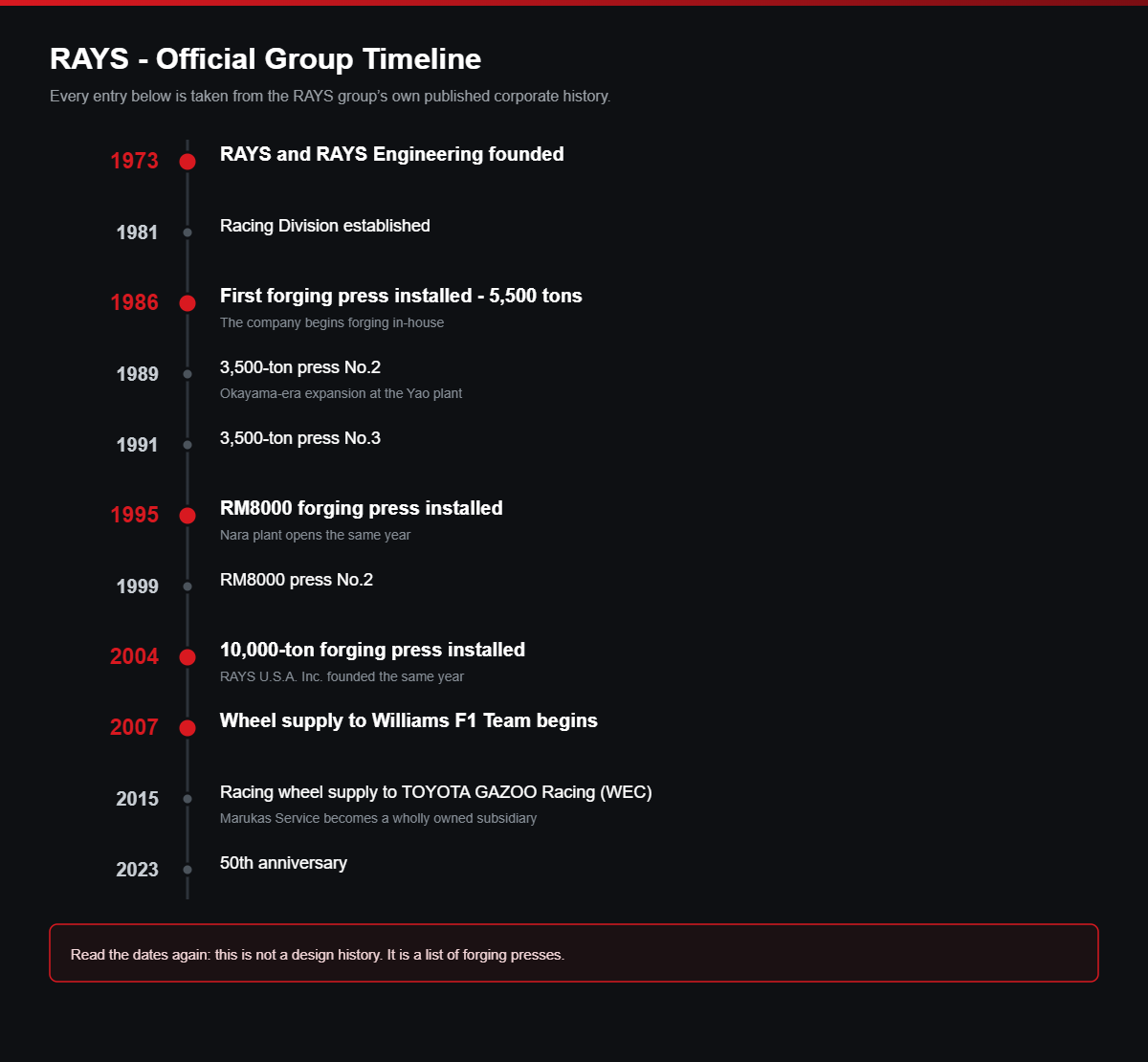
RAYS began in 1973, but for its first thirteen years it was not a forging company. The presses start arriving in 1986, and once they start they do not stop.
What makes this list unusual is that RAYS chose to publish it. Most wheel manufacturers describe forging in marketing terms — “advanced forging technology” — without ever saying what equipment they own. RAYS lists the tonnage and the year, press by press, in its official group history. That is a company telling you where its money went.
Why Press Tonnage Matters
Forging squeezes a solid billet of aluminium into shape under enormous pressure. The metal’s grain flows around the form rather than being poured into it, which produces a denser, stronger structure than casting — the reason a forged wheel can be lighter at the same strength.
The catch is that force scales with size. A larger diameter, a wider rim or a more complex spoke form all need more tonnage. Press capacity is therefore a hard ceiling on what a manufacturer can physically make.
Seen that way, the 2004 installation of a 10,000-ton press is the moment RAYS could produce large-diameter forged monobloc wheels in volume. Everything the brand is now known for downstream of that date sits on top of that machine.
RAYS and WORK: Two Answers to the Same Problem
RAYS and WORK are headquartered in the same Osaka neighbourhood, Nagata-nishi in Higashi-Osaka, roughly a kilometre apart. They were founded four years apart. They are the two names an American enthusiast is most likely to know. And they solved the central problem of the aftermarket — how do you make a wheel in a specification the car maker never offered? — in completely opposite ways.
| RAYS | WORK | |
|---|---|---|
| Core method | Forged monobloc | Assembled multi-piece |
| Capital went into | Presses (6 between 1986–2004) | Assembly plants (from 1979) |
| How you get a rare size | A dedicated die and production run | A different rim half at assembly |
| Repairable rim | No — one piece of metal | Often yes — rim is a component |
| Headquarters | Nagata-nishi, Higashi-Osaka | Nagata-nishi, Higashi-Osaka |
Neither approach is better. They are different businesses that happen to sell the same category of object, and knowing which one you are buying explains most of what you need to know about price, availability and repairability.
The Group Is Larger Than the Brand
WORK is one company with one subsidiary. RAYS is a group. Its published history records the founding or absorption of RAYS Engineering (1979), RAYS Creative (1982), Parts Bank and Twin (1982), Bester — later RAYS Foundry — for casting (1988), Riza (1990), RAYS R&D (1992), Pacific Alloy Logistics (1994), Tsubaki Precision Die (1997), Fuji Pacific Alloy (2003), RAYS U.S.A. (2004), RAYS CWP (2005) and Marukas Service, taken to full ownership in 2015.
Two things follow. First, RAYS does its own casting as well as its own forging — the cast lines were consolidated into RAYS CWP in 2005. Second, when you buy a RAYS product you may be buying from any of several brand lines the group operates, of which VOLK RACING is only the best known.
The Model Families
- VOLK RACING — the forged flagship. TE37 in its many forms, CE28, ZE40, G025, 21A/21C.
- gramLIGHTS — the 57-series. 57DR, 57CR, 57XR and relatives.
- HOMURA — premium road and luxury fitments.
- VERSUS — the VOUGE and VV lines.
- TEAM DAYTONA — SUV, 4×4 and van applications, including the FDX and M9 series.
- A-LAP and VMF — further road and utility lines.
The TE37 alone currently exists in more than thirty listed variants. In 2023 RAYS marked the design’s thirtieth anniversary with a dedicated commemorative series.
What This Means When You Are Buying
1. A forged wheel is one piece of metal. A damaged rim cannot be swapped as a component the way it often can on a multi-piece WORK. Straightening a forged wheel is a specialist job and not always advisable. Inspect the rim edge carefully on any used set.
2. Sizes are fixed by tooling. Unlike a made-to-order multi-piece wheel, a forged monobloc exists only in the sizes RAYS chose to tool for. If a specification does not appear in the catalogue, it was not made — which is worth remembering when a listing claims an unusual offset.
3. The TE37 is among the most counterfeited wheels in the world. A genuine set carries specific markings and a specific weight. That subject deserves its own article rather than a paragraph here, and we will publish one with photographs of stock we have handled.
What We Could Not Verify
- The meaning of the name RAYS, and of VOLK RACING. Neither is explained on the company’s official pages. Several English sources state confident etymologies; none cite a source.
- What “37” refers to in TE37. A widely repeated story attributes it to a development or die number. We found no official statement and are not going to invent one.
- Employee count and capital. RAYS does not publish either figure. What it does publish is its 2026 certification under Japan’s Health & Productivity Management programme in the small-to-medium enterprise category — which places an upper bound on the company’s size, if not an exact number.
- The relationship between the 1986 5,500-ton press and the “No.2” 3,500-ton press of 1989. The official history numbers them in a sequence we cannot reconstruct from the document alone, so we have reproduced the entries as published rather than interpreting them.
FAQ
Are all RAYS wheels forged?
No. RAYS operates cast production as well — the group’s casting operations were consolidated into RAYS CWP in 2005. VOLK RACING is the forged line; other group lines include cast models. Check the specific model.
Is RAYS the same as VOLK RACING?
VOLK RACING is a brand line operated by RAYS, not a separate company. gramLIGHTS, HOMURA, VERSUS, TEAM DAYTONA, A-LAP and VMF are others.
Has RAYS supplied professional motorsport?
Yes. Its official history records the start of wheel supply to the Williams F1 Team in 2007 and racing wheel supply to TOYOTA GAZOO Racing for WEC in 2015.
Where are RAYS wheels made?
The group history records forging plants at Yao (from 1984, expanded 1989) and Nara (from 1995), casting operations consolidated as RAYS CWP with a Hamakita plant expanded in 2016, and distribution centres at Nishinomiya and Hamamatsu.
Why is a forged wheel lighter?
Forging compresses solid aluminium under pressure so the grain follows the shape of the part, producing a denser structure than casting. The same strength can therefore be achieved with less material.
Can a forged RAYS wheel be repaired?
It is a single piece of metal, so a bent rim cannot be replaced as a component. Repair is possible in some cases but is specialist work and depends on the damage. Treat rim condition as a primary factor when buying used.
Sources
Every figure in this article comes from the RAYS group’s own corporate disclosures — the company overview and group history pages of rayswheels.co.jp — read in the original Japanese. Where those documents are silent, we have said so rather than filling the gap from secondary sources.
Related Guides
- WORK Wheels — the neighbouring company that took the opposite approach
- Nissan Skyline R34 — 5×114.3 / 66.1 mm, the classic TE37 application
- Toyota AE86 — 4×114.3, one of the few modern forged options left for the pattern
- Toyota GR86 & Subaru BRZ — 5×100, and why Toyota wheels do not fit it
- Lancer Evolution IV–IX — 5×114.3 / 67.1 mm
Looking for a specific set? We specialise in genuine Japanese wheels — RAYS, Volk, Enkei, SSR, WORK, BBS Japan and the rare discontinued sets that never left the country. Tell us the wheel, the fitment, the year — our team searches our networks until we find it.