Ask an enthusiast where BBS wheels come from and most will say Germany. The name is German, the founders were German, and the town in the company name — Schiltach, in the Black Forest — is German.
But if you are looking at a forged BBS wheel, the odds are very good that it was made in Toyama Prefecture, by a company that spent its first twelve years making bobbins for the textile industry and has been Japanese-owned throughout.
This is not a technicality. It changes what the brand’s repeated bankruptcies mean, it changes what “genuine BBS” means, and it changes what you should look for on the wheel.
The Short Version
- There are two BBS companies. A German one (currently the assets of BBS Autotechnik, held by KW automotive) and a Japanese one, BBS Japan Co., Ltd., in Takaoka, Toyama.
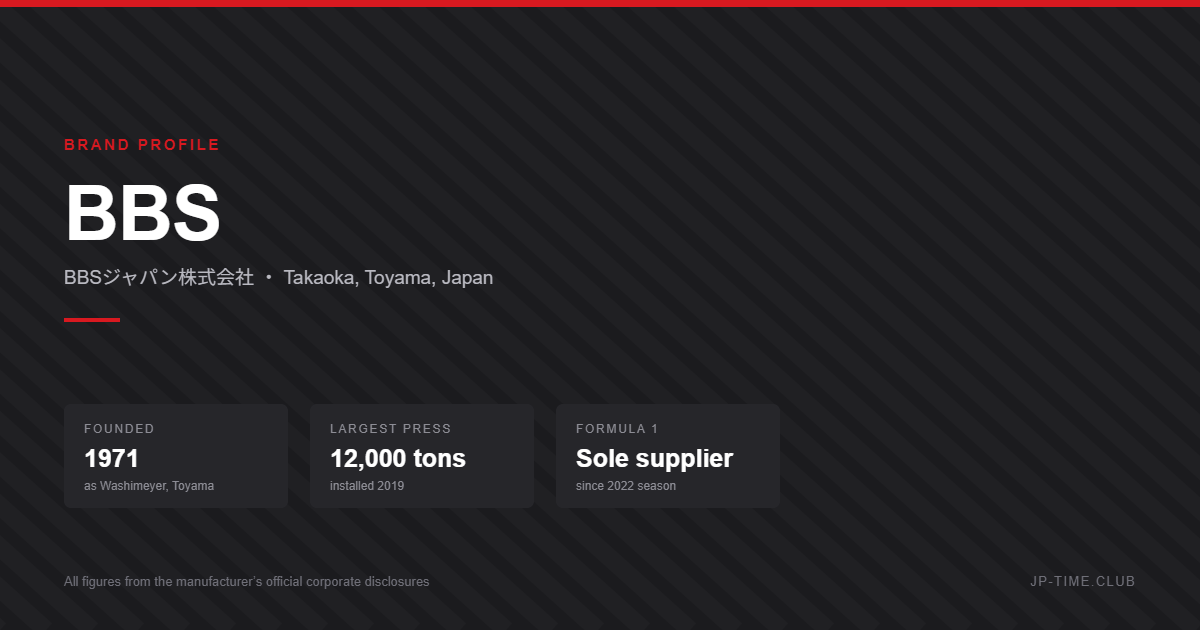
- The Japanese company is not a licensee. It is the source of the forging technology the brand is built on, and since 2011 it has held the trademark rights for BBS-brand forged and racing wheels.
- It started as a textile-machinery company called Washimeyer, founded in 1971 to make aluminium yarn-winding beams.
- The German company has gone insolvent repeatedly — 2007, 2020 and 2024 among them. The Japanese company went through its own court-supervised reorganisation in 2012 and emerged under new ownership.
- Since 2022, BBS Japan has been the sole wheel supplier to Formula 1 and, on a separate contract, to NASCAR.
The Part Nobody Puts in the Story
BBS Japan’s own corporate history is unusually candid about where it came from, and it is worth reading in the original Japanese because the English-language version of the BBS story leaves this out almost entirely.
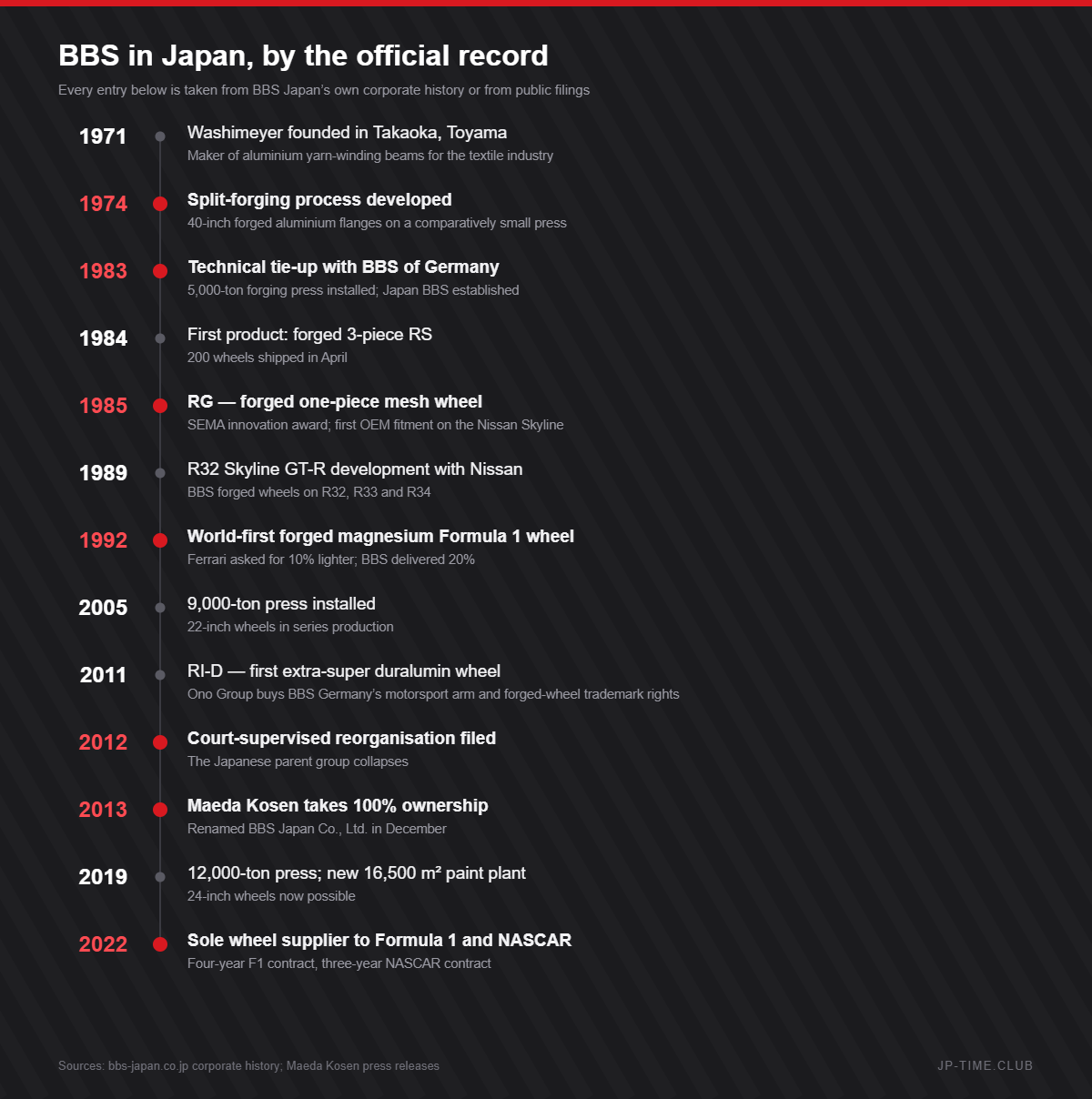
In July 1971, a company called Washimeyer (ワシマイヤー) was founded in Takaoka, Toyama, to manufacture aluminium yarn-winding beams — the large spools that thread is wound onto in a textile mill. A beam has to be light enough to handle and strong enough to carry an enormous wound load without deflecting. Solving that problem is a forging problem.
In 1974 the company developed what its history calls split forging: rotating the workpiece and forging it in successive sections rather than in one hit. The point of the technique is that it lets a comparatively small, comparatively cheap press produce very large forgings — in Washimeyer’s case, aluminium beam flanges 40 inches (about one metre) across. The company describes clearing “extremely difficult technical problems including heat management” to get there.
That is the technology BBS wheels are built on. It arrived from the textile industry, nine years before anyone in Toyama made a wheel.
The 1983 Partnership Ran the Other Way Round
The usual telling is that a Japanese company licensed a German brand. BBS Japan’s history describes something close to the opposite.
By 1981 the German BBS — founded in 1970 by Heinrich Baumgartner and Klaus Brand in Schiltach, initially making fibreglass body parts — had concluded that forged wheels were the future but could not fund the capital equipment. It went looking for a technical partner, and according to BBS Japan’s account it turned down a queue of suitors because it feared ending up as a badge on someone else’s cheap product.
Washimeyer approached them. Baumgartner flew to Japan, toured several companies, and saw the split-forging line last. The history says he was “shocked.” Washimeyer wanted to diversify out of a declining textile sector; BBS wanted forging know-how it did not have. The deal came together quickly.
The tie-up was signed in 1983, a 5,000-ton press was installed, and in February 1984 the first Japanese-made product was completed: the forged three-piece RS. Two hundred wheels shipped that April.
In 1985 came the wheel that mattered more: the RG, a one-piece forged wheel with the full cross-spoke mesh face. Nobody had managed a complex mesh in one forged piece before. It won a technical innovation award at the SEMA show in the United States, and it brought the first OEM contract — an option fitment on the Nissan Skyline.
A History You Can Read in Press Tonnage
We made the same observation writing about RAYS, and it holds here: the honest way to read a Japanese forged-wheel company is through the size of its presses, because a press is the one thing a company cannot fake, borrow or outsource.
| Year | Press | What it made possible |
|---|---|---|
| 1983 | 5,000 tons | The first forged three-piece wheels |
| 2005 | 9,000 tons | 22-inch wheels in series production |
| 2019 | 12,000 tons | 24-inch class; a 16,500 m² paint plant added the same year |
The company also states a forging ratio of 4 or more — the cast billet is compressed to a quarter of its original bulk or less. The purpose is to convert cast grain structure into forged grain structure and to keep the metal flow lines running continuously through the spokes rather than being cut across by machining. That is what a forged wheel is actually buying you, and it is why press tonnage is not a vanity number.
A detail worth correcting because English sources get it wrong: BBS Japan’s second plant is at Yokkaichi in Takaoka City, Toyama — a district name. It is not Yokkaichi in Mie Prefecture, several hundred kilometres away.
The German Company Has Failed Repeatedly. The Wheels Kept Coming.
This is the part that worries buyers, so it is worth setting out plainly.
BBS in Germany listed on the Frankfurt exchange in 1987. In 2007 it went bankrupt and was taken over by the Belgian group Punch International. In 2015 the Korean firm Nice Holdings became majority owner. In 2020 it filed for insolvency again and was acquired by the German suspension manufacturer KW automotive in March 2021. Insolvency proceedings opened again on 1 October 2024, most of the roughly 240 staff at Schiltach and Herbolzheim were let go, and in March 2025 KW automotive took over the relevant assets outright.
None of that stopped forged BBS wheels being made, because they are not made there. In 2011 the Japanese group that owned Washimeyer bought BBS Germany’s motorsport division along with the trademark rights to BBS-brand racing and forged wheels. BBS Japan’s current company page lists its major customers as Porsche, Bentley, Ford, Formula 1 teams — and BBS of Germany. The German company is a client.
The Japanese Company Went Through It Too
We are not going to tell you the Japanese side sailed through untouched, because it did not.
In October 2012, Washimeyer and two other core companies of its parent Ono Group filed for court-supervised corporate reorganisation at the Tokyo District Court — the Japanese procedure closest to Chapter 11. A reorganisation plan naming Maeda Kosen as sponsor was approved in September 2013. On 1 November 2013 Maeda Kosen took 100% ownership through a full capital reduction and third-party share allocation, and that December the surviving entity absorbed the affiliated companies and was renamed BBS Japan Co., Ltd.
Maeda Kosen is not a car company. It is a listed civil-engineering materials manufacturer from Fukui Prefecture that makes geosynthetics and nonwoven fabrics for infrastructure work. That is an odd parent for a wheel maker, and it is the reason BBS Japan today is financially boring in a way the German company has never managed to be.
Formula 1, and Why It Matters to a Road Wheel Buyer
BBS built the world’s first forged magnesium Formula 1 wheel in 1992. Ferrari asked for 10% lighter than the cast magnesium wheels of the day; the company delivered 20%, and got an unusual three-year contract out of it.
When F1 moved from 13-inch to 18-inch wheels for the 2022 season it went to a single supplier, and that supplier is BBS Japan — a four-year contract, announced by Maeda Kosen in January 2022. NASCAR signed separately for three years.
The sentence in that announcement that should interest a buyer is this one: BBS Japan states that its road wheels are made in the same factory, by the same process, as its racing wheels. The technology pages put it more bluntly still — same factory, same staff. Marketing departments say things like this all the time; the difference here is that the company only has the one forging operation, so it is a description of a constraint rather than a claim.
Two more concrete numbers from the same source: BBS Japan warrants its finish for two years and the wheel itself for five.
What This Means When You Are Buying
Do not treat “BBS” as one thing. The catalogue spans forged one-, two- and three-piece wheels, flow-formed wheels and cast wheels. Those are different products at different price points from different production lines, and only some of them come out of Toyama. A cast BBS and a forged BBS have almost nothing in common except the badge.
Check the wheel, not the seller’s description. Country of manufacture is cast into a genuine wheel. If a listing claims a Japanese-made forged wheel, the wheel should be able to say so itself — ask for that photograph. The same goes for the size and offset stamp.
The German insolvencies are not a reason to avoid a used forged BBS. They are a reason to be careful about warranty and spares on recent European-market product. A 1990s three-piece RS or LM from Japan was made by a company that still exists, still makes wheels, and still makes the parts.
Three-piece wheels are serviceable, and that is the point. The reason the RS and LM survive in the used market in the numbers they do is that barrels and hardware are replaceable. A kerbed one-piece forged wheel is a repair question; a kerbed three-piece is often a parts question.
Beware the RS name. The BBS RS is one of the most widely copied wheel designs ever made. Replicas are everywhere, they are frequently cast, and they are frequently sold without the word “replica” anywhere in the listing.
What We Could Not Verify
- Exactly which current models are made where. BBS Japan describes itself as manufacturing domestically and also importing and exporting; the German operation has its own lines. We could not find a published model-by-model production-location list from either company, and we are not going to guess at one.
- The RS date discrepancy. English sources date the three-piece RS to 1977; BBS Japan dates its own first forged RS to February 1984. These are most likely different wheels sharing a name — an earlier German product and a later Japanese forged one — but we could not find a source that states this explicitly.
- The RG date discrepancy. BBS Japan gives 1985 for the forged one-piece RG and the SEMA award; the English-language Wikipedia entry gives 1987. We have used the manufacturer’s own date.
- The 2011 trademark purchase in detail. The scope is described in a BBS Japan announcement of 30 November 2011 which is no longer accessible at its original address. We have relied on secondary summaries of it, and we cannot confirm the exact territories or wheel categories covered.
- Whether the model-letter prefixes mean anything. RS, RG, RI, RE, RF, RN, RP, FI, FS, FL — we could find no published scheme, only enthusiast speculation.
- Current production volumes and headcount for BBS Japan. Not published in a form we could confirm.
FAQ
Is BBS a German or a Japanese company?
Both, and they are separate companies. The brand originated in Schiltach, Germany in 1970. The forged wheels are made by BBS Japan in Takaoka, Toyama, which has held the forged and racing wheel trademark rights since 2011 and is owned by the listed Japanese firm Maeda Kosen.
Did BBS go out of business?
The German company has entered insolvency several times, most recently in October 2024, with its assets taken over by KW automotive in March 2025. BBS Japan is a separate company and continues to manufacture; it supplies Formula 1.
Are BBS wheels still made in Japan?
BBS Japan manufactures domestically at Takaoka. It does not publish a model-by-model list of production locations, so the reliable check is the country of manufacture cast into the wheel itself.
Why are forged BBS wheels so expensive?
A forging ratio of four or more means most of the billet is squeezed away, the presses that do it cost tens of millions of dollars, and the finishing is done by hand. It is an expensive way to make a wheel and BBS has never pretended otherwise.
What is the difference between the RS and the LM?
The RS is the three-piece cross-spoke wheel that made the brand’s name. The LM is a two-piece design launched in 1994, based on the wheels BBS was making for Le Mans. The SUPER-RS, launched the same year, keeps the RS face on a stronger two-piece rim.
Sources
The company history, plant locations, press tonnages, forging ratio and warranty terms in this article are taken from BBS Japan’s own corporate pages at bbs-japan.co.jp, read in the original Japanese. The Formula 1 and NASCAR contract terms are from the Maeda Kosen press release of 17 January 2022. The German company’s ownership and insolvency history is drawn from published reporting and from KW automotive’s own announcements. The 2012 reorganisation and 2013 acquisition are from public filings by Maeda Kosen. Where those documents are silent, we have said so above rather than filling the gap.
Related Guides
- RAYS — the neighbouring company that took the opposite approach
- WORK Wheels — 5×114.3 / 66.1 mm, the classic TE37 application
- Toyota Supra — 4×114.3, one of the few modern forged options left for the pattern
- Mazda MX-5 Miata — 5×100, and why Toyota wheels do not fit it
- Honda Civic — 5×114.3 / 67.1 mm
Looking for a specific set? We specialise in genuine Japanese wheels — RAYS, Volk, Enkei, SSR, WORK, BBS Japan and the rare discontinued sets that never left the country. Tell us the wheel, the fitment, the year — our team searches our networks until we find it.