Enthusiasts tend to file WORK, RAYS and ENKEI in the same mental folder: Japanese wheel brands. Here is what separates them.
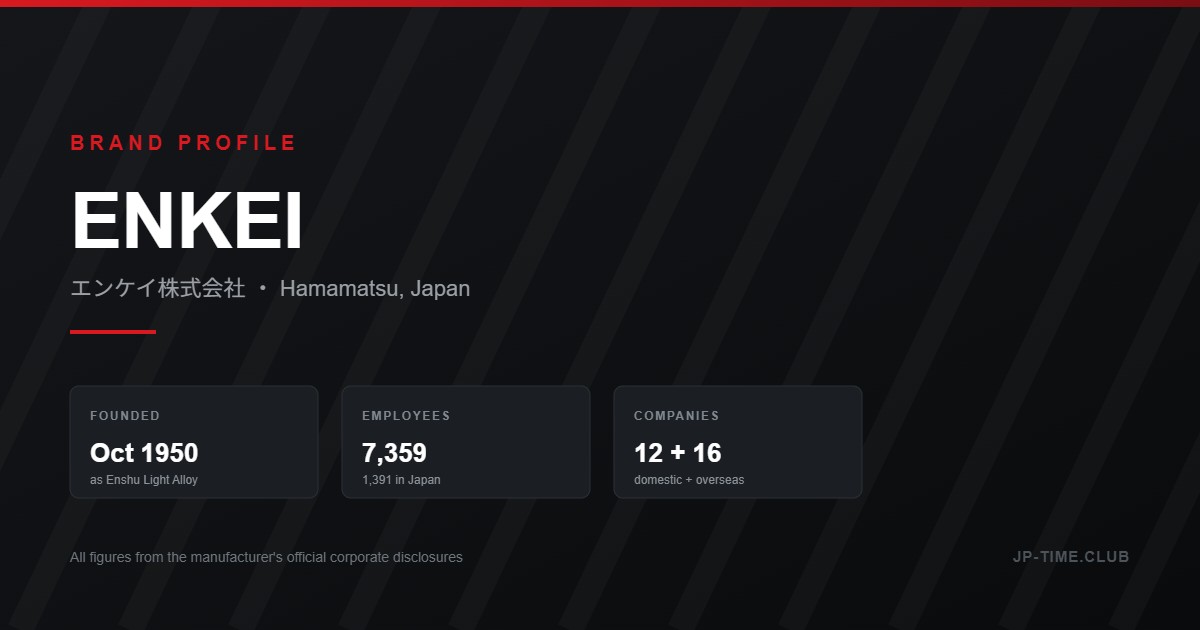
WORK employs 170 people. ENKEI employs 7,359 — and 5,968 of them work outside Japan.
ENKEI is not a bigger version of the other two. It is a different category of company that happens to sell into the same enthusiast market. Understanding that explains almost everything about how its wheels are priced, where they are built and why the catalogue looks the way it does.
The Short Version
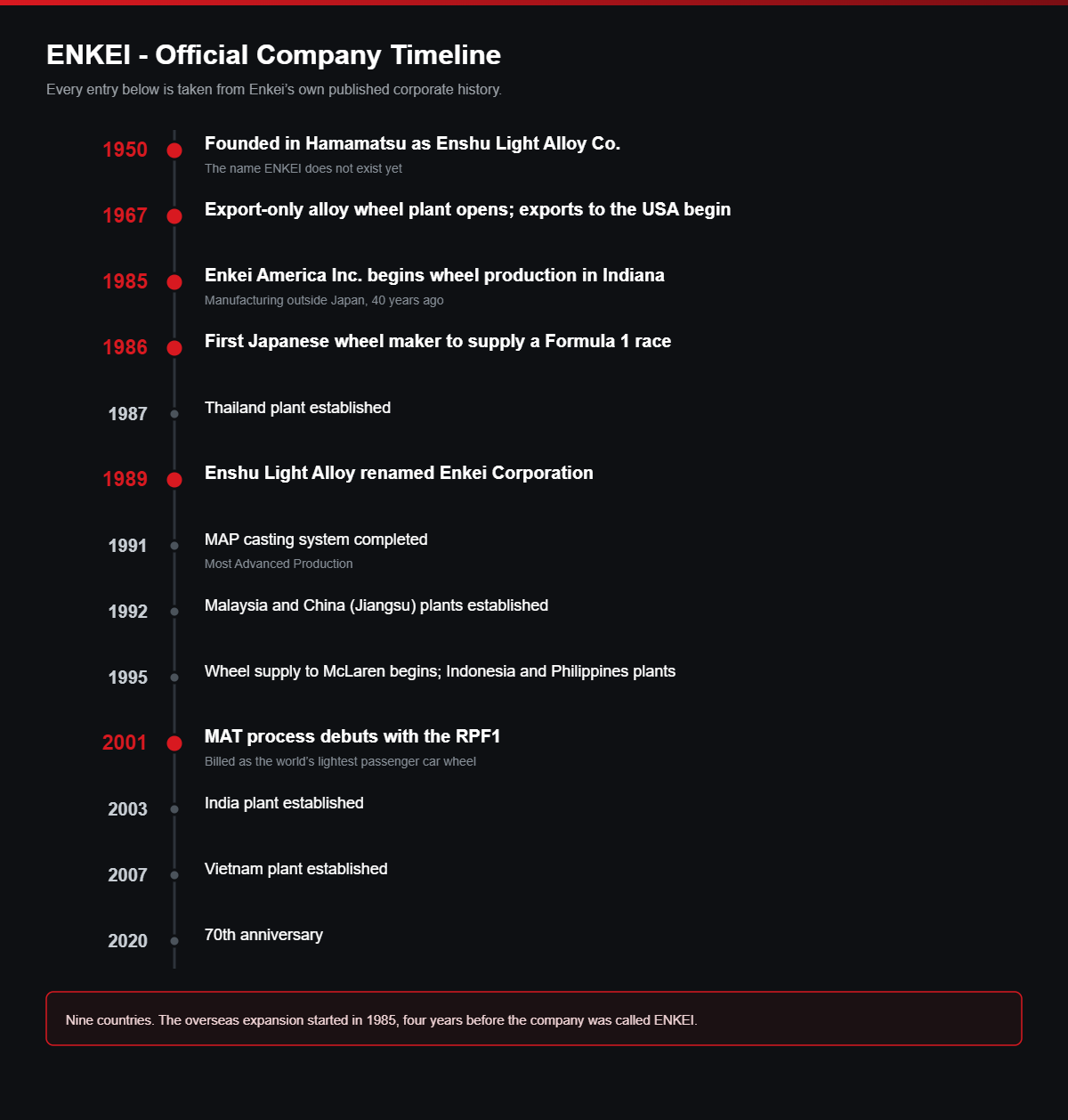
- Founded 5 October 1950 in Hamamatsu — as Enshu Light Alloy Co., not as ENKEI.
- Exporting alloy wheels to the United States from 1967.
- Manufacturing in Indiana from 1985, then Thailand, Malaysia, China, Indonesia, the Philippines, India and Vietnam.
- Today: 7,359 employees (1,391 in Japan, 5,968 overseas), 12 domestic and 16 overseas companies, consolidated revenue of ¥206.4 billion for FY2025.
- First Japanese wheel manufacturer to supply a Formula 1 race, in 1986.
What the Official Record Actually Says
Two dates reframe the brand entirely.
1967. Enkei built a plant specifically for export and started shipping wheels to America. That is not a company that later discovered an overseas market — it is a company that was aiming at one within seventeen years of founding, at a time when Japanese manufacturing was only beginning to be taken seriously abroad.
1985. Production began in Indiana. Enkei has been building wheels on American soil for forty years. Most enthusiasts who think of Enkei as a “JDM brand” are unaware of this, and it matters when you are deciding what you are actually buying.
The Name Is Younger Than the Company
The company was founded in 1950 as 遠州軽合金 (Enshu Keigokin — “Enshu Light Alloy”; Enshu is the historical name for the region around Hamamatsu). It was renamed Enkei Corporation in December 1989 — thirty-nine years later.
The official history does not explicitly state where “Enkei” came from, but it does record something suggestive: the group’s Chinese subsidiaries are registered as 遠軽鋁業 and 遠軽模具. 遠軽 is precisely the first character of 遠州 and the first character of 軽合金 — read together, En-kei.
We are presenting that as an observation about the documented record, not as an official explanation. Enkei has not published one.
Scale, and Why It Matters to a Buyer
| WORK | ENKEI | |
|---|---|---|
| Employees | 170 | 7,359 |
| Manufacturing countries | Japan | Japan, USA, Thailand, Malaysia, China, Indonesia, Philippines, India, Vietnam |
| Core method | Assembled multi-piece | Advanced casting at volume |
| Production style | High-mix, low-volume, built to order | High-volume series production |
Neither is better. But it explains the price gap, and it explains availability: an Enkei RPF1 is in stock everywhere because it is produced in series, while a particular WORK specification may take weeks because it is assembled when you order it.
An honest note for anyone buying “a Japanese wheel.” Enkei is unambiguously a Japanese company, headquartered in Hamamatsu and founded there in 1950. It is also a genuine multinational, with 81% of its workforce outside Japan and factories on three continents. Which plant produced a specific wheel depends on the model and the market it was sold into. If country of manufacture matters to you, check the individual product rather than assuming from the brand.
MAT and the RPF1
Enkei’s official history gives the RPF1 a precise origin: October 2001, the first wheel produced by its MAT (Most Advanced Technology) process, described at launch as the world’s lightest passenger-car wheel.
MAT follows the earlier MAP (Most Advanced Production) casting system completed in 1991. The RPF1 is therefore not simply a popular design — in the company’s own telling it is the demonstration piece for a manufacturing method, which is why it has stayed in the catalogue for over two decades and why it occupies the price position it does.
Motorsport
The official record notes two milestones. In December 1986, Enkei became the first Japanese wheel manufacturer to supply wheels to a Formula 1 race. In 1995, supply to McLaren began.
Enkei continues to be visible in Formula 1 and in Japanese series today. For a company whose volume comes from OEM and mass-market production, motorsport is the part of the business that keeps the enthusiast catalogue credible.
What This Means When You Are Buying
1. Availability is a feature. Series production means common Enkei models are genuinely obtainable in common sizes. If you need four matching wheels quickly, this is the easiest of the major Japanese brands to satisfy.
2. Cast, not forged. Enkei’s reputation rests on advanced casting rather than forging. A well-made cast wheel using MAT is light and strong for its class, but it is a different product from a forged monobloc — see our RAYS profile for what forging actually changes.
3. Check the JWL and VIA stamping on the individual wheel. Enkei produces for many markets with differing regulatory requirements. Japanese-market wheels carry JWL marking, and VIA registration is the standard third-party verification. Read the wheel, not the model name.
What We Could Not Verify
- The official explanation of the name. The 遠州軽合金 → 遠軽 → ENKEI reading is strongly supported by the company’s own subsidiary names, but Enkei does not state it. We are calling it an observation, not a fact.
- Which Formula 1 team received wheels in 1986. The official history records the milestone and illustrates it with a 1987 Suzuka photograph, but does not name the team.
- Where any individual wheel model is manufactured. Enkei publishes the location of its plants but not a model-by-model production map. We are not going to guess.
- Capital. Not published on the corporate overview page.
FAQ
Is Enkei a Japanese company?
Yes. Founded in Hamamatsu, Shizuoka in October 1950, headquartered there today. It is also a multinational: 5,968 of its 7,359 employees work outside Japan, across 16 overseas companies.
Are Enkei wheels made in Japan?
Some are. Enkei operates plants in Japan and in eight other countries. The company does not publish a model-by-model production map, so check the specific product if origin matters to you.
Is the RPF1 forged?
No. It is the first product of Enkei’s MAT casting process, launched in October 2001 and presented as the world’s lightest passenger-car wheel at the time.
What is the difference between MAP and MAT?
MAP (Most Advanced Production) is the casting system completed in 1991. MAT (Most Advanced Technology) is the later process that debuted with the RPF1 in 2001.
Has Enkei been involved in Formula 1?
Yes. Its official history records it as the first Japanese wheel maker to supply an F1 race, in December 1986, and the start of supply to McLaren in 1995.
How big is Enkei compared with WORK or RAYS?
Substantially larger. Enkei reports 7,359 employees and ¥206.4 billion in consolidated revenue for FY2025. WORK reports 170 employees. RAYS does not publish an employee figure but is certified in Japan’s small-to-medium enterprise category.
Sources
Every figure in this article comes from Enkei’s own corporate disclosures — the company outline and company history pages of enkei.co.jp — read in the original Japanese. Employee, revenue and office counts are as published for FY2025 and April 2026. Where those documents are silent, we have said so rather than filling the gap from secondary sources.
Related Guides
- WORK Wheels — 170 people, built to order
- RAYS — a company history told in forging presses
- Toyota GR86 & Subaru BRZ — 5×100, a very common RPF1 application
- Lancer Evolution IV–IX — 5×114.3 / 67.1 mm
- Honda Civic — 4×100 and 5×114.3
Looking for a specific set? We specialise in genuine Japanese wheels — RAYS, Volk, Enkei, SSR, WORK, BBS Japan and the rare discontinued sets that never left the country. Tell us the wheel, the fitment, the year — our team searches our networks until we find it.