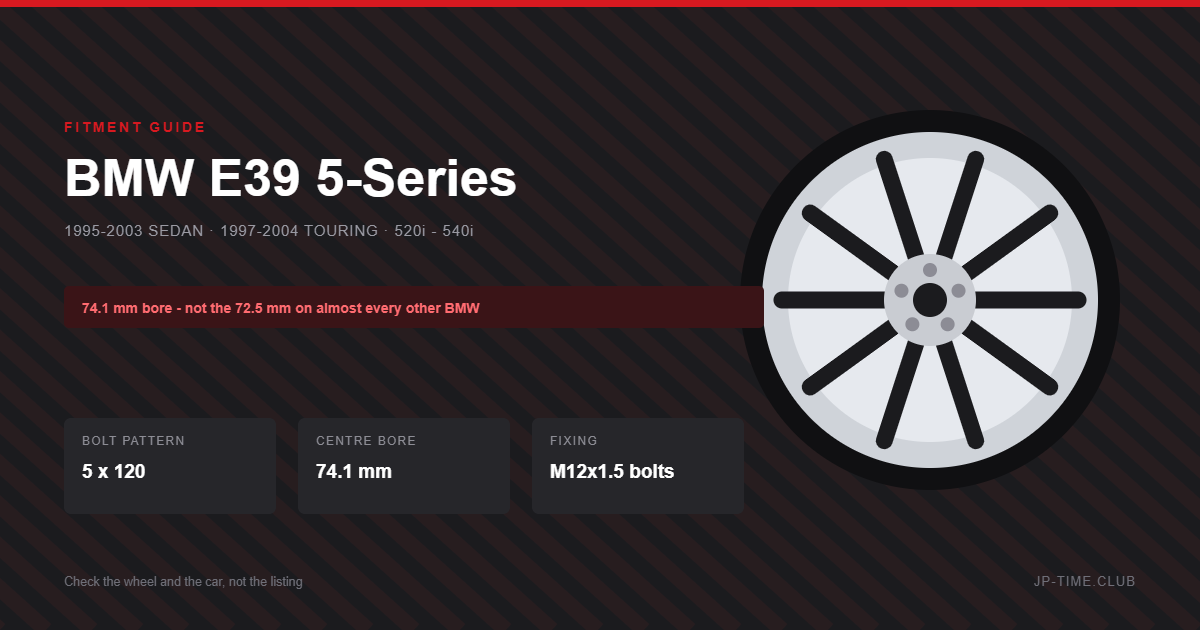
The E39 has a fitment quirk that catches people who assume all 5×120 BMWs are interchangeable. They are not, and the reason is the centre bore.
The E39 uses a 74.1 mm centre bore. Almost every other BMW of the era — E28, E30, E32, E34, E36, E38, E53 — uses roughly 72.5 mm. Same bolt pattern, different hub diameter.
The Short Version
- 5×120, 74.1 mm bore, M12×1.5 conical-seat bolts. BMW uses bolts, not studs.
- An E39 wheel will not centre on an older BMW hub without a ring — its bore is too big.
- An older BMW wheel will not go onto an E39 hub at all. A 72.5 mm bore will not pass over a 74.1 mm hub.
- The M5 shares the bore and pattern. No difference there — the difference is brakes and factory width.
- Sedan 1995–2003, Touring from January 1997 to 2004. All 25-year eligible or becoming so.
The Bore, In Detail
This is the whole article, so it is worth being careful about how we know it.
We could not find a BMW AG document stating 74.1 mm. What we found instead is arguably better evidence for a buyer: multiple independent vendors sell centring rings specifically sized 74.1 mm to 72.56 mm, described as being for fitting E39-sourced wheels to E24, E28, E32 and E34 hubs. Companies do not manufacture and stock a ring for a dimensional difference that does not exist.
That is corroborated by ECS Tuning’s own material and by an independent BMW bolt-pattern reference. One AI-generated search summary claimed 72.56 mm for the E39, contradicting every direct-fitment source; we have treated that as an error rather than a competing view.
The only other BMW confirmed to share 74.1 mm is the E70-generation X5 and later.
| Chassis | Bore | Fits an E39 hub? |
|---|---|---|
| E39 5-Series | 74.1 mm | — |
| E70 X5 and later | 74.1 mm | Yes |
| E28 / E30 / E32 / E34 / E36 / E38 / E53 | ~72.5 mm | No — bore too small to pass over the hub |
The asymmetry matters. Rings solve one direction only: you can take up slack between a large wheel bore and a small hub. You cannot make a small bore fit a large hub with anything short of a machine shop.
Factory Wheels by Style Number
BMW numbers its wheel designs, and used listings almost always quote the style number. Here is what we could confirm.
| Style | Name | Fitted to | Size | Offset | Tyre |
|---|---|---|---|---|---|
| 5 | Spider / basketweave | base and sport option, c.1996–2000 | 17×8.0 | +20 | not confirmed |
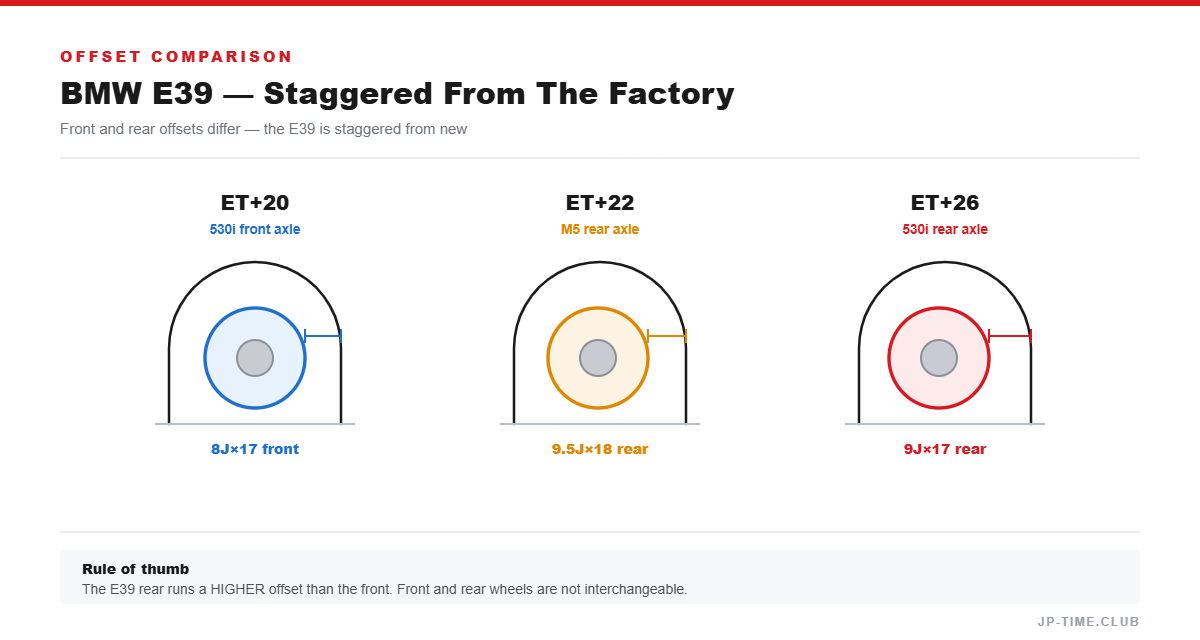
| 32 | Mixed Radial | 540i sport | 17×8.0 f / 17×9.0 r | +20 f / +26 r | 235/45-17 f / 255/40-17 r |
| 42 | Cross Spoke | 530i sport, 2003 | 17×8.0 square | +20 | 235/45-17 |
| 65 | M Double Spoke | M5 only | 18×8.0 f / 18×9.5 r | +20 f / +22 r | 245/40ZR18 f / 275/35ZR18 r |
| — | M5 17″ option | M5 | 17×8.0 square | +20 | 235/45R17 94H |
+20 is the recurring number. Four of the five confirmed fitments sit there, front and rear. If you are shopping and you see an E39 wheel quoted well away from +20, that is worth a question rather than an assumption.
We could not itemise base-trim fitments for the 520i, 523i, 525i, 528i and diesels — those were likely 15 to 16 inch, often steel, and we found no sourced sizes.
The M5 Is Not Different Where People Think
The E39 M5 uses the same 5×120 pattern and the same 74.1 mm bore as every other E39. There is no M-specific hub.
What is different is the factory fitment — staggered 18×8 and 18×9.5 on Style 65 — and the brakes behind it. We could not find caliper dimensions, so we cannot give you a minimum diameter. What we can say is that the factory answer was 18 inches, and that going smaller on an M5 is a measure-first proposition.
Clearance, and What Actually Limits You
The E39 takes wheels well, and the constraint people hit is not the bore — it is the rear arch.
Owner reports describe 275-section rear tyres on 19×9.5 at +20 requiring the rear lip to be rolled or pulled, while 19×8.5 front and 19×9.5 rear at +20 on 265-section rubber is reported to clear without modification.
Those are community figures, not specifications, and they assume a car at standard ride height. The point they make is the useful one: on this car, tyre width and offset decide clearance, and the bore decides only whether the wheel will go on at all.
Bolts, Not Studs
BMW uses wheel bolts that thread into the hub, rather than studs with nuts. On E-chassis cars including the E39 the specification is M12×1.5 with a 60° conical seat. Later F-chassis BMWs moved to M14×1.25.
Two practical consequences. Aftermarket wheels often need different-length bolts than the factory ones, because seat depth varies. And hanging a wheel on the hub while you start the first bolt is genuinely awkward — a guide pin is a cheap tool that prevents an expensive scratch.
What We Could Not Verify
- A BMW AG document confirming 74.1 mm. The figure is corroborated by multiple independent vendors and references, but not by the manufacturer.
- Whether the Touring differs from the sedan in bore. Nothing suggests it does.
- Factory tyre size for the Style 5 wheel.
- Base-trim wheel sizes for 520i through 528i and the diesels.
- M5 caliper dimensions and any minimum wheel diameter that follows from them.
Related Fitment Guides
- BMW M5 — the M car across generations
- BMW M3 E46 — the other 5×120 of the era, and a different bore
- BBS — whose wheels these cars wore from the factory more often than not
- OZ Superturismo vs Ultraleggera
Seen on the road
Which wheels are you looking for? Tell us the wheel, the size and the fitment — send us a request and we will go and find it.
Wheel identification is taken from the hashtags the owner applied to their own post.
Getting E39 Wheels From Japan
Japan ran a large grey-import market for the E39 and the wheels that went on them, which means European sizes turn up here in condition that is often better than the local market offers. Tell us the size, the offset and whether you are staggered or square through the Request page — and if you are buying wheels from another BMW, tell us that too, because the bore is the first thing we will check.