
The Short Version
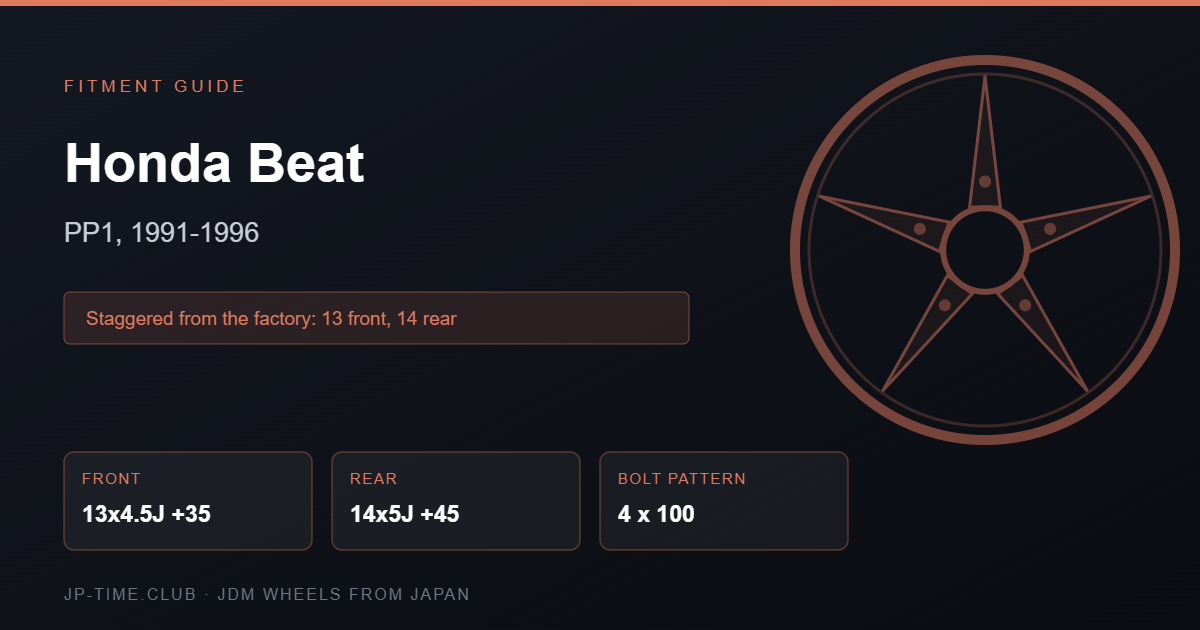
- The Beat is staggered from the factory. 13×4.5J at +35 on 155/65R13 at the front, 14×5J at +45 on 165/60R14 at the rear.
- A square set is not the factory setup. This surprises people, and it is the most important thing on this page.
- 4×100, confirmed.
- The hub bore is explicitly marked “under investigation” in the Japanese database, on every grade. We could not confirm a figure from anywhere else either.
Mid-Engined Means Staggered
The Beat is a mid-engined kei roadster with its weight behind the driver, and Honda specified the wheels accordingly. The front gets a 13-inch wheel, 4.5J wide, at +35. The rear gets a 14-inch wheel, 5J wide, at +45. Different diameter, different width, different offset.
We checked the base grade, Version C and Version Z pages and all three are identical — Honda did not vary this by trim. So if you see a Beat advertised with a different factory setup, it is not factory.
This matters commercially because most used wheel sets are sold as four matching wheels. A square set of four 13×4.5J will bolt to a Beat and will under-tyre the rear axle of a mid-engined car. A square set of four 14×5J will foul at the front on many cars. If you are buying for a Beat, buy front and rear separately, or buy a set that was specifically assembled for one.
Factory Specification
| Position | Wheel | Tyre | Grades | PCD / Holes / Bore |
|---|---|---|---|---|
| Front | 13×4.5J +35 | 155/65R13 | Base, Version C, Version Z | 100 / 4 / under investigation |
| Rear | 14×5J +45 | 165/60R14 | Base, Version C, Version Z | 100 / 4 / under investigation |
About That Bore Marker
The Japanese database prints PCD, hole count and hub bore on a single line for every car. On the Beat it reads: 100 mm, 4 holes, 調査中 — under investigation.
That is an explicit statement that the figure has not been researched, rather than a blank field. We then went hunting for the usual fallback, a hub-ring maker’s fitment table, and could not find a checkable product listing for the Beat. We saw a search result attributing 56 mm to a Japanese shop, but the page itself would not load for us, so we are not reporting 56 mm as verified.
If you own a Beat: measure the machined register on the hub, in two directions, and take the larger figure. Send it to us with your chassis code and we will publish it here with credit.
Sizing a Beat
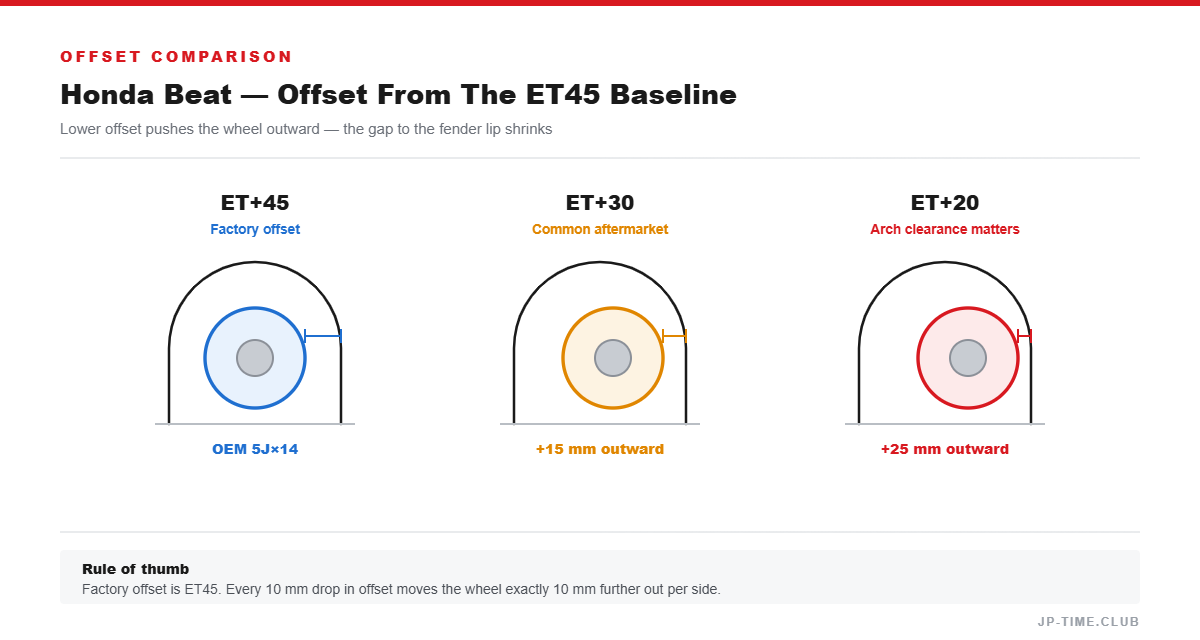
The factory 4.5J and 5J rims are extremely narrow, and the car is tiny, so there is very little room to work with. The realistic window is 14×5.5J to 15×6J, keeping the stagger, in the +30 to +45 range.
Two things to keep in mind. First, the Beat weighs about 760 kg and makes 64 PS — there is nothing to be gained from heavy wheels, and quite a lot to lose. Second, keep the stagger. The reason it is there is that a mid-engined car with more weight over the rear wants more tyre there, and removing that has handling consequences that a 660 cc engine will not save you from.
Kei regulations in Japan require the tyre to stay inside the body, which is why Beats look the way they do at home. That constraint does not follow the car overseas.
Importing
The Beat ran from May 1991 to 1996, so the whole model is eligible for US import. It was never sold new outside Japan, which is why it has the following it does.
As with any kei car, federal import eligibility and state-level road registration are separate questions, and the second one varies a lot. Our kei import and road legality guide covers that.
What We Could Not Verify
- Hub bore. Explicitly marked “under investigation” in the Japanese database on all three grades. We found no hub-ring vendor listing to fill the gap, and the one secondary figure we saw referenced could not be loaded to check.
- Whether any late-run or special-edition Beat deviates from the staggered setup. All three grades we checked are identical.
Seen on the road
Which wheels are you looking for? Tell us the wheel, the size and the fitment — send us a request and we will go and find it.
Wheel identification is taken from the hashtags the owner applied to their own post.