
The Short Version
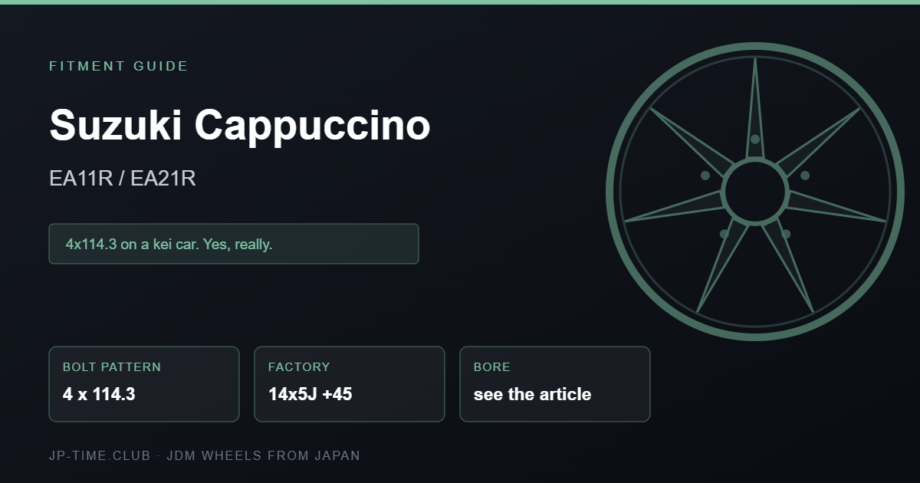
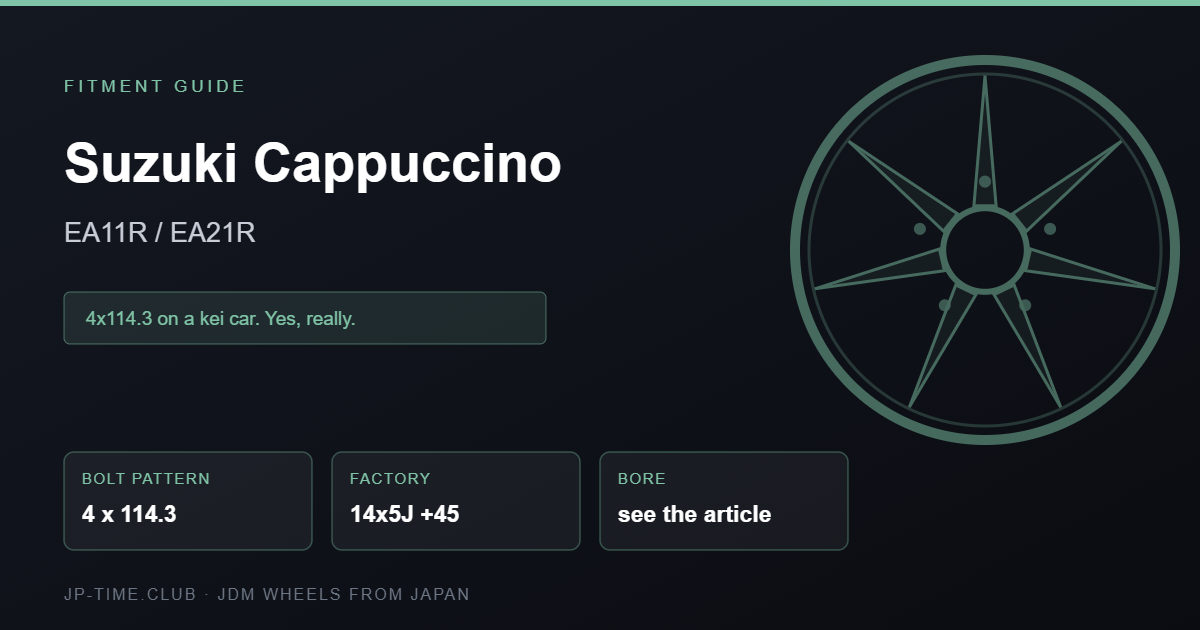
- 4×114.3. On a kei car. We checked this carefully because it is so unusual, and it is correct — we read the line ourselves.
- 14×5J at +45, square front and rear, on 165/65R14. Not staggered, unlike the Beat.
- EA11R and EA21R are identical. No fitment change between the two generations.
- On the 60 versus 64 mm bore argument: neither Japanese database states a figure at all. Both mark it “under investigation”. The only concrete number we found anywhere is 60 mm, and it comes from a hub-ring manufacturer.
Four Studs at 114.3 on a 660 cc Car
This is the detail that makes people assume a listing is wrong. Kei cars are almost universally 4×100. The Cappuccino is 4×114.3 — four studs on the bolt circle normally associated with much larger cars.
We verified it directly rather than taking it on trust: the Japanese factory database’s grade page for the E-EA11R base grade reads PCD 114.3 mm, 4 holes. The EA21R pages read the same. Both databases agree.
The practical consequence is awkward. Most 4×114.3 wheels were made for 1970s and 1980s Japanese cars and are 13, 14 or 15 inch — which suits a Cappuccino fine — but the modern 4×114.3 market is small. Meanwhile the enormous 4×100 kei wheel market is closed to you. Buy accordingly, and be sceptical of any listing that claims a 4×100 wheel fits.
Factory Specification
| Generation | Chassis | Period | Wheel | Tyre | PCD / Holes / Bore |
|---|---|---|---|---|---|
| 1st | EA11R | 1991.11–1995.05 | 14×5J +45 front and rear | 165/65R14 | 114.3 / 4 / under investigation |
| 2nd | EA21R | 1995.05–1998.10 | 14×5J +45 front and rear | 165/65R14 | 114.3 / 4 / under investigation |
Note that despite being front-engine rear-drive, the Cappuccino is square — the same wheel front and rear. That is the opposite of the mid-engined Beat, which is staggered. The two cars are usually discussed together and they are not the same problem.
Settling the 60 Versus 64 Argument
We had this car blocked because we had seen both 60 mm and 64 mm cited as the hub bore and could not tell which was right. Here is what we found.
Neither Japanese database gives a number. Both print 調査中 — under investigation — in the hub bore field, for both the EA11R and the EA21R. So the disagreement does not originate in the factory data. Something else generated both figures.
60 mm has a real source. Kics, a Japanese wheel-hardware manufacturer, sells a hub-centric ring listed explicitly for the Cappuccino EA11R and EA21R, specified as PCD 114.3, four holes, M12×P1.25, 60 mm bore. One product covering both generations. That is a company whose product does not work if the number is wrong.
64 mm has no source we could find. No vendor listing, no citable forum post, nothing.
So our position is: 60 mm is the best available figure, from a hardware manufacturer rather than from the factory data, and we could find nothing at all behind 64 mm. We are still not going to print 60 mm as a verified factory specification, because it is not one. If you are ordering rings, 60 mm is what the maker of the rings says. If you are ordering wheels, measure your hub.
One speculation, clearly labelled as ours: the 64 mm figure may have drifted across from Honda, whose cars commonly use 64 mm, because the Cappuccino, the Beat and the AZ-1 are always written about together. We have no evidence for that. It is a guess about how an error propagates, not a finding.
Sizing
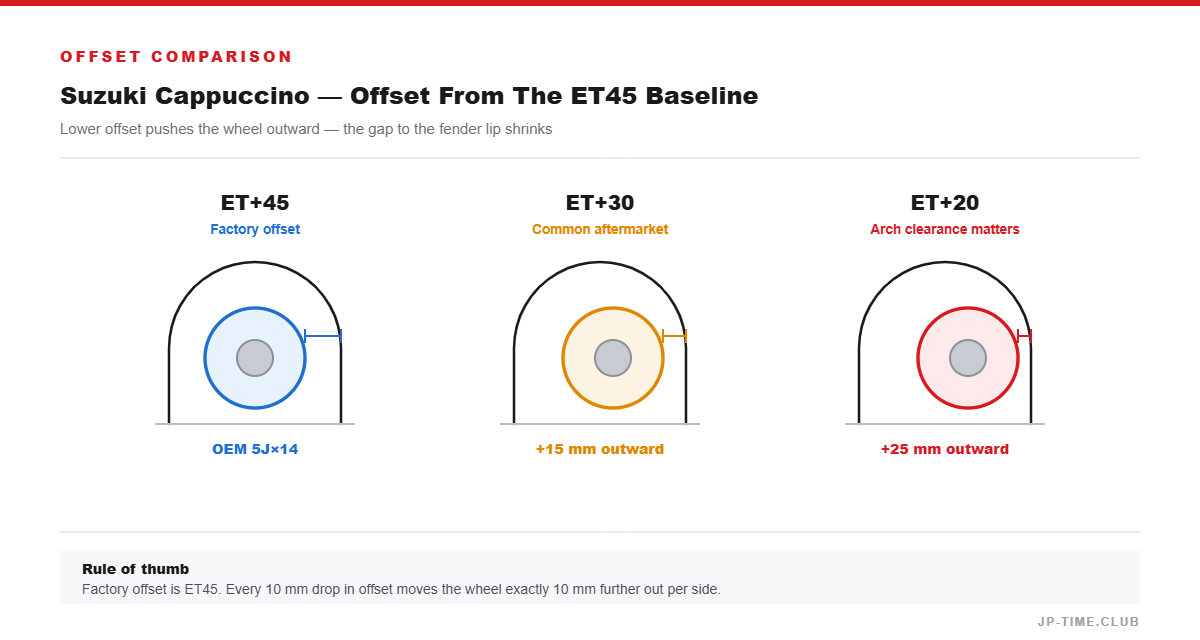
Factory 14×5J at +45 is narrow, and the Cappuccino’s arches are kei-narrow too. The realistic window is 14×6J to 15×6.5J in the +35 to +45 range, keeping it square.
The car weighs about 700 kg and it is rear-drive with a limited-slip differential on some grades — it responds to wheel weight far more than it responds to width. A light 14-inch wheel will do more for it than a wide 15.
Importing
Production ran from November 1991 to October 1998, so the EA11R is fully eligible for US import and the EA21R is eligible up to August 2001, which covers its entire run. The whole model is importable.
As always with kei cars, state road-registration rules are a separate matter from federal import eligibility.
What We Could Not Verify
- A factory hub bore figure. Both Japanese databases explicitly mark the field unresearched, for both generations.
- Any source at all supporting the 64 mm figure. We looked and found none.
- Whether the 60 mm hub-ring specification reflects the actual hub or a working clearance the manufacturer chose.
Seen on the road
Which wheels are you looking for? Tell us the wheel, the size and the fitment — send us a request and we will go and find it.
Wheel identification is taken from the hashtags the owner applied to their own post.