
The Short Version
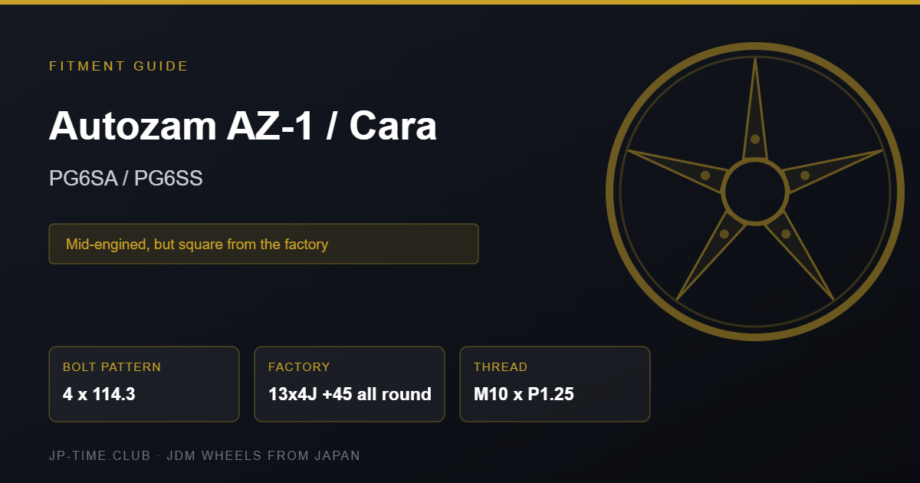
- 4×114.3 on a kei car — the same unusual pattern as the Suzuki-built Cappuccino.
- Square from the factory: 13×4J at +45, front and rear. Despite being mid-engined.
- The Suzuki Cara is chassis PG6SS, not PG6SA. Same car, different badge, one grade instead of three.
- The hub bore is explicitly marked “under investigation” for both.
Mid-Engined, But Not Staggered
We expected the AZ-1 to be staggered. The Honda Beat is mid-engined and staggered, and the two cars are always discussed together as part of the ABC trio.
The AZ-1 is not. Every grade — the base car, the Mazdaspeed version and the M2-1015 — runs 13×4J at +45 with 155/65R13, front and rear identical. So does the Cara.
That is useful in a practical way: a set of four matching wheels is factory-correct for an AZ-1, which is not true of the Beat.
Worth noting the contrast, though. RS Watanabe’s own recommended aftermarket fitment for the AZ-1 is staggered — 13×5.0J at +35 front, 13×5.5J at +37 rear. That is their wheel recommendation for a mid-engined car, not a factory specification, and the distinction matters when you are reading a listing.
Factory Specification
| Car | Chassis | Period | Grade | Wheel | Tyre | PCD / Holes / Bore |
|---|---|---|---|---|---|---|
| Autozam AZ-1 | E-PG6SA | 1992.10–1995.09 | Base 5MT | 13×4J +45 F&R | 155/65R13 | 114.3 / 4 / under investigation |
| Autozam AZ-1 | E-PG6SA | 1994.02–1995.09 | Mazdaspeed version | 13×4J +45 F&R | 155/65R13 | 114.3 / 4 / not re-confirmed |
| Autozam AZ-1 | E-PG6SA | 1994.05–1995.09 | M2-1015 | 13×4J +45 F&R | 155/65R13 | 114.3 / 4 / not re-confirmed |
| Suzuki Cara | E-PG6SS | 1993.01–1995.12 | Base 5MT, only grade | 13×4J +45 F&R | 155/65R13 | 114.3 / 4 / under investigation |
The Cara Is a Different Chassis Code
Small but worth getting right. The AZ-1 is PG6SA. The Cara is PG6SS. Same car, built by Suzuki, sold through Mazda’s Autozam channel and Suzuki’s own network respectively.
The only substantive difference we found is grade count: the AZ-1 had three, the Cara one. Wheel, tyre, PCD and offset are identical.
Note also that RS Watanabe’s Suzuki page has no Cara listing at all — the AZ-1 appears only under Mazda. If you are searching a fitment chart for a Cara and finding nothing, that is why.
Suzuki-Built Does Not Mean Shared Hardware
The AZ-1 and the Cappuccino were both built by Suzuki in the same era and both use the unusual 4×114.3 pattern, so it is tempting to treat them as one fitment. They are not.
RS Watanabe gives the AZ-1 M10×P1.25 lug threads and the Cappuccino M12×P1.25. Different studs. Wheel nuts do not transfer, and neither does the assumption that anything else does.
Sizing
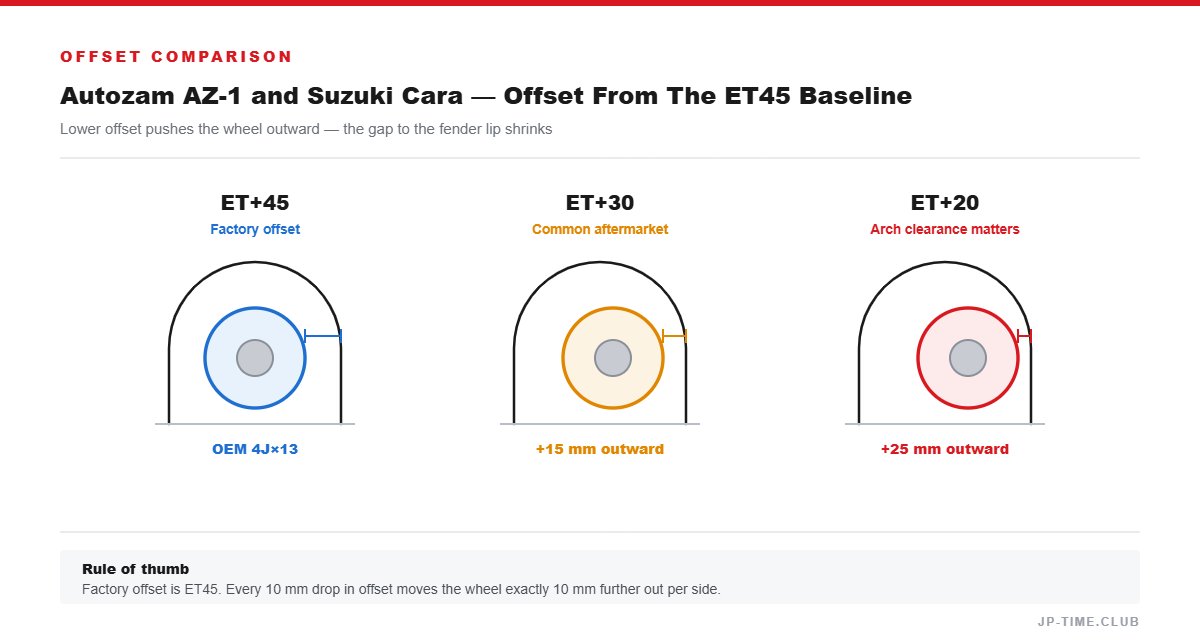
A 4J rim is about as narrow as production wheels get. The realistic window is 13×5J to 13×5.5J in the +30 to +45 range, which is exactly where the classic Japanese 13-inch wheels sit and why AZ-1s so often wear them.
The car weighs 720 kg. Wheel weight matters here more than on almost anything else we cover. Since the bore is unpublished, measure the register before ordering rings.
Importing
The AZ-1 ran October 1992 to September 1995 and the Cara January 1993 to December 1995. Both are fully past the US 25-year mark. Neither was sold outside Japan.
What We Could Not Verify
- Hub bore. Explicitly marked “under investigation” on both cars.
- Whether the Mazdaspeed and M2-1015 grades also carry that marker specifically. Their wheel sizes match on the index; we opened the base grade.
- The 17 mm hex figure our own notes carried. Neither source publishes across-flats dimensions.