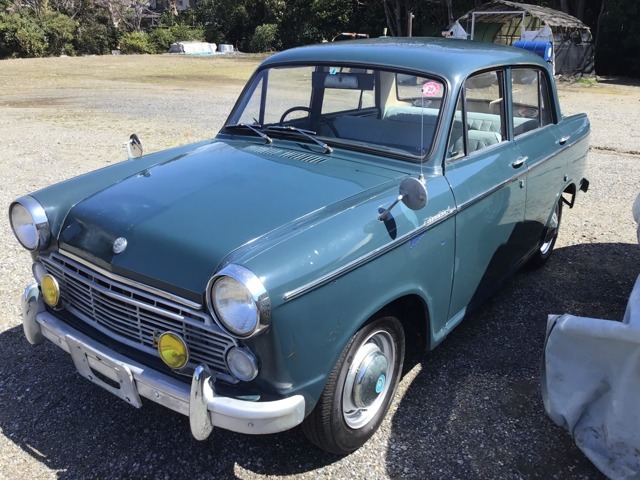
Every “Nissan Bluebird” guide on this site so far has covered the U12 — a boxy, unglamorous sedan built from 1987 to 1991. This car is the reason that nameplate existed at all. It’s a Bluebird 1200 Deluxe, photographed on a Japanese used-car lot, 1963 model year, 78,000km on the clock, dark blue-green paint over blue vinyl. It’s the last and most developed version of the original Bluebird, sold in the few months before Nissan replaced the whole car with an all-new design in August 1963.
Three Cars Under One Name: 310 → 311 → 312
The first Bluebird wasn’t one car — it was three, sold under one name over four years, each a running update of the last:
- 1959 (Showa 34): the 310-type. Nissan’s answer to a Japan that was just starting to put itself on four wheels, offered with a 988cc C1-type engine or a 1189cc E1-type engine.
- 1960: the 311-type. Power increased on both engines (C1: 34→45hp, E1: 43→55hp) and a full-synchro transmission was added.
- 1961: the 312-type. A grille and instrument-panel redesign, sold through to the end of production.
Nissan’s own Heritage Collection describes the 1200 Deluxe grade — the car pictured here — as the final, most-developed form of the 312-type. In August 1963, Nissan replaced the entire 310-series lineage with the completely redesigned 410-series Bluebird, a rounder, Pininfarina-influenced car that shared nothing but the name with what came before it.
This Car, As Photographed
The details match the 1200 Deluxe grade: round headlights in chrome bezels, a vertical-bar grille, fender-mounted wing mirrors, a chrome trim strip running the length of the beltline, and whitewall-less 13-inch steel wheels wearing plain dome hubcaps — no aftermarket wheel of any kind, just the way these cars left the factory. Inside, a blue vinyl bench-style interior, column shifter, and a period AM radio sit ahead of a simple twin-dial instrument cluster. The engine bay houses the inline-four, wearing decades of use but presented as a running, driven car rather than a static restoration.
What We Confirmed
| Spec | Value |
|---|---|
| Chassis type | P312 (final development of the 310-series Bluebird) |
| Grade | 1200 Deluxe |
| Engine | E1-type, 1,189cc inline-4, OHV |
| Output | 55PS @ 4,800rpm / 8.8kgm @ 3,600rpm |
| Dimensions (L x W x H) | 3,915mm x 1,496mm x 1,470mm |
| Wheelbase | 2,280mm |
| Track (front/rear) | 1,209mm / 1,194mm |
| Curb weight | 900kg |
| Tire size | 5.60-13-4PR (13-inch wheels) |
| Brakes (front/rear) | Drum / drum |
| Suspension (front/rear) | Independent wishbone / longitudinal leaf spring |
These figures come directly from Nissan’s own Heritage Collection page for the Datsun Bluebird 1200 Deluxe, which explicitly identifies this grade as the 312-type.
Why This Guide Has No Bolt Pattern
Every other fitment guide on this site is built by cross-referencing at least two independent sources: a Japanese vehicle-registration fitment database (Cars Japan, Spec Tank), a consumer-facing aggregator (Wheel-Size.jp), or a genuine OEM part currently for sale with its specs listed by the seller. For the 310-series Bluebird, none of that exists in any source we could find.
That absence is itself informative. We checked a used-parts retailer’s own “compatible vehicles” guide for a generic 4×114.3, 4-hole steel wheel, and its Bluebird coverage explicitly starts at the 410-series (1963–67) and runs through the U12 — the 310/311/312 generation isn’t on the list at all. That’s consistent with 4×114.3 becoming a de facto standard on Japanese cars starting around the 410’s era, not necessarily before it. The 310-series simply predates the point where any fitment-tracking resource we rely on for other guides begins.
If you’re working on a later Bluebird and need real numbers, our Nissan Bluebird (U12) Wheel Fitment Guide has a confirmed 4×114.3 bolt pattern with sourced offsets.
What We Could Not Verify
- Bolt pattern, hub bore, and offset of the OEM wheel. Not found in any fitment database, aggregator, or genuine parts listing we could access.
- Whether this specific car is a late 311-type or an early-to-mid 312-type. The styling (grille, instrument panel) is most consistent with what Nissan’s own Heritage page describes as the final 312-type “1200 Deluxe,” but the chassis plate isn’t legible in the photos available to us, so we’re not stating the exact type code as confirmed.
- Whether the steel wheels and hubcaps pictured are the original factory units or later same-style replacements. Visually consistent with factory-style steel wheels for the era, but we have no way to confirm originality from photos alone.
Sources: Nissan Heritage Collection — Datsun Bluebird 1200 Deluxe, Japanese Wikipedia — Nissan Bluebird, genuine steel-wheel compatible-vehicle listing (Taihei Tire, used to confirm the absence of 310-series coverage in modern fitment guides).