
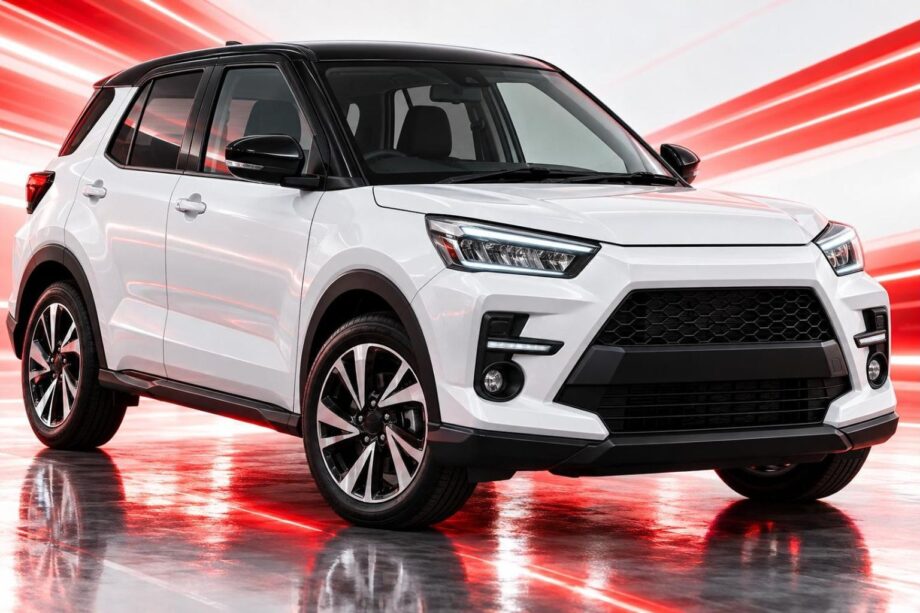
Toyota Japan lists the Raize as its own model and publishes a short question-and-answer page, in PDF form, with the tyre and wheel sizes fitted at the factory. This guide sets out what that page prints, where its table is unclear, and what a buyer of aftermarket or second-hand wheels can and cannot take from it. The translations are ours. We read one version of the page, which covers the Raize and the Raize Hybrid.
The Short Version
- 100 for the pattern, 54 for the hub. Every row prints a PCD of 100 and a figure of 54 in the hub-bore position as we read it.
- Two diameters, one width. The alloy rows show 195/60R17 on a 17×6J wheel and 195/65R16 on a 16×6J wheel. A steel 16×6J wheel appears on a row labelled X.
- The inset is 40. The same figure appears on all five rows.
- The hole count is not clear. Three rows print a 4 and two rows print a 5 in the hole-count position. We could not tell what the 5 stands for, and we do not state a hole count as fact.
- The column order is scrambled. The headings and the values are out of order in the text we could read, so the inset, hub-bore and hole figures are our inference from position, not a clean read.
What Toyota’s Page Prints
The page carries a mark that we read as “added from November 2021”. A legend says a filled circle means standard equipment, and units are given as approximate millimetres. Our reading of the table, with the inferred columns marked:
| Grade label | Tyre | Wheel | PCD | Inset (ET), inferred | Hub bore, inferred | Other values printed | Marker |
|---|---|---|---|---|---|---|---|
| Z | 195/60R17 90H | 17×6J alloy, cut-bright with black paint | 100 | 40 | 54 | 13 and 5 | Standard |
| G | 195/65R16 92H | 16×6J alloy, silver paint | 100 | 40 | 54 | 13 and 5 | Standard |
| Z | 195/60R17 90H | 17×6J alloy, cut-bright with black paint | 100 | 40 | 54 | 13 and 4 | Standard |
| G | 195/65R16 92H | 16×6J alloy, silver paint | 100 | 40 | 54 | 13 and 4 | Standard |
| X | 195/65R16 92H | 16×6J steel, resin full cap | 100 | 40 | 54 | 14 and 4 | Standard |
The two pairs of Z and G rows differ only in the last figure, a 5 on the first pair and a 4 on the second. The page does not say whether that split follows the petrol and hybrid versions, and its petrol and hybrid columns came through empty. The first figure, 13 on the alloy rows and 14 on the steel row, sits next to the hole count in the text; it may be a bolt-hole diameter, but the page gives us no heading we can tie it to.
Source and Its Limits
This is a single page from the manufacturer, listing factory fitments only. The text of the PDF reached us with its headings detached from the numbers, so the assignment of values to columns is by order and by plausibility. The grade labels sit beside the rows, and the Z and G rows repeat. The page prints no nut or bolt type, so we cannot say how the wheels are fastened.
What This Means When Shopping
- Pattern. 100 is the figure to look for. A wheel listed with a 100 pattern shares that number, but the number of holes is the other half of the pattern, and the page leaves it unsettled for us. Check the hole count against the car or the manufacturer’s data before buying.
- Hub bore. The page appears to print 54 mm. Our reference on hub bore explains how to measure it yourself, and we suggest measuring before buying.
- Inset. The figure we read is 40 on every row. A wheel with a different inset sits further in or out relative to the fender.
- Size. The factory sizes are 16×6J and 17×6J. The page says nothing about anything wider or larger.
- Other compact Toyotas. Our guides to the Yaris Cross and the Vitz and Yaris cover other bodies. The pattern alone does not make a wheel suitable.
Importing
In the US, the 25-year import exemption (49 CFR 591.5(i)) applies to a vehicle that is 25 or more years old, counted from the date of manufacture. As arithmetic only, a car built in November 2021 would reach 25 years in November 2046. We have not verified any build month, and the date on Toyota’s page is the date of the page version, not a build date. We did not check the import rules of other countries.
What We Could Not Verify
- The hole count, which the page prints as 4 on some rows and 5 on others, and what the 5 means.
- The inset and hub-bore values, which we read by position from a scrambled table, and the meaning of the 13 and 14.
- Whether the two pairs of Z and G rows are the petrol and the hybrid versions.
- Whether the page has been revised since the version we read.
- The model’s generations, chassis codes and launch date.
- Whether non-factory wheel sizes fit. Toyota’s page lists only factory fitments.
- Nut or bolt type, tightening torque and load rating, none of which the page prints.
- Rules in any country other than the US 25-year arithmetic above.
Looking for a specific set? We specialise in genuine Japanese wheels — RAYS, Volk, Enkei, SSR, WORK, BBS Japan and the rare discontinued sets that never left the country. Tell us the wheel, the fitment, the year — our team searches our networks until we find it.