Introduction
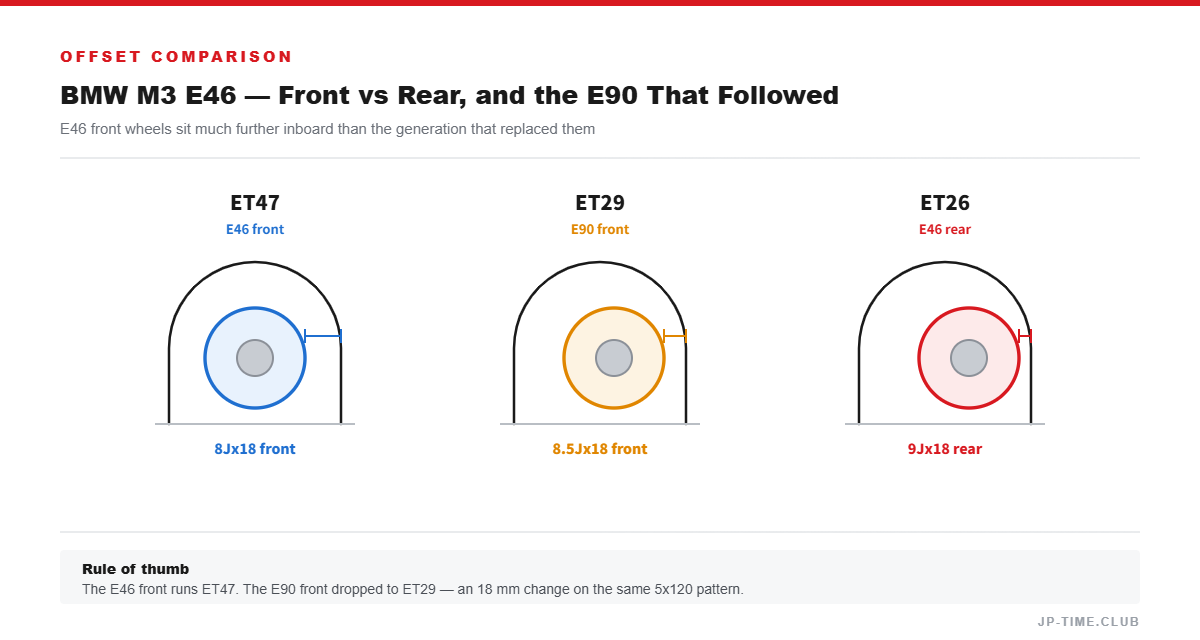
The E46 M3 is one of the most wheel-swapped cars in the world, and one of the easiest to get wrong. Its 5×120 pattern is shared with almost every BMW of the era and with the Lexus LS460 — but the E46’s ET47 front offset is far higher than the generation that replaced it. Fit a set of E90 M3 wheels and the front track changes by nearly 20 mm.
Section 1: OEM Wheel Specifications
All E46 M3s use 5×120 with a 72.6 mm hub bore, M12 x 1.5 lug bolts and 115 Nm torque, staggered front to rear.
| Variant | Years | Front Wheel | Rear Wheel | Front Tyre | Rear Tyre | Hub Bore |
|---|---|---|---|---|---|---|
| M3 3.2i | 2000–2006 | 8Jx18 ET47 | 9Jx18 ET26 | 225/45R18 | 255/40R18 | 72.6 mm |
| M3 CSL | 2003 | 8.5Jx19 ET44 | 9.5Jx19 ET27 | 235/35R19 | 265/30R19 | 72.6 mm |
| M3 CSL (JDM spec) | 2003 | 8Jx19 ET47 | 9.5Jx19 ET27 | 225/40R19 | 255/35R19 | 72.6 mm |
The CSL is a different fitment, not just a different wheel. It runs 19-inch at both ends with a wider 8.5J front at ET44 — and the Japanese-market CSL is listed differently again at 8Jx19 ET47. If you are buying CSL wheels, confirm which specification they are.
The generation trap
The E90/E92 M3 that followed uses the same 5×120 pattern and the same 72.6 mm hub bore, but runs 8.5Jx18 ET29 front and 9.5Jx18 ET23 rear. E90 wheels will bolt straight onto an E46 and push the front wheels roughly 18 mm further out. Some owners do this deliberately; most do not realise it is happening.
Section 2: Recommended Fitment Ranges
Factory-Faithful
Verified OEM: ET45–49 front, ET24–29 rear.
- Standard M3: 8Jx18 ET47 front, 9Jx18 ET26 rear
- Lug bolts, not studs. M12 x 1.5, 115 Nm — there is nothing protruding from the hub to hang the wheel on
Aftermarket Fitment
- Common range: ET25 to ET40 front on 8.5J–9.5J, with rears from ET15 to ET30
- Spacers are routine because the factory front offset is so high. As with all lug-bolt cars, spacers require correctly lengthened bolts with full thread engagement — this is a safety item
- 5×120 is a large pool. It is shared across most BMWs of the era, and with the Lexus LS460 — but hub bore differs, so check before assuming
- These are scene norms, not manufacturer specifications. Measure your own car
Instagram Search Keywords
Post counts verified July 2026:
Model Tags:
- #BMWM3 (7.4M)     #E46 (3.5M)
- #E46M3 (752K)     #M3CSL (72K)
- #E46M3CSL (25K)

Wheel Brand Tags:
- #RAYSWheels (776K)  #BBSWheels (1.1M)
- #WORKWheels (1.9M)
Section 3: Real-World Build References
Reference image for style and stance — not a verified measurement of the ranges above.
Japanese-market E46 on TE37. The top comment on the original post simply asks what the specs are — via @fukuhamakko
Section 4: Selection Tips and Cautions
- Buy by axle. Front and rear differ in width and offset
- E90 M3 wheels fit but change the track. ET29 front versus ET47 is an 18 mm difference per side
- CSL wheels come in more than one specification. Confirm which
- Lug bolts, M12 x 1.5, 115 Nm. Recalculate bolt length whenever wheel thickness or spacers change
- 72.6 mm hub bore. Shared with most BMWs — but not with every 5×120 car. The Lexus LS460 is 5×120 with a 60.1 mm bore
Fitment verification checklist:
- ✓ Confirm front and rear offsets separately
- ✓ Confirm the wheels are E46 spec, not E90
- ✓ Confirm hub bore is 72.6 mm, not another 5×120 car’s
- ✓ Confirm bolt length and seat type, especially with spacers
- ✓ Check caliper clearance before reducing diameter
Conclusion
The E46 M3’s fitment is defined by an unusually high front offset that the rest of the M3 line moved away from. Work axle by axle, treat 5×120 as the start of the question rather than the end of it, and remember that the wheels from the next generation will bolt on without telling you what they have changed.
Looking for genuine JDM wheels in 5×120? Submit a Request and we will search our networks in Japan for the size and offset you need.
Seen on the road
Which wheels are you looking for? Tell us the wheel, the size and the fitment — send us a request and we will go and find it.
Wheel identification is taken from the hashtags the owner applied to their own post.
Related Fitment Guides
- BMW M3 E36 — the generation before
- BMW M3 E90 / E92 — the generation after
- BMW M5 — the same 5×120 era
- Porsche Cayman / Boxster — the same rear-out logic
Every guide in this series is built the same way: verified factory specifications, an offset diagram, and an honest account of what fits and what does not.