Introduction
The E36 M3 does something none of its successors do: it runs the same offset at both ends. Front and rear differ only in width — 7.5J against 8.5J, both at ET41. That makes it the simplest M3 to buy wheels for, and it explains why so many E36s end up on square setups that would look wrong on any later car.
Section 1: OEM Wheel Specifications
The E36 M3 uses 5×120 with a 72.6 mm hub bore, M12 x 1.5 lug bolts and 115 Nm torque — the same hardware BMW carried through to the F80.
| Variant | Years | Front Wheel | Rear Wheel | Front Tyre | Rear Tyre | Hub Bore |
|---|---|---|---|---|---|---|
| M3 3.2 | 1992–1999 | 7.5Jx17 ET41 | 8.5Jx17 ET41 | 225/45ZR17 | 245/40ZR17 | 72.6 mm |
Where the E36 sits in the M3 line
| Generation | Years | Bolt Pattern | Hub Bore | Front | Rear | Stagger direction |
|---|---|---|---|---|---|---|
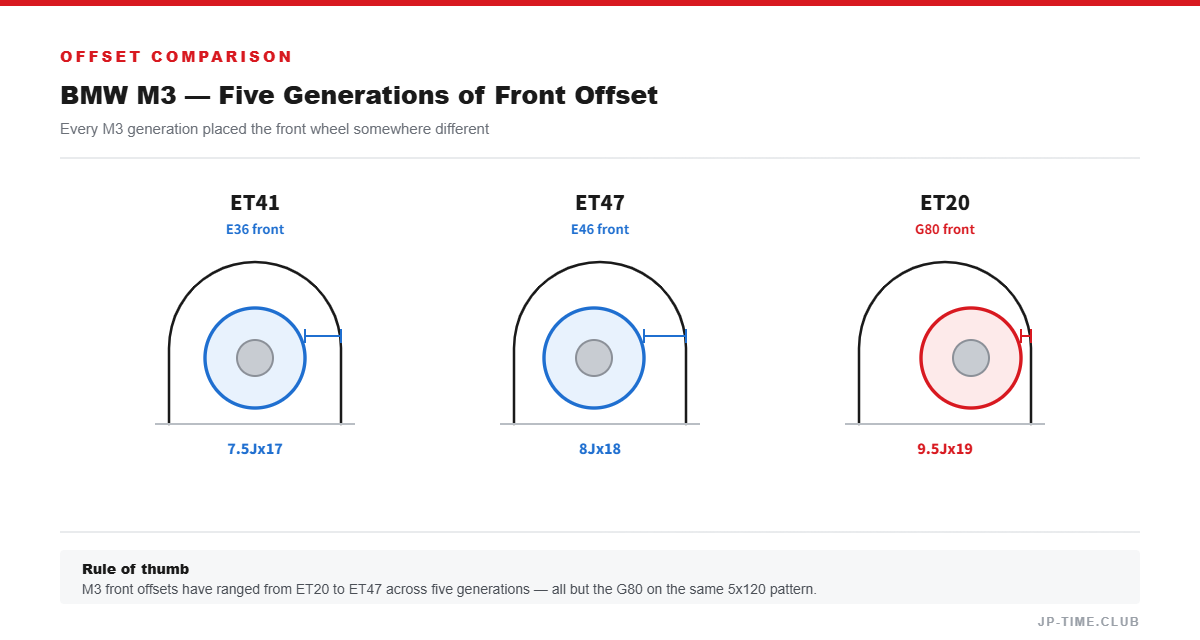
| E36 | 1992–1999 | 5×120 | 72.6 mm | ET41 | ET41 | None — width only |
| E46 | 2000–2006 | 5×120 | 72.6 mm | ET47 | ET26 | Rear further out |
| E90/E92 | 2007–2013 | 5×120 | 72.6 mm | ET29 | ET23 | Rear slightly out |
| F80 | 2014–2018 | 5×120 | 72.6 mm | ET29 | ET40 | Rear further in |
| G80 | 2021– | 5×112 | 66.6 mm | ET20 | ET20 | None — diameter differs |
Read that table before buying any used M3 wheel. Four of the five generations share 5×120 and a 72.6 mm bore, so wheels from an E36, E46, E90 or F80 will physically bolt to any of the others. The offsets range from ET20 to ET47, and the direction of the front-to-rear stagger reverses twice along the way. A wheel fitting is not the same as a wheel fitting correctly.
Section 2: Recommended Fitment Ranges
Factory-Faithful
Verified OEM: ET39–43 at both axles, 7.5J front and 8.5J rear.
- Square setups work here in a way they do not on later M3s, because the factory already uses one offset at both ends
- Lug bolts, M12 x 1.5, 115 Nm
Aftermarket Fitment
- Common range: ET20 to ET38 on 8J–9.5J, with the E36 being one of the more forgiving BMW chassis for wider rims
- E46 wheels sit further in at the front (ET47 against ET41) and further out at the rear (ET26 against ET41) — a 15 mm swing at the back
- Bolt length must be recalculated with any spacer or wheel thickness change
- These are scene norms, not manufacturer specifications. Measure your own car
Instagram Search Keywords
Model Tags:
- #BMWM3 (7.4M)   #E36M3   #E36
- #M3E36          #BMWE36

Wheel Brand Tags:
- #BBSWheels (1.1M)   #RAYSWheels (776K)
- #WORKWheels (1.9M)
Section 3: Selection Tips and Cautions
- Same offset, different widths. Front and rear wheels are still not interchangeable
- Later M3 wheels bolt on but change the geometry. Check the table above before assuming
- 72.6 mm hub bore — shared with E46, E90 and F80, but not with the G80 or with non-BMW 5×120 cars such as the Lexus LS460
- Lug bolts, not studs. M12 x 1.5, 115 Nm
- These cars are now old. Check hub faces and bolt threads for corrosion before fitting anything new
Fitment verification checklist:
- ✓ Confirm ET41 unless you are deliberately changing the stance
- ✓ Confirm front and rear widths separately
- ✓ Confirm hub bore is 72.6 mm
- ✓ Confirm bolt length and seat type
- ✓ Inspect hub faces for corrosion on a car of this age
Conclusion
The E36 is the most straightforward M3 in this series and a useful reference point for the rest of the line. One offset, two widths, and a bolt pattern that stayed put for another twenty years. If you are moving wheels between M3 generations, this is the car to measure everything else against.
Looking for genuine JDM wheels in 5×120? Submit a Request and we will search our networks in Japan for the size and offset you need.
Related Fitment Guides
- BMW M3 E46 — the generation that introduced the rear-out stagger
- BMW M3 G80 — the return to equal offsets
- Toyota MR2 SW20 — the same width-only philosophy
- BMW M5 — BMW’s saloon fitment history
Every guide in this series is built the same way: verified factory specifications, an offset diagram, and an honest account of what fits and what does not.