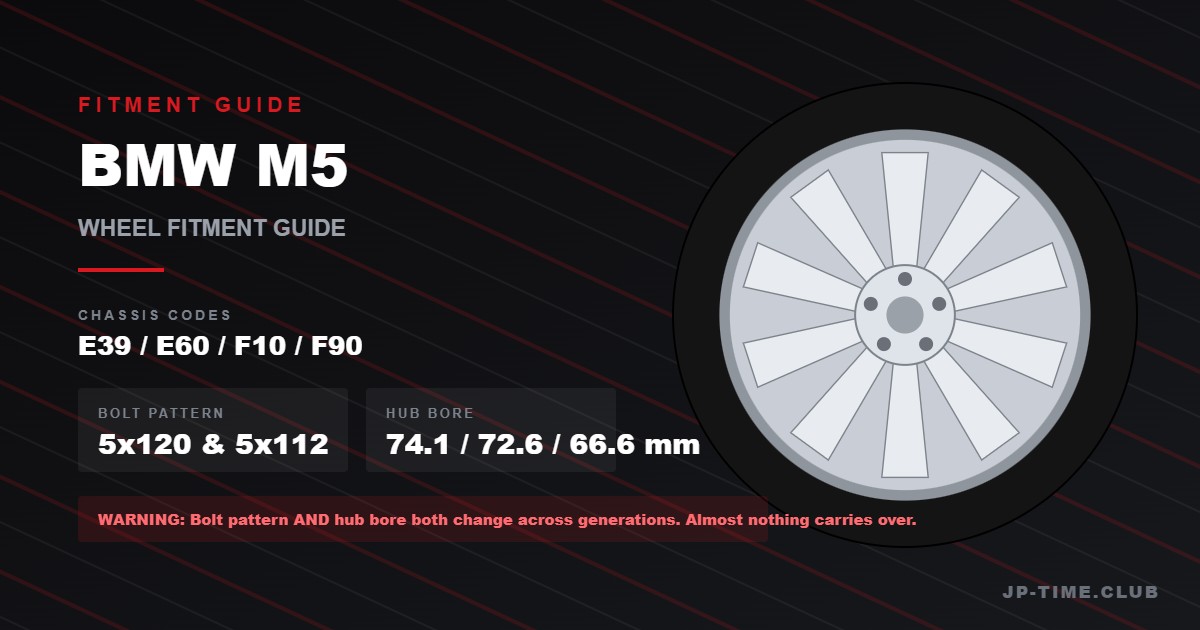
We recently published a guide to the Mitsubishi Lancer Evolution, which ran the same bolt pattern, hub bore, thread and offset for eleven years across six generations. The BMW M5 is the exact opposite. Over five generations it changed hub bore three times, bolt pattern once, thread size once, and offset by twenty millimetres.
Practically nothing carries over. If you are looking at a set of M5 wheels, the generation is not a detail — it is the entire specification.
Section 1: OEM Wheel Specifications by Generation
| Generation | Years | Bolt Pattern | Hub Bore | Thread | Front Wheel | Rear Wheel |
|---|---|---|---|---|---|---|
| E39 | 1998-2003 | 5×120 | 74.1 mm | M12x1.5 | 8Jx18 ET20 | 9.5Jx18 ET22 |
| E60 Saloon | 2004-2010 | 5×120 | 72.6 mm | M12x1.5 | 8.5Jx19 ET12 | 9.5Jx19 ET28 |
| E61 Touring | 2004-2010 | 5×120 | 72.6 mm | M12x1.5 | 8.5Jx19 ET12 | 9.5Jx19 ET17 |
| F10 | 2011-2017 | 5×120 | 72.6 mm | M14x1.25 | 9Jx19 ET32 | 10Jx19 ET34 |
| F90 | 2018-2023 | 5×112 | 66.6 mm | M14x1.25 | 9.5Jx19 ET26 | 10.5Jx19 ET28 |
| F90 Competition / CS | 2018-2023 | 5×112 | 66.6 mm | M14x1.25 | 9.5Jx20 ET28 | 10.5Jx20 ET28 |
BMW uses lug bolts rather than studs and nuts. Thread size refers to the bolt. F90 wheel bolt torque is in the region of 140 Nm; always confirm against the figure for your specific car.
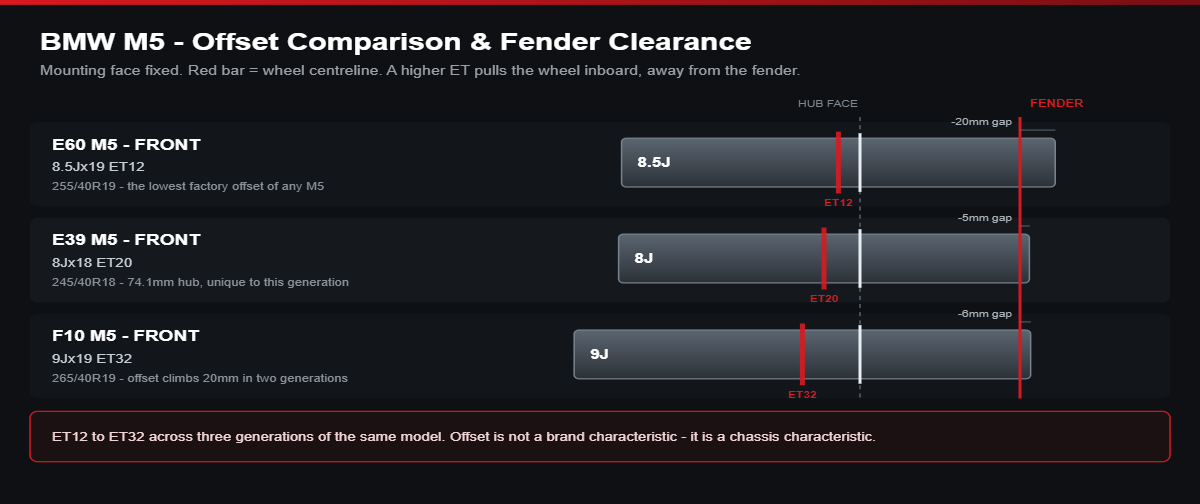
Section 2: Offset Comparison & Fender Clearance Visualization
Section 3: The Three Hub Bores
This is where most cross-generation M5 wheel purchases fail:
- E39: 74.1 mm. The largest of the three, and unusual even within BMW. A 72.6 mm E60 or F10 wheel will not physically go onto an E39 hub.
- E60 / F10: 72.6 mm. The standard modern BMW bore for this chassis family. These two generations are bore-compatible with each other.
- F90: 66.6 mm — and a different bolt pattern. The F90 moved to 5×112, aligning BMW with the Volkswagen Group and Mercedes standard.
The direction of the error matters. A wheel with a larger bore than the hub can be centred with a ring. A wheel with a smaller bore cannot be fitted at all. So an E39 wheel can be made to work on an E60 with a 74.1–72.6 ring; the reverse is impossible without machining.
A Japanese-market E39 M5 running 20-inch SSR Professor wheels — two inches over the factory 18, on a chassis with the unusual 74.1 mm bore. — via @@nao_m5.bmw.ferrari.japan
Section 4: The E60 and Its ET12 Front
The E60 M5 carries the lowest factory offset in this guide, and one of the lowest of any production saloon: 8.5Jx19 ET12 at the front, paired with 9.5Jx19 ET28 at the rear. That is a 16 mm offset split across the axles, in the “rear-in” direction — the rear wheel is wider but sits further inboard relative to its own centreline.
Two consequences for owners:
- You cannot rotate front wheels to the rear or vice versa. They are different in both dimensions.
- Aftermarket wheels in ET12 are rare. Most 19×8.5 wheels are made in ET30–ET40. Fitting one to an E60 front pulls the wheel 20 mm or more inboard — which on this car means contact with the strut, not a gap at the fender.
This is the reverse of the problem the Honda NSX presents. On an NSX, aftermarket offsets are too low. On an E60 M5 front axle, they are too high.
Section 5: The F90 Break
The F90 is a clean break from every M5 before it: 5×112, 66.6 mm bore, M14x1.25 bolts. Nothing from an E39, E60 or F10 fits, and nothing from an F90 fits backwards.
What it does open up is the enormous 5×112 / 66.6 mm pool shared with modern Mercedes-AMG and, from the G80 generation, the BMW M3. If you have read our Mercedes-AMG guide or our G80 M3 guide, the numbers will look familiar — because they now are.
Section 6: Popular Aftermarket Sizes
- E39: 19×8.5 ET25 front / 19×9.5 ET25 rear is the standard modern upgrade. 20-inch fits with care on a car at stock height. Remember the 74.1 mm bore — specify it when ordering.
- E60: 19×8.5 ET15–ET20 front / 19×10 ET25 rear. The front offset is the constraint, not the rear.
- F10: 20×9 ET30 front / 20×10.5 ET32 rear. The F10 has the most forgiving arch of the pre-F90 cars.
- F90: 20×9.5 ET25 front / 20×10.5 ET28 rear, or 21-inch on Competition cars. Note the 5×112 pattern when shopping.
Section 7: Load Rating on a 1,900 kg Car
An F90 M5 weighs around 1,900 kg and makes over 600 hp. That is a genuinely demanding application for a wheel, and it is not a place to fit something without a documented load rating.
On used Japanese wheels, look for the JWL and VIA stamps on the inside of the spoke face — but also check the specific load rating, because JWL certification covers passenger cars generally, not this weight class specifically. Reputable Japanese manufacturers publish a load rating per wheel model and size; on a car this heavy, ask for it.
Related Fitment Guides
- BMW M3 G80 — the same 5×112 destination
- Lexus LS460 — the other 5×120 luxury saloon
- Audi A7 & S7 — a direct competitor on 5×112
- Tesla Model S & Model 3 — 5×120 with a smaller bore
Every guide in this series is built the same way: verified factory specifications, an offset diagram, and an honest account of what fits and what does not.
Buying Wheels for Your M5
Generation first, then bore, then bolt pattern, then offset. The M5 is the clearest example in this series of a car where the badge tells you almost nothing about the fitment.
Looking for a specific set? We specialise in genuine Japanese wheels — RAYS, Volk, Enkei, SSR, WORK, BBS Japan and the rare discontinued sets that never left the country. Tell us the wheel, the fitment, the year — our team searches our networks until we find it.
Specifications in this guide reflect factory equipment. Trim levels, optional wheel packages and market-specific variants can differ. Always confirm the fitment against your own car before purchase.