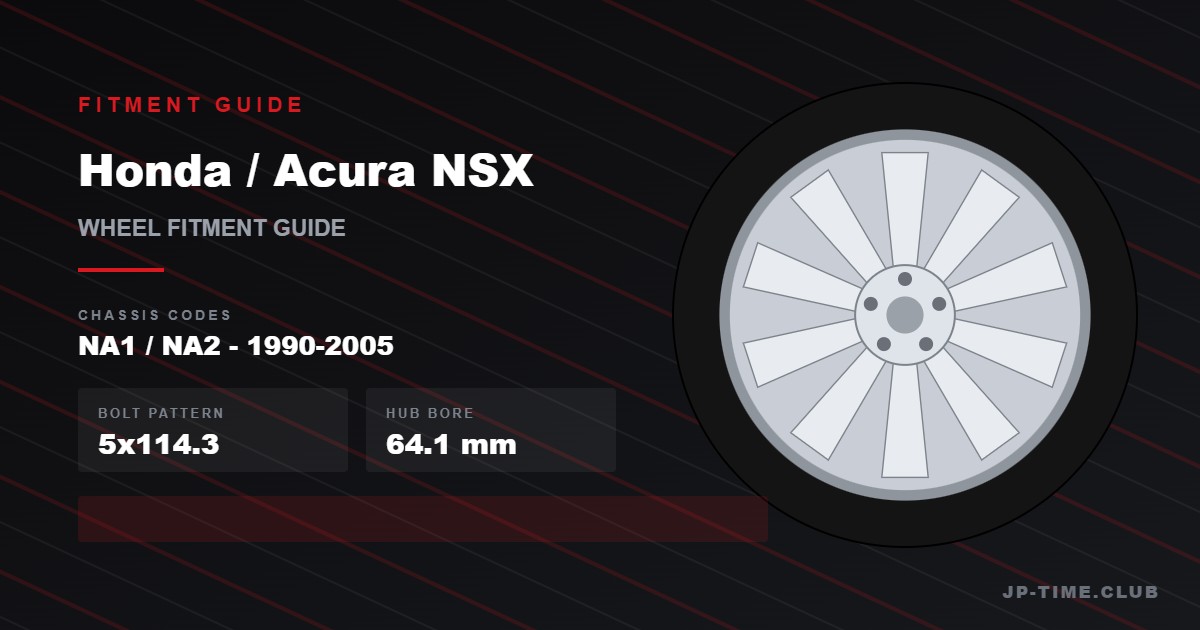
The NSX has the hardest fitment in this entire series, and it is not because the numbers are unusual. It is because they are extreme.
ET55 at the front. ET60 at the rear. Those are offsets you normally see on front-wheel-drive family cars, not mid-engined supercars — and almost nothing in the performance aftermarket is made in them. Add a 16-inch front and 17-inch rear on every pre-2002 car and you have a platform where “a set of wheels” means four wheels in two different diameters and two different offsets.
Section 1: OEM Wheel Specifications
| Model Years | Bolt Pattern | Hub Bore | Thread | Front Wheel | Rear Wheel | Tyres (F / R) |
|---|---|---|---|---|---|---|
| 1991-2001 | 5×114.3 | 64.1 mm | M12x1.5 | 7Jx16 ET55 | 8.5Jx17 ET60 | 215/45R16 / 245/40R17 |
| 2002-2005 (facelift) | 5×114.3 | 64.1 mm | M12x1.5 | 7Jx17 ET55 | 9Jx17 ET55 | 215/40R17 / 255/40R17 |
The 2002 facelift moved the front to 17 inches, widened the rear to 9J and brought both axles to a common ET55.
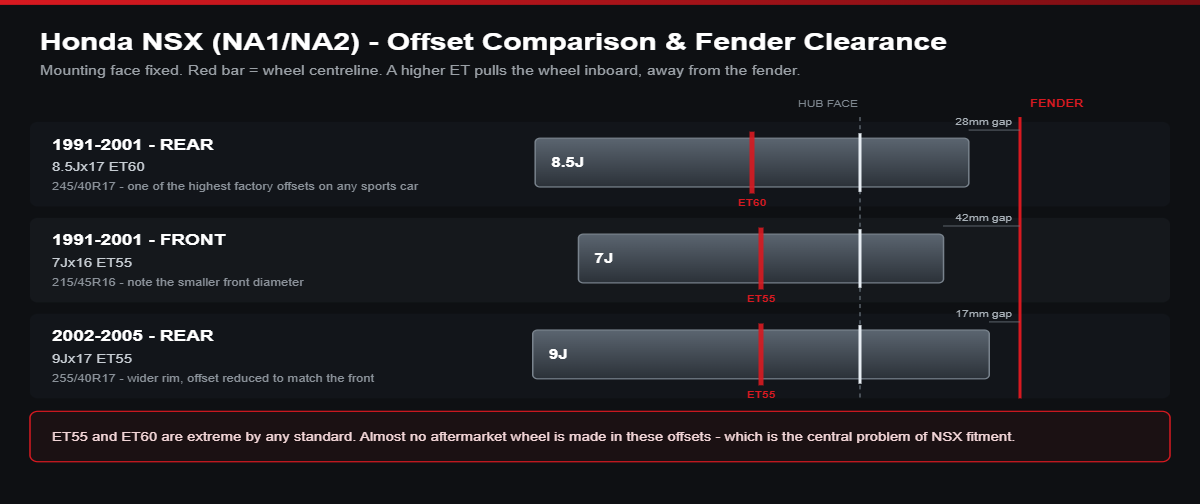
Section 2: Offset Comparison & Fender Clearance Visualization
Section 3: Why the Offsets Are So High
The NSX is a wide car with a comparatively narrow track. Honda built the body around aerodynamics and around a mid-mounted V6, then set the suspension geometry to suit the handling balance rather than the styling. The result is a large gap between the hub face and the fender, filled by a wheel with a very high offset.
This has one enormous practical consequence: you cannot simply buy a “5×114.3 17-inch wheel” and expect it to fit. A typical aftermarket 17×8.5 comes in ET30 to ET45. Fitted to an NSX rear, an ET35 wheel sits 25 mm further outboard than factory — well past the arch on a standard car.
Your realistic options are:
- Genuine NSX or NSX-R wheels — correct offsets, correct staggered diameters, and increasingly expensive.
- Japanese aftermarket wheels made specifically for the NSX — RAYS, Volk, WORK, SSR and Mugen all produced NSX-specific fitments in period. These are the sets worth hunting.
- Custom-built multi-piece wheels — a three-piece wheel can be assembled to any offset you specify. On this platform, that is a legitimate mainstream solution rather than an extravagance.
- A wider wheel at a lower offset with body work — the route taken by most modified NSXs, and a body project rather than a wheel purchase.
A period Japanese tuned NSX — multi-piece wheels built to the offsets this car needs rather than bought off the shelf. — via @@foglightlover
Section 4: The Staggered Diameter Problem (1991-2001)
Pre-facelift NSXs run 16-inch fronts and 17-inch rears. That is unusual even among supercars of the era, and it creates two problems for a buyer:
- You cannot buy a matching set of four. Any “set of NSX wheels” listed as four identical wheels is either a facelift set, or it is not an NSX set.
- Tyre choice is narrow. 215/45R16 in a modern performance compound is a shrinking market. Many owners convert to a 17-inch front for exactly this reason.
The 17-inch front conversion using facelift-specification 7Jx17 ET55 wheels is the standard fix. It keeps the factory offset, keeps the rolling diameter close, and opens up the modern tyre catalogue. It is one of the few genuinely uncontroversial modifications on the car.
Section 5: The 64.1 mm Hub Bore
The NSX uses Honda’s standard 64.1 mm bore with M12x1.5 studs — shared with the Integra Type R, S2000, Accord, Prelude and Civic Type R. That means:
- Honda wheels fit mechanically, including Integra Type R and S2000 wheels. Whether the offset suits is a different question — almost none of them come close to ET55.
- Nissan wheels (66.1 mm) will not sit hub-centric and need rings. Toyota wheels (60.1 mm) will not fit at all. Same bolt pattern, wrong bore. See our Civic guide for how the same Honda bore behaves on a front-wheel-drive car.
Section 6: Brake Clearance and Weight
Standard NSX brakes clear a 16-inch wheel at the front — the car was designed that way. However, many NSXs have been upgraded to larger front brake packages over thirty years of ownership, and a 16-inch front is then no longer viable. Check what is behind the wheel before you buy the wheel.
Weight is the other point. At roughly 1,350 kg with a high-revving naturally aspirated V6, the NSX responds to a reduction in unsprung mass more than almost any other car in this series. A light forged 17-inch wheel at the correct offset does more for how the car drives than an extra inch of rim ever will.
Related Fitment Guides
- Honda S2000 — Honda’s other extreme-offset car
- Honda Integra Type R — the DC5 runs ET60
- Honda Civic — the same 64.1 mm bore
- Toyota MR2 SW20 — the mid-engined comparison
Every guide in this series is built the same way: verified factory specifications, an offset diagram, and an honest account of what fits and what does not.
Buying Wheels for Your NSX
Two questions decide everything: pre-facelift or facelift, and what offset is the wheel actually made in? On most cars offset is a detail. On an NSX it is the whole purchase.
Looking for a specific set? We specialise in genuine Japanese wheels — RAYS, Volk, Enkei, SSR, WORK, BBS Japan and the rare discontinued sets that never left the country. Tell us the wheel, the fitment, the year — our team searches our networks until we find it.
Specifications in this guide reflect factory equipment for Japanese-market vehicles. Trim levels, optional wheel packages and market-specific variants can differ. Always confirm the fitment against your own car before purchase.
Seen on the road
Which wheels are you looking for? Tell us the wheel, the size and the fitment — send us a request and we will go and find it.
Wheel identification is taken from the hashtags the owner applied to their own post.
Addendum, August 2026: the Hub Bore Is Printed as a Pair
A later verification pass against the Japanese factory wheel database turned up something worth recording. On every NSX grade page, the hub bore field reads “70/64 mm” rather than a single figure — we opened the NA1 page and confirmed it.
Our reading is that this is a front and rear pair, not a formatting quirk: the NSX is mid-engined with different front and rear hubs, exactly like the S30 Fairlady Z, where careful owner measurements give roughly 72.8 mm at the front and 68 mm at the rear. We are labelling that as our reading rather than as a statement from the source, which prints the pair without explaining it.
The practical consequence is the one that matters: do not buy four identical hub rings for an NSX on the strength of a single published number. Measure both ends. Our forthcoming hub bore guide covers how.
Two other points from the same pass. The bolt pattern is 5×114.3 across all fifteen years and every grade, including Type R and Type S — genuinely constant. And the NA1 Type R (1992–95) ran the small 15-inch front and 16-inch rear wheels, the same as the base car; it was not a bigger-wheel model. The platform-wide step to 16/17 inch came at the February 1997 facelift, and to 17 inch front and rear in December 2001.