The A7 and S7 are square-setup cars. Same wheel front and rear, on every package, on both models. After the staggered complexity of the 370Z, the M5 and the NSX, that is a relief — and it makes the A7 one of the easier cars in this series to shop for.
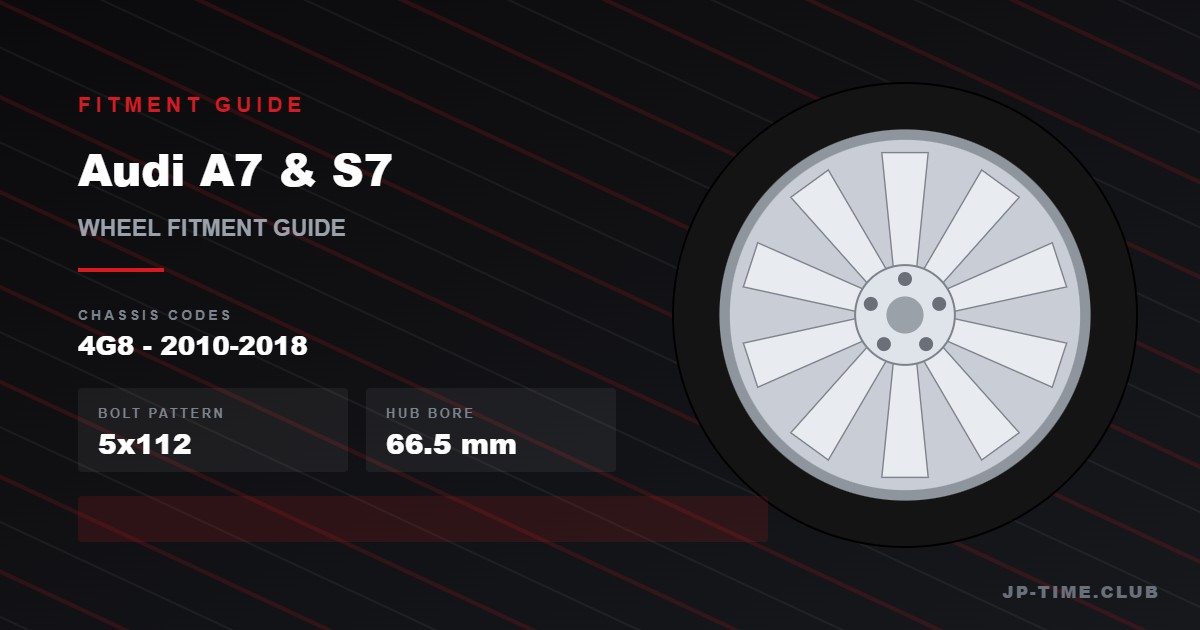
The specification: 5×112, 66.5 mm bore, M14x1.5 bolts, ET32 on 18 and 19-inch packages, ET37 on the S7’s 20-inch.
Section 1: OEM Wheel Specifications
| Model | Package | Bolt Pattern | Hub Bore | Thread | Wheel (front & rear) | Tyre |
|---|---|---|---|---|---|---|
| A7 | 18-inch | 5×112 | 66.5 mm | M14x1.5 | 8.5Jx18 ET32 | 255/45R18 |
| A7 | 19-inch | 5×112 | 66.5 mm | M14x1.5 | 8.5Jx19 ET32 | 255/40R19 |
| S7 | 19-inch | 5×112 | 66.5 mm | M14x1.5 | 8.5Jx19 ET32 | 255/40R19 |
| S7 | 20-inch | 5×112 | 66.5 mm | M14x1.5 | 9Jx20 ET37 | 265/35R20 |
Wheel bolt torque is approximately 120 Nm. Audi, like BMW and Mercedes, uses lug bolts that thread into the hub rather than studs with nuts.
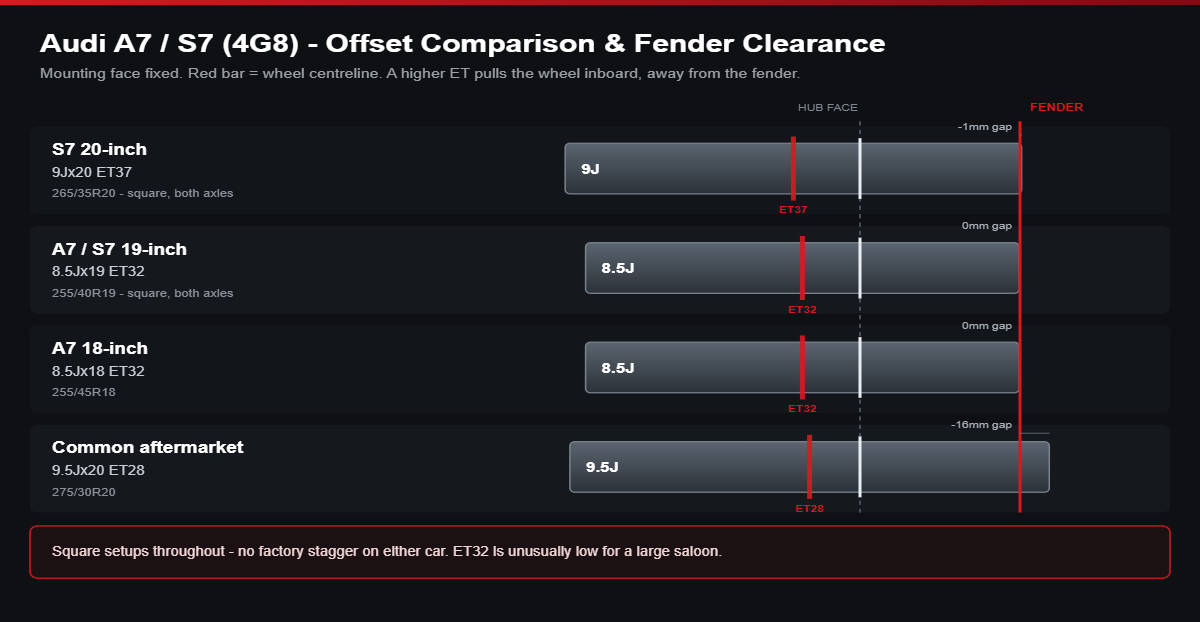
Section 2: Offset Comparison & Fender Clearance Visualization
Section 3: 66.5 or 66.6? The Half-Millimetre Question
Audi publishes a 66.5 mm hub bore. BMW and Mercedes-Benz publish 66.6 mm on their 5×112 cars. In practice these are the same nominal fitment with different rounding conventions, and wheels are routinely sold as fitting all three.
What that means practically:
- Mercedes-AMG and modern BMW 5×112 wheels fit an A7 or S7. See our Mercedes-AMG guide and G80 M3 guide.
- The offsets do not always suit. Mercedes and BMW 5×112 cars are frequently staggered, so a “matching set of four” from those platforms may be two fronts and two rears.
- Older BMW 5×120 wheels do not fit. Different pattern entirely — see our BMW M5 guide.
There is no meaningful Japanese 5×112 tradition, so this is a European parts pool rather than a JDM one.
A lowered A7 running well below the factory ET32 — the direction almost every modified example goes. — via @@audi_obsession
Section 4: Weight Is the Governing Number
An S7 weighs around 1,970 kg and makes 450 hp through all four wheels. That is heavier than every Japanese car in this series and heavier than most of the German ones.
Two consequences:
- Load rating is not optional. Check the published rating per wheel, not just the JWL or TÜV mark. A wheel rated for a 1,400 kg coupe has no business on this car.
- Large wheels get heavy fast. A cast 21-inch wheel for this platform can easily exceed 15 kg. On an already heavy car with air or adaptive suspension, that has a real effect on ride quality and on the suspension’s ability to control the wheel.
Section 5: Realistic Aftermarket Fitments
- 19×8.5 ET32–ET35 — factory-equivalent. The right choice if you simply want a lighter or better-looking wheel.
- 20×9 ET35 — the natural step up. Fits standard arches at stock ride height with a 265/35R20.
- 20×9.5 ET28 — roughly 17 mm more poke per side than an S7’s 20-inch. Fender roll and some camber on a lowered car.
- 21×9.5 ET30 — the appearance-led route. Watch weight and watch pothole tolerance; sidewall is minimal.
Below ET25 on standard bodywork you are into rolled arches. The A7’s rear arch is the constraint — the front has more room than you would expect from the styling.
Section 6: A Note on Lug Bolts
Audi uses lug bolts, not studs. Bolt length is determined by the thickness of the wheel at the mounting face, so an aftermarket wheel will often need bolts of a different length to the factory items — too short and thread engagement is inadequate, too long and the bolt bottoms out in the hub.
Buy bolts specified for the wheel, and check the seat type — Audi uses a ball seat on most models while many aftermarket wheels are designed for a conical seat. Mismatched seats will loosen.
Related Fitment Guides
- Mercedes-AMG — the same 5×112 pool
- BMW M5 — a direct competitor
- Tesla Model S & Model 3 — similar weight and fasteners
- BMW M3 G80 — 5×112 on a smaller BMW
Every guide in this series is built the same way: verified factory specifications, an offset diagram, and an honest account of what fits and what does not.
Buying Wheels for Your A7 or S7
5×112, 66.5 mm, ET32 as the reference, and a load rating that respects two tonnes. The square setup means you can buy four identical wheels — which is more of a luxury than it sounds.
Looking for a specific set? We specialise in genuine Japanese wheels — RAYS, Volk, Enkei, SSR, WORK, BBS Japan and the rare discontinued sets that never left the country. Tell us the wheel, the fitment, the year — our team searches our networks until we find it.
Specifications in this guide reflect factory equipment. Trim levels, model years, optional wheel packages and market-specific variants can differ. Always confirm the fitment, bolt specification and load rating against your own car before purchase.