
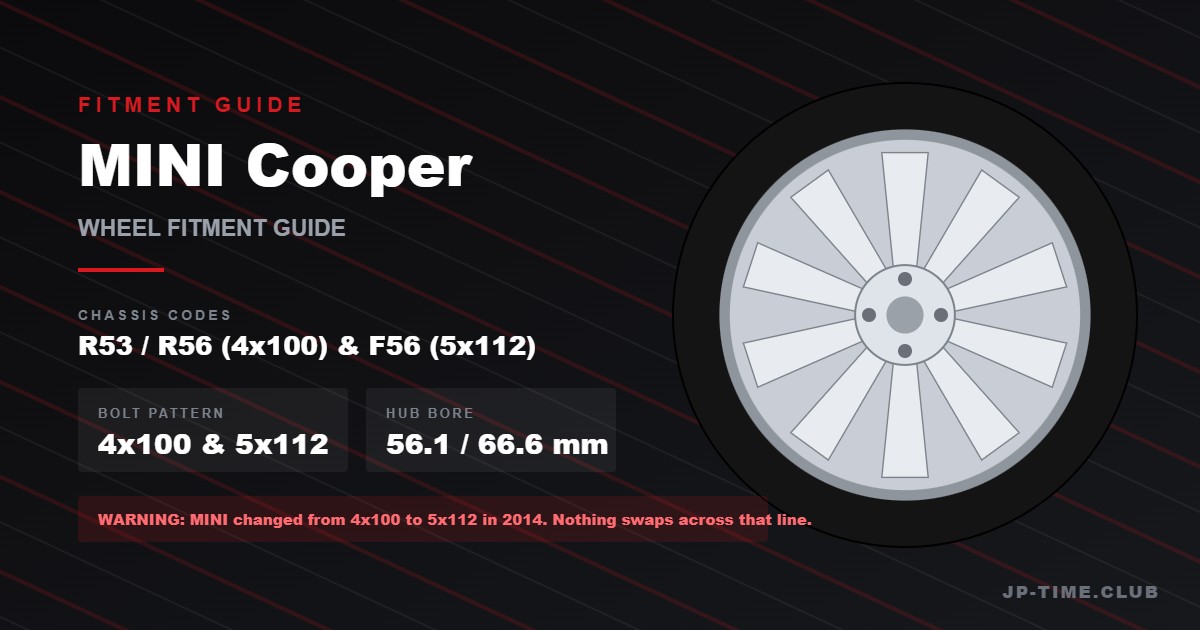
In 2014, MINI changed everything. The R56 and everything before it is 4×100 with a 56.1 mm bore. The F56 and everything after is 5×112 with a 66.6 mm bore. Nothing crosses that line.
But the part that matters most for anyone reading this on a Japanese wheel site is the earlier car: the R53 and R56 share their 4×100 bolt pattern and 56.1 mm hub bore exactly with Honda. Civic, CR-X, del Sol, Integra base models — identical.
Section 1: OEM Wheel Specifications
| Generation | Years | Bolt Pattern | Hub Bore | Thread | OEM Wheel | OEM Tyre |
|---|---|---|---|---|---|---|
| R50 / R53 | 2001-2006 | 4×100 | 56.1 mm | M12x1.5 | 5.5Jx15 ET45 6.5Jx16 ET48 |
175/65R15 195/55R16 |
| R56 / R55 / R57 | 2006-2014 | 4×100 | 56.1 mm | M14x1.25 | 5.5Jx15 ET45 5.5Jx16 ET45 6.5Jx16 ET48 |
175/65R15 175/60R16 195/55R16 |
| F56 / F55 Cooper | 2014-2021 | 5×112 | 66.6 mm | M14x1.25 | 5.5Jx15 ET46 5.5Jx16 ET46 |
175/65R15 175/60R16 |
| F56 Cooper S | 2014-2021 | 5×112 | 66.6 mm | M14x1.25 | 6.5Jx16 ET54 7Jx17 ET54 |
195/55R16 205/45R17 |
F56 wheel bolt torque is approximately 140 Nm. Note that MINI uses lug bolts, not studs and nuts — this matters more than it sounds, and we cover it below.
Section 2: Offset Comparison & Fender Clearance Visualization
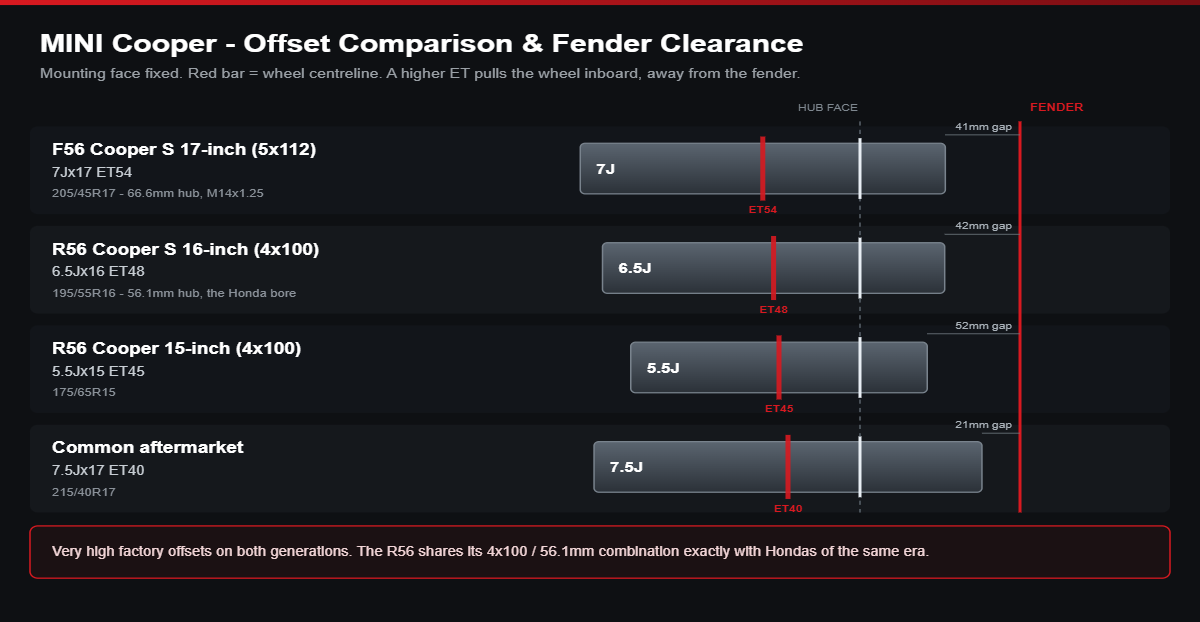
Section 3: The Honda Connection (R53 / R56)
This is the useful part. A 2001–2014 MINI is 4×100 / 56.1 mm. So is a Honda Civic EG/EK, a CR-X, a del Sol and a base Integra.
That means the Japanese 4×100 catalogue — Volk TE37 in 4×100, WORK, SSR, Enkei, Watanabe — is directly compatible on pattern and bore with an R53 or R56 MINI. This is not a common piece of knowledge, and it opens up a considerably more interesting range of wheels than the European 4×100 market offers.
See our CR-X guide for the same fitment on the Honda side.
Two things to resolve first.
1. Bolts versus studs
MINI, like BMW, uses lug bolts that thread into the hub rather than studs with nuts. Japanese wheels are designed around studs and nuts, and the bolt seat geometry and required bolt length depend on the wheel’s thickness at the mounting face.
The clean solution, widely used in Japan, is a stud conversion — screw-in studs that replace the bolts and let you use conventional nuts. On an R56 this also allows converting from the factory M14x1.25 to M12, which matches Japanese wheel hardware directly.
It is a straightforward job, it makes wheel fitting far easier, and it is why so many Japanese-market MINIs have had it done.
2. Offset
The factory ET45–ET48 is high but not extreme, and most Japanese 4×100 wheels sit in ET35–ET45. That is a workable range on a MINI, though anything below ET35 will need arch work on a car this narrow.
A Japanese R56 converted from factory lug bolts to M12 studs and nuts — the standard route to running Japanese wheels on a MINI. — via @@masao_yanagawa
Section 4: The F56 and 5×112
The F56 moved to BMW’s modern 5×112 / 66.6 mm combination — the same as the G80 BMW M3, the F90 M5 and modern Mercedes-AMG. See our G80 M3 guide and Mercedes-AMG guide.
This gives the F56 access to a large and growing European aftermarket, but it removes the Honda cross-compatibility entirely. There is no Japanese 5×112 tradition to speak of.
Note also that the F56 Cooper S runs a very high ET54. Most aftermarket 5×112 wheels are made in ET30–ET45 for larger BMWs; fitting one to an F56 pushes the wheel well outboard of where MINI put it.
Section 5: Realistic Fitments
- R56, 16×7 ET40–ET45 — a clean upgrade with 195/50R16. No arch work.
- R56, 17×7.5 ET40 — the common enthusiast fitment with 205/40R17. Mild fender roll on a lowered car.
- R56, 17×8 ET35 — aggressive on a car this narrow. Roll and camber expected.
- F56, 17×7.5 ET45–ET50 — near factory-equivalent.
- F56, 18×8 ET45 — the usual step up. Watch tyre availability in 205/40R18.
The MINI is a short, narrow, stiffly sprung car. It is very sensitive to wheel weight and tyre sidewall — going to 18 inches with a 35-series tyre changes the ride considerably more than it would on a larger car.
Related Fitment Guides
- Honda CR-X & del Sol — identical 4×100 and 56.1 mm
- Honda Civic — and the same again
- Mercedes-AMG — where the F56’s 5×112 leads
- Toyota Vitz / Yaris & GR Yaris — the small-car bore comparison
Every guide in this series is built the same way: verified factory specifications, an offset diagram, and an honest account of what fits and what does not.
Buying Wheels for Your MINI
Pre-2014 or post-2014? That single question decides between 4×100 / 56.1 mm and 5×112 / 66.6 mm. Then sort out the bolt-versus-stud question before you order anything Japanese.
Looking for a specific set? We specialise in genuine Japanese wheels — RAYS, Volk, Enkei, SSR, WORK, BBS Japan and the rare discontinued sets that never left the country. Tell us the wheel, the fitment, the year — our team searches our networks until we find it.
Specifications in this guide reflect factory equipment. Trim levels, model years, optional wheel packages and market-specific variants can differ. Always confirm the fitment and fastener specification against your own car before purchase.