ADVAN Racing is the odd one out in this series, and the reason is structural.
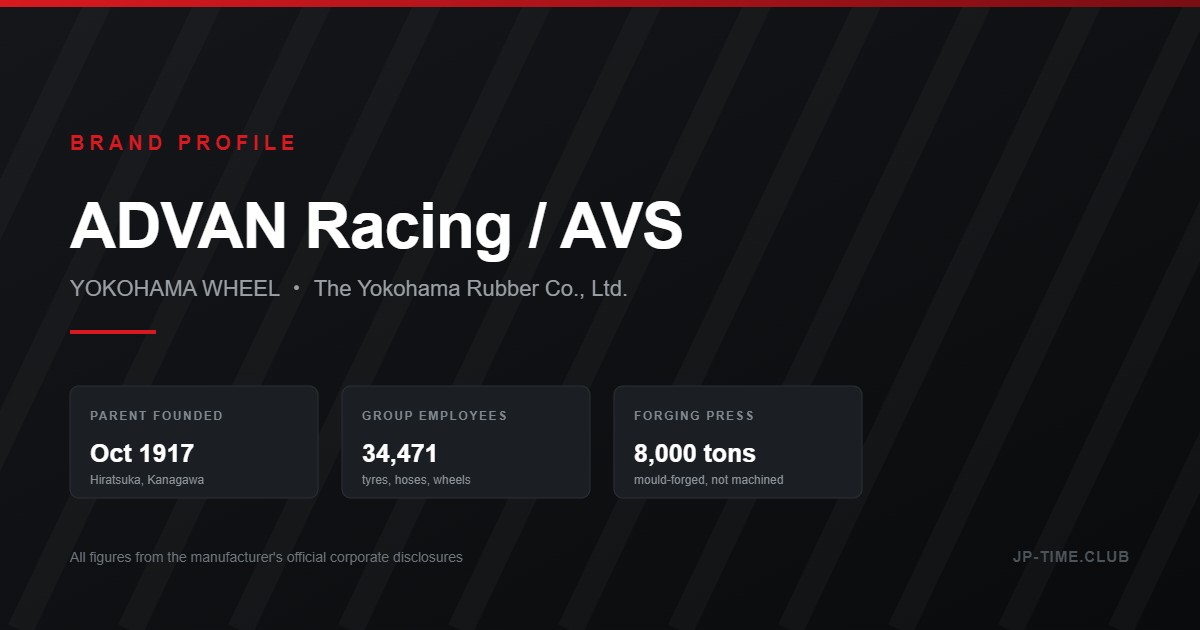
WORK, RAYS and ENKEI are wheel companies. ADVAN Racing is a product line inside a rubber company — specifically The Yokohama Rubber Co., Ltd., founded in 1917, which employs 34,471 people and makes tyres, high-pressure hoses, conveyor belts, marine fenders, dock fenders, aircraft water tanks, golf equipment — and aluminium wheels.
That sounds like a footnote. It is actually the most useful thing to know about the brand, and it leads to something none of the other three do.
The Short Version
- ADVAN Racing and AVS are the two wheel brands of YOKOHAMA WHEEL, operated by The Yokohama Rubber Co., Ltd.
- Parent company founded 13 October 1917, headquartered in Hiratsuka, Kanagawa.
- Group revenue ¥1.235 trillion (FY2025); 34,471 consolidated employees.
- Yokohama Wheel publishes its full manufacturing process — casting, flow forming, heat treatment, finishing and forging — in Japanese and English.
- Forging is comparatively new for the company. The first forged model was the AVS MODEL F7, made by mould forging on a press rated to 8,000 tons.
A Wheel Brand Owned by a Tyre Company
The practical consequence is that the wheel division sits alongside the people who make ADVAN tyres. Yokohama Wheel describes designing wheels to draw out the performance of the tyres fitted to them, and the shared ADVAN name across both product lines is not a licensing arrangement — it is one company.
The scale contrast with the rest of this series is stark:
| Company | Employees | What else it makes |
|---|---|---|
| WORK | 170 | Wheels only |
| ENKEI | 7,359 | Wheels, castings |
| Yokohama Rubber | 34,471 | Tyres, hoses, conveyor belts, marine fenders, aircraft parts, golf equipment |
The Thing Nobody Else Does
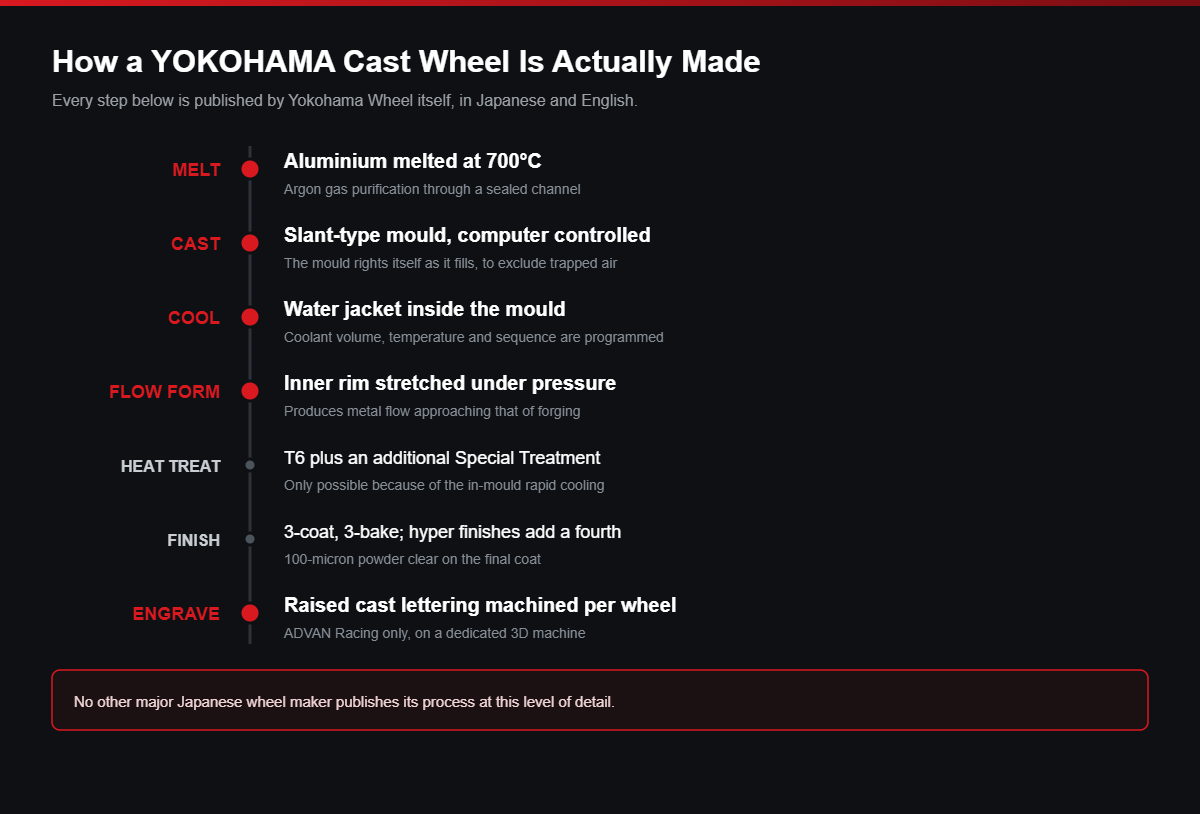
Yokohama Wheel publishes a page describing exactly how its wheels are made. Not marketing adjectives — process steps, temperatures and tolerances, in both Japanese and English. Among the major Japanese wheel makers this is genuinely unusual, and it is worth reading if you care what you are buying.
The published casting sequence:
- Aluminium melted at 700°C, purified with argon gas and delivered through a channel sealed against outside air.
- Poured into a slant-type mould that is computer-controlled to return gradually to vertical as it fills — the stated purpose being to keep residual gas out of the casting and fill it quickly.
- Rapid cooling begins immediately via a water jacket built into the mould, with coolant volume, temperature and cooling sequence programmed.
- The inner rim is then flow formed — stretched under pressure after casting — which the company states produces a metal flow approaching that of forging.
- T6 heat treatment plus an additional “Special Treatment.” Yokohama notes this second stage is only possible because of the in-mould rapid cooling earlier in the process.
- Finishing is three coats and three bakes as standard, with a fourth added for hyper-type finishes, ending in a 100-micron powder clear coat.
- On ADVAN Racing wheels specifically, the top surface of the raised cast lettering is machined on each individual wheel using a dedicated three-dimensional machine.
That last detail is the one to remember. The crisp machined face on ADVAN Racing lettering is a separate manufacturing operation performed per wheel — which makes it a useful thing to look at closely when you are assessing whether a wheel is what it claims to be.
Forging: Newer, and Deliberately Different
Yokohama Wheel is candid that forging is a recent undertaking for it: in its own words, the challenge “has just begun,” with the AVS MODEL F7 as the first model.
The interesting part is the method it chose. Rather than machining a wheel out of a forged blank — the approach it describes as common in the market — Yokohama uses mould forging, forming the wheel progressively through a series of dies so the metal flow lines follow the disc design and rim profile. It uses four moulds where three would be usual, in order to achieve a full-face design reaching to the rim flange, and the final stage rotates the die directly into a spin-forming operation for the rim. Maximum press rating: 8,000 tons.
For comparison, RAYS installed a 10,000-ton press in 2004 and has been forging since 1986. Yokohama is a casting specialist that has moved into forging; RAYS is a forging specialist. Neither statement is a criticism — but it explains where each brand’s strongest products sit.
The Motorsport Policy
Yokohama Wheel states a policy that is worth quoting because it is unusual: it supplies race teams with wheels of the same design and specification as the street versions, on the reasoning that knowledge gained from competition should feed directly into the products customers buy.
Its published examples are historical — ADVAN Racing RS wheels supplied to Scuderia Pro Team’s BMW 320Si in WTCC, and ADVAN Racing RC III to TUSK Engineering’s Lancer Evolution X in PWRC, both from around 2009. More recently the company reports an ADVAN Racing RC-4 fitted to the ADVAN KTMS GR Yaris Rally2 that won its class at round five of the 2025 All-Japan Rally Championship.
The Two Brands
ADVAN Racing is the performance line. Current models include the GT and GT BEYOND families, GT BEYOND-R, RZⅢ, RZ-DF2, RC-4, TC-4, RG-D2, and dedicated versions for Porsche as well as heavy-duty variants for trucks, SUVs and the Suzuki Jimny.
AVS is the more road- and comfort-oriented line, and it is where the company’s first forged model appeared.
What This Means When You Are Buying
1. Most ADVAN Racing wheels are cast, not forged. They are cast well — flow-formed inner rim, T6 plus special treatment — but if you specifically want forged, check the individual model rather than assuming the brand.
2. The lettering is a tell. Machined raised lettering is a documented per-wheel operation on genuine ADVAN Racing product. Sloppy, uneven or unmachined lettering is worth a second look.
3. The finish is thick and deliberate. A 100-micron powder clear coat is a substantial layer. It is durable, but it also means refinishing a damaged ADVAN Racing wheel to original standard is not a trivial job.
What We Could Not Verify
- Where the wheels are physically manufactured. Yokohama Wheel publishes its process in detail but we could not find a plant location or a model-by-model production map on the official pages. The section is titled “Japanese Made Wheels,” which is a claim we are reporting rather than independently confirming.
- When the wheel business began. The parent company’s corporate history is dominated by tyres and industrial rubber. We found no official founding date for the wheel division itself.
- How the ADVAN name originated. Not stated on the pages we reviewed.
- Current status of the WTCC and PWRC supply. Those examples date from around 2009 on a page that has not been updated. We have presented them as historical.
- Wheel-division employee count or revenue. Not disclosed separately from the group.
FAQ
Who makes ADVAN Racing wheels?
YOKOHAMA WHEEL, a business of The Yokohama Rubber Co., Ltd., the tyre manufacturer founded in Japan in 1917.
Is ADVAN Racing the same as ADVAN tyres?
Same company, same brand name, two product categories. It is not a licensing arrangement between separate firms.
Are ADVAN Racing wheels forged?
Most are cast, using flow forming on the inner rim and a T6-plus-special heat treatment. The company describes its forging programme as recent, beginning with the AVS MODEL F7.
What is flow forming?
After casting, the rim area is stretched and formed under pressure. Yokohama states this produces metal flow approaching that of a forged part, improving the strength and toughness of the inner rim.
What is the difference between ADVAN Racing and AVS?
ADVAN Racing is the performance-focused line; AVS is the more road and comfort-oriented line. Both are Yokohama Wheel brands.
Why is the lettering on ADVAN Racing wheels so crisp?
Because it is machined. Yokohama states the top surface of the raised cast lettering is finished on each individual wheel using a dedicated three-dimensional machining process.
Sources
Manufacturing details come from Yokohama Wheel’s own “Japanese Made Wheels” technical pages at yokohamawheel.jp, published in Japanese and English. Corporate figures come from the company profile of The Yokohama Rubber Co., Ltd. and are as published for FY2025. Where those documents are silent, we have said so rather than filling the gap from secondary sources.
Related Guides
- RAYS — the forging specialist, for contrast
- ENKEI — the other casting-led major
- WORK Wheels — 170 people, built to order
- Nissan Z (RZ34) — a current ADVAN Racing GT application
- Suzuki Jimny — 5×139.7, and ADVAN Racing makes a dedicated version
Looking for a specific set? We specialise in genuine Japanese wheels — RAYS, Volk, Enkei, SSR, WORK, BBS Japan and the rare discontinued sets that never left the country. Tell us the wheel, the fitment, the year — our team searches our networks until we find it.