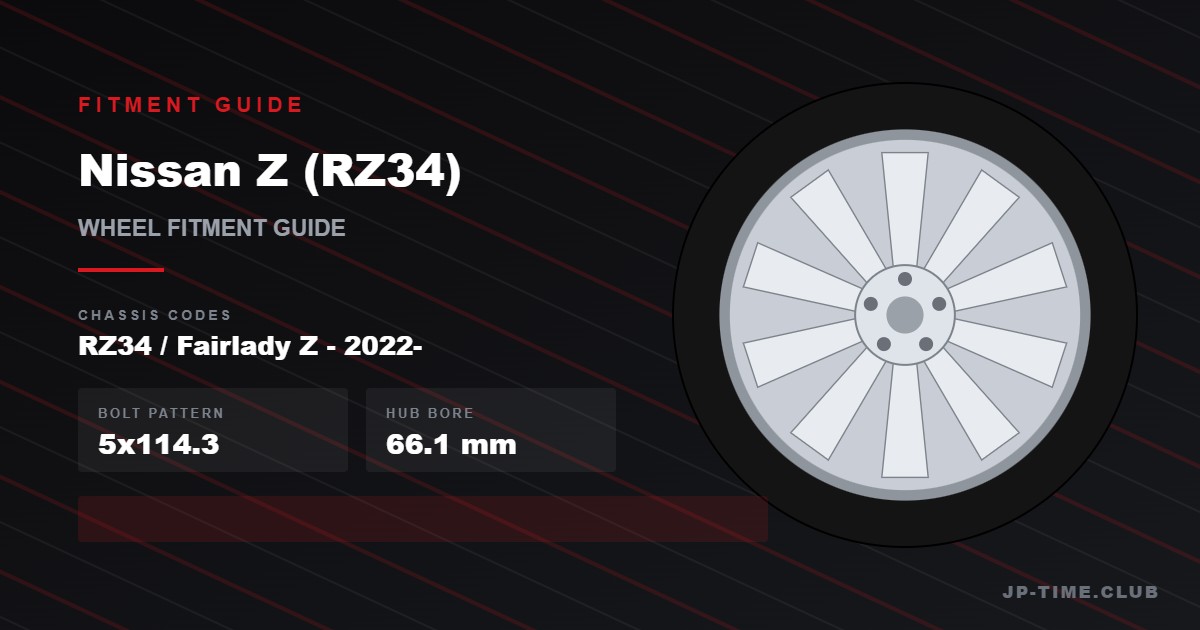
The RZ34 inherits more than the Z badge. It inherits the 370Z’s approach to rear track: set it with offset, not geometry.
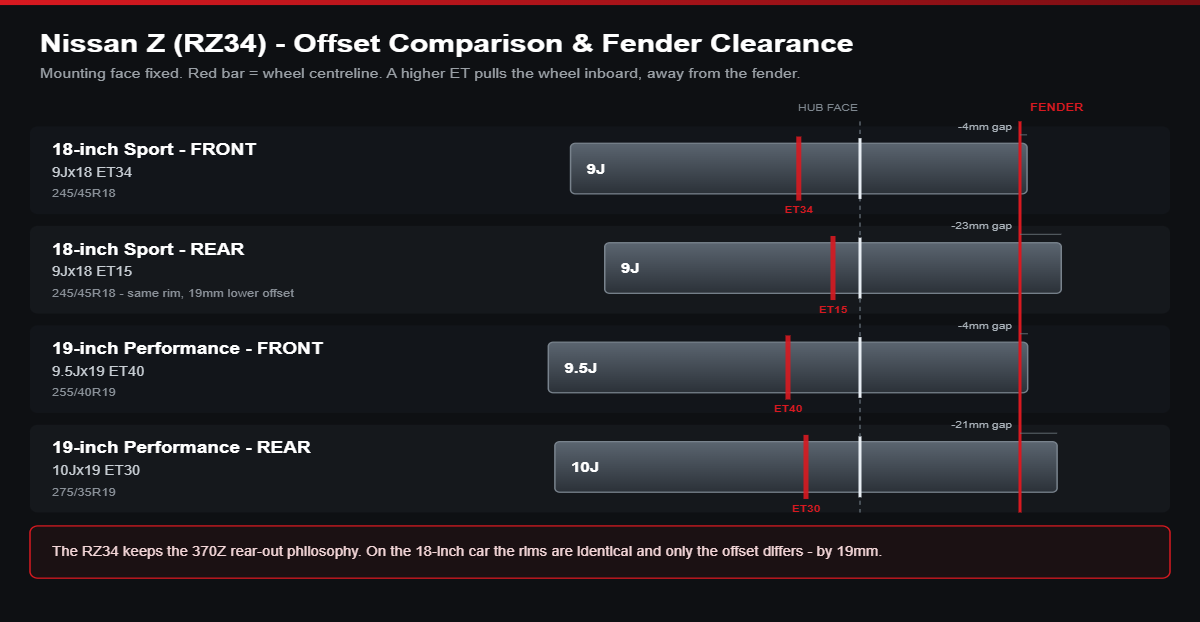
On the 18-inch Sport package, front and rear rims are identical — both 9Jx18. The only difference is the offset: ET34 at the front and ET15 at the rear. Nineteen millimetres, and it is the entire reason those wheels are not interchangeable.
Section 1: OEM Wheel Specifications
| Package | Bolt Pattern | Hub Bore | Thread | Torque | Front Wheel | Rear Wheel |
|---|---|---|---|---|---|---|
| 18-inch (Sport) | 5×114.3 | 66.1 mm | M12x1.25 | 108 Nm | 9Jx18 ET34 | 9Jx18 ET15 |
| 19-inch (Performance) | 5×114.3 | 66.1 mm | M12x1.25 | 108 Nm | 9.5Jx19 ET40 | 10Jx19 ET30 |
Bolt pattern, hub bore and thread are the long-standing Nissan combination, shared with the 370Z, 350Z, Z32, S14, S15 and every five-lug Skyline.
Section 2: Offset Comparison & Fender Clearance Visualization
Section 3: Same Rim, Different Wheel
The 18-inch RZ34 is an unusually clean illustration of what offset actually does. Two wheels that measure identically — same diameter, same width, same bolt pattern, same bore — place the tyre 19 mm apart because the mounting face sits in a different place.
Three practical points:
- You cannot rotate front to rear. The wheels look interchangeable and are not.
- A “set of four RZ34 18s” must be two fronts and two rears. If a listing does not specify, ask — and ask for a photograph of the offset stamp on the inside of the spoke face.
- A square aftermarket set will not reproduce the factory stance. Four ET34 wheels will leave the rear sunken; four ET15 wheels will not clear the front strut.
A Japanese forged wheel set on an RZ34 running the factory 19-inch geometry: 9.5J +40 front, 10J +30 rear. — via @@yokohamawheelusa
Section 4: The 19-inch Performance Package
The Performance car runs 9.5Jx19 ET40 front and 10Jx19 ET30 rear — wider rims at both ends and a 10 mm offset split rather than 19 mm. Toward the rear, the extra half-inch of rim and the lower offset work together.
This is a slightly less extreme arrangement than the 370Z’s, which ran a 28 mm split on the 18-inch package. The RZ34 achieves a similar result with more of the work done by rim width.
Section 5: Realistic Aftermarket Fitments
- 19×9.5 ET22 front / 19×10.5 ET22 rear — the common square-offset upgrade. Slightly more front poke than factory, slightly less rear.
- 19×9.5 ET40 / 19×10.5 ET30 — effectively factory-equivalent in aftermarket form. The safe choice for a lighter forged wheel.
- 18×9.5 ET22 / 18×10.5 ET15 — the track-oriented option. More tyre choice, more sidewall, and the RZ34’s brakes clear 18 inches.
- 20-inch — possible but adds weight to a car that already weighs around 1,600 kg. Consider what you are buying it for.
The front is the constraint, exactly as on the 370Z. The rear arch will accept more than the front strut and inner liner will.
Section 6: What Fits From the Rest of the Nissan Range
The RZ34 uses 5×114.3 / 66.1 mm / M12x1.25, unchanged from decades of Nissan practice:
- 370Z and 350Z wheels fit — check which axle. See our 350Z guide.
- R34 and R33 GT-R wheels fit — see our R34 guide.
- Z32 300ZX wheels fit — see our Z32 guide.
- Toyota wheels (60.1 mm) will not fit at all. Evo and RX-7 FD wheels (67.1 mm) need hub rings.
Fifty years of Z cars, and the studs have not moved. That is worth something.
Related Fitment Guides
- Nissan 370Z — the direct predecessor
- Nissan 350Z — and the one before that
- Nissan 300ZX Z32 — the 1990 Z
- Nissan GT-R R35 — Nissan’s other current fitment
Every guide in this series is built the same way: verified factory specifications, an offset diagram, and an honest account of what fits and what does not.
Seen on the road
Which wheels are you looking for? Tell us the wheel, the size and the fitment — send us a request and we will go and find it.
Wheel identification is taken from the hashtags the owner applied to their own post.
Buying Wheels for Your Z
Front or rear? On an 18-inch RZ34 that question is the entire specification — everything else about the two wheels is identical.
Looking for a specific set? We specialise in genuine Japanese wheels — RAYS, Volk, Enkei, SSR, WORK, BBS Japan and the rare discontinued sets that never left the country. Tell us the wheel, the fitment, the year — our team searches our networks until we find it.
Specifications in this guide reflect factory equipment for Japanese-market vehicles. Trim levels, optional wheel packages and market-specific variants can differ. Always confirm the fitment against your own car before purchase.