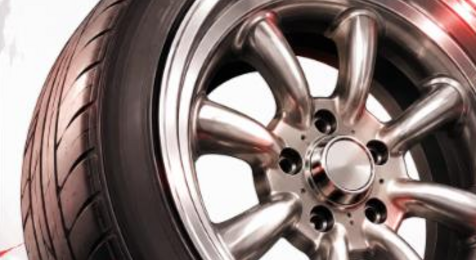
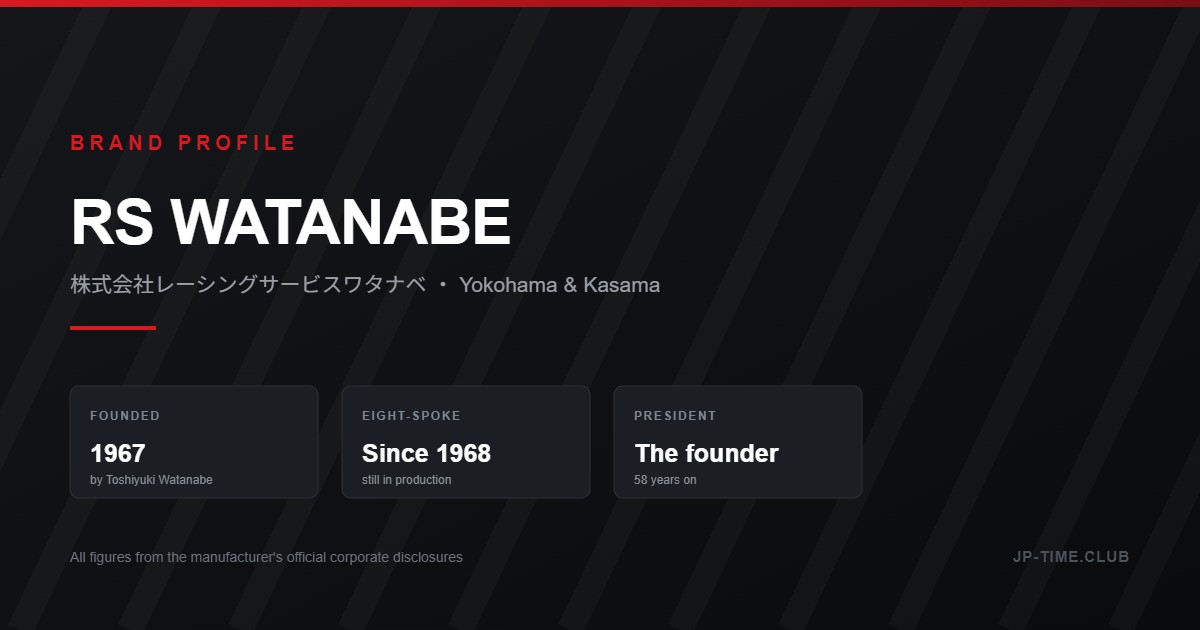
Every other brand in this series is a wheel company. RS Watanabe is a racing car constructor that has been selling the same wheel design since 1968.
Toshiyuki Watanabe founded the business in 1967 to design and build racing cars — Formula, FL, FJ-1300, F3 and FP-2000 machines that, by the company’s account, took a number of series championships and course records. The wheels came out of that. Fifty-eight years later, Watanabe is still the company’s president.
The Short Version
- Founded 1967 by Toshiyuki Watanabe, initially building racing cars.
- Incorporated 1972, becoming a joint-stock company in 1975. Casting plant built in Kasama, Ibaraki in 1984.
- The Eight-Spoke dates from 1968 and is still in the catalogue.
- Specialises in one-piece cast aluminium and magnesium wheels, made in-house end to end.
- States that its 1996 RM8 two-piece magnesium wheel was the first to pass Japan’s VIA test.
- Head office in Tsurumi, Yokohama. Founder-president plus three officers.
What the Official Record Actually Says
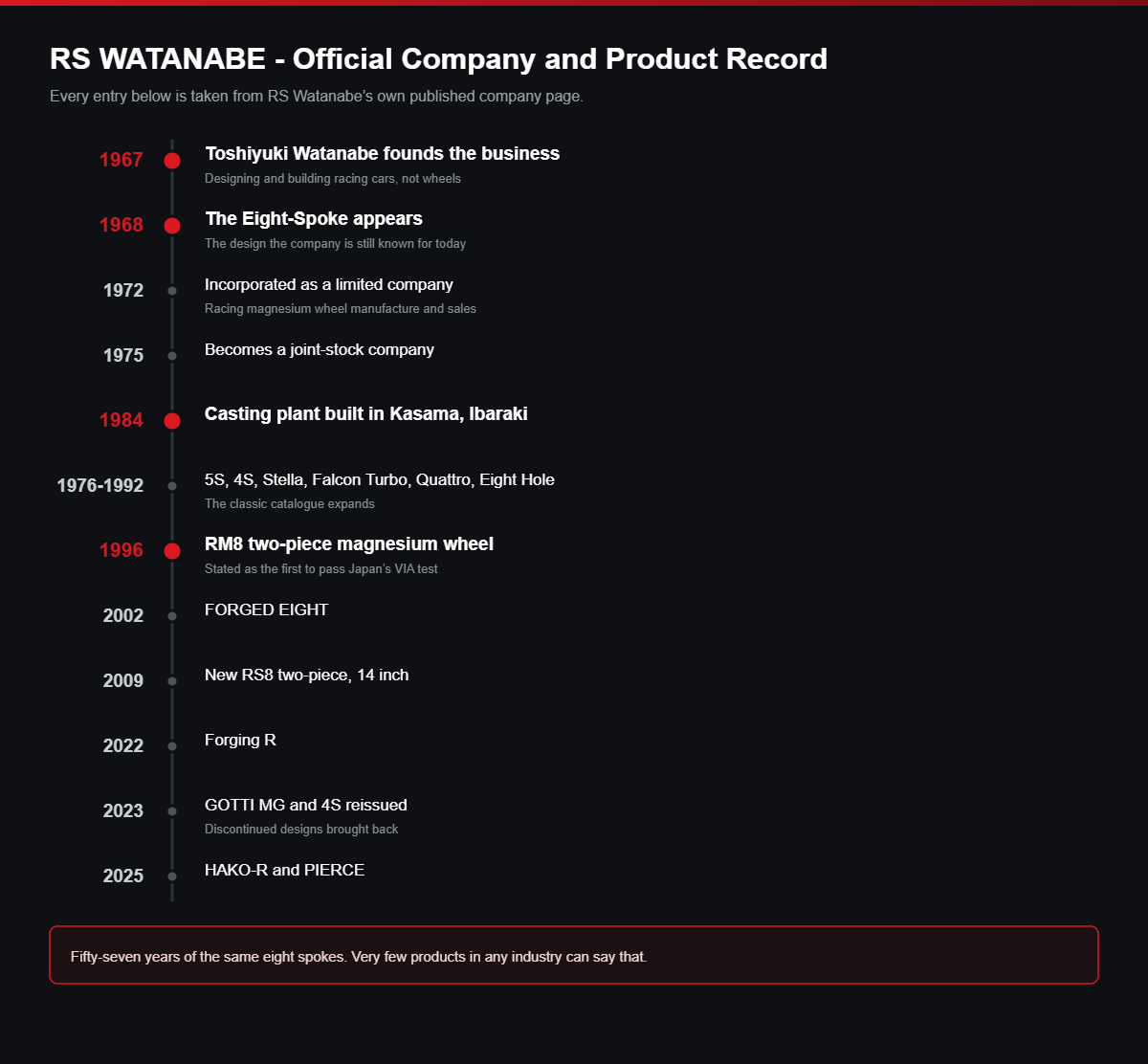
Read that list again and notice what it is not. It is not a record of factories, presses, overseas subsidiaries or funding rounds. It is a list of products, roughly one every few years, from a company that has never grown beyond a founder and three officers.
The Eight-Spoke — the kamaboko-section eight-spoke design — arrived in 1968 and never left. The company states plainly that in the Japanese wheel industry, eight spokes simply means RS Watanabe.
Magnesium, and Why It Matters
Watanabe manufactures in both aluminium and magnesium, which very few aftermarket wheel companies do at all. Magnesium is roughly a third lighter than aluminium at similar stiffness, and considerably harder to cast safely.
The company’s 1996 RM8, a two-piece magnesium wheel, is described in its own record as the first to pass Japan’s VIA test — the third-party verification standard that sits alongside JWL marking. Getting a magnesium wheel through that process is a genuine engineering credential.
If you are buying a magnesium Watanabe secondhand, treat it differently from an aluminium wheel. Magnesium is more sensitive to corrosion and to impact damage, and refinishing requires someone who has done it before.
The F3 Connection
One line in the company record connects three names in this catalogue. Watanabe states that it founded Japan’s F3 association together with Hayashi and Speed Star, and that its president is now honorary advisor to that body.
Hayashi Racing and Speed Star — the company whose SSR brand is now made by Tanabe — were not competitors in the modern sense. They were three constructors building the same category of racing car, and the wheels each is remembered for came out of that shared world.
Not Only Wheels
The stated business of the company covers four areas: racing car design and manufacture, road car parts, golf clubs, and industrial plant design and installation. The company record also mentions a cowled three-wheeled motorcycle called the Manbo and faithfully reproduced rickshaws.
This is not eccentricity for its own sake. It is what a small, highly skilled casting and fabrication shop does to stay busy across sixty years.
Reissues: An Unusual Policy
Note the 2023 entries: the GOTTI MG and the 4S were brought back into production. In 2024 and 2025 the RS8R, HAKO-R and PIERCE followed.
Most manufacturers let a discontinued design die. Watanabe reissues them — which is worth knowing if you are hunting a design you assumed was gone. It also means that for a handful of models, “vintage” and “current production” can look very similar. Check the date and the markings on the wheel rather than assuming age from the design.
What This Means When You Are Buying
1. This is a small company. A founder-president and three officers, one casting plant in Ibaraki. Production is limited by nature, and popular sizes go out of stock rather than being backfilled from a warehouse.
2. One-piece cast is the core. Unlike WORK, there is no built-to-order multi-piece system here. Sizes are what Watanabe tooled for.
3. Older Watanabes are genuinely old. An Eight-Spoke could be from 1970 or from last year. On a wheel that may be five decades old, condition assessment matters far more than model name — look at the mounting face, the spoke roots and any evidence of previous refinishing.
What We Could Not Verify
- The 1996 “first to pass VIA” claim for the RM8. It is the company’s own statement. We found no independent confirmation and no competing claim.
- Employee count, capital and revenue. None are published. The company lists a president and three officers, which suggests a small operation, but that is an inference rather than a figure.
- Exact founding month in 1967. The record gives the year only.
- Which current models are cast in magnesium versus aluminium. The company states it produces both but does not provide a per-model breakdown on the page we reviewed.
FAQ
How old is the Watanabe Eight-Spoke design?
The company’s own product record dates it to 1968. It remains in production.
Are Watanabe wheels magnesium or aluminium?
Both. The company manufactures one-piece cast aluminium and magnesium wheels in-house, and its RM8 is a two-piece magnesium design.
Where are they made?
The company’s plant is in Kasama, Ibaraki prefecture, built in 1984. The head office is in Tsurumi, Yokohama.
Is RS Watanabe still in business?
Yes. New models were released in 2024 and 2025, and the founder remains president.
Can I still buy a discontinued Watanabe design?
Sometimes. The company has reissued the GOTTI MG and 4S in recent years. Otherwise the used market is the route.
Does Watanabe make anything besides wheels?
Yes — racing cars, road car parts, golf clubs, industrial plant work, and by its own account a three-wheeled motorcycle and reproduction rickshaws.
Sources
Every figure in this article comes from RS Watanabe’s own company page at rs-watanabe.co.jp, read in the original Japanese, including its published company outline and product chronology. Where that document is silent, we have said so rather than filling the gap from secondary sources.
Related Guides
- Toyota AE86 — 4×114.3, the natural home of the Eight-Spoke
- Nissan Silvia S13 — the other great four-lug platform
- WORK Wheels — built to order, at the opposite end of the scale
- WEDS — the listed company in the same industry
- RAYS — listed by Watanabe as one of its major trading partners
Looking for a specific set? We specialise in genuine Japanese wheels — RAYS, Volk, Enkei, SSR, WORK, BBS Japan and the rare discontinued sets that never left the country. Tell us the wheel, the fitment, the year — our team searches our networks until we find it.