
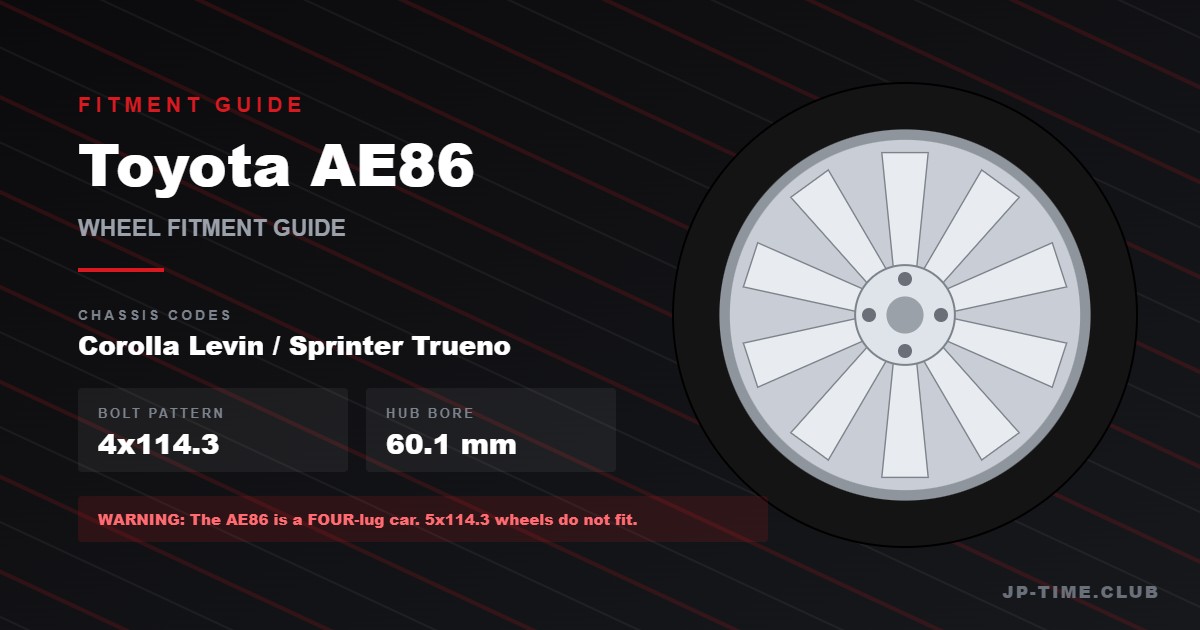
Two numbers govern every AE86 wheel purchase, and both surprise people.
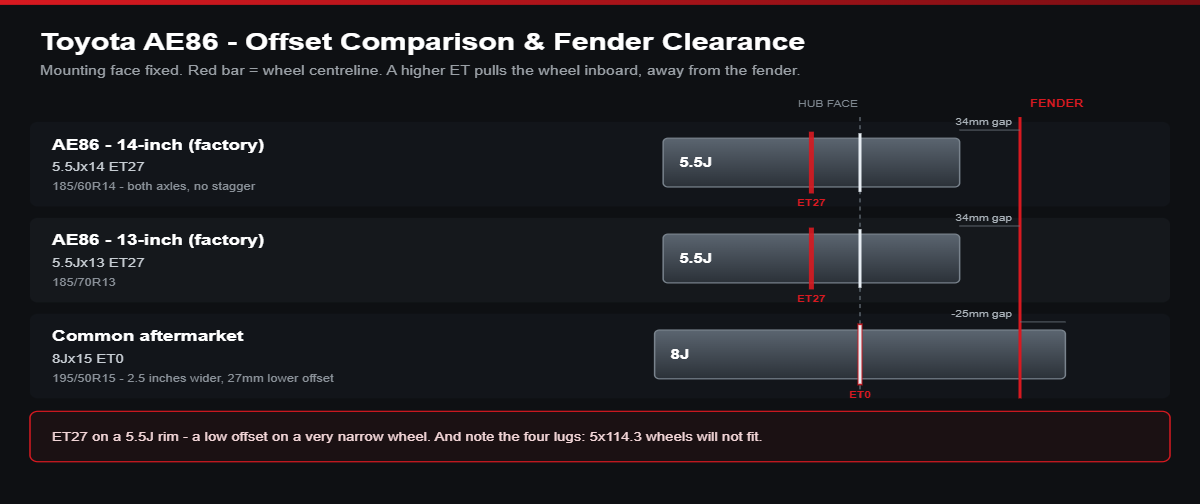
The first is four lugs. The AE86 is a 4×114.3 car — the 5×114.3 wheels that fit almost every other Toyota in this series will not go on. The second is ET27 on a 5.5-inch rim: a genuinely low offset by modern standards, on a wheel narrow enough that a modern hot hatch would be embarrassed by it.
Put together, they explain why the AE86 aftermarket looks nothing like any other Japanese platform.
Section 1: OEM Wheel Specifications
| Model | Chassis Code | Bolt Pattern | Hub Bore | Thread | OEM Wheel | OEM Tyre |
|---|---|---|---|---|---|---|
| 1.6 GT / GT-APEX | AE86 | 4×114.3 | 60.1 mm | M12x1.5 | 5.5Jx14 ET27 | 185/60R14 |
| 1.6 (13-inch) | AE86 | 4×114.3 | 60.1 mm | M12x1.5 | 5.5Jx13 ET27 | 185/70R13 |
| 1.5 (base) | AE85 | 4×114.3 | 60.1 mm | M12x1.5 | 5Jx13 ET27 | 155R13 |
The AE86 and the 1.5-litre AE85 share bolt pattern, hub bore and thread. Front and rear are identical — there is no factory stagger.
Section 2: Offset Comparison & Fender Clearance Visualization
Section 3: The Four-Lug Problem
4×114.3 is a genuinely limited pattern in the modern market. It was standard on Japanese compacts of the 1970s and 80s and then largely disappeared. What that means for an AE86 owner:
- The catalogue is small but specialised. RAYS, WORK, SSR, Watanabe, TE37V and Enkei all still produce — or have produced — 4×114.3 wheels specifically for this car and its contemporaries. These are the sets worth hunting, and they are almost exclusively a Japanese market.
- Other four-lug JDM cars share it. The S13 Silvia, the four-lug R32 and R33 Skylines, the early Civic and the Starlet are all 4×114.3. Bore differs — the S13 and four-lug Skylines are 66.1 mm, the AE86 is 60.1 mm — so Nissan four-lug wheels need no rings on an AE86, while AE86 wheels will not fit a Nissan hub. See our S13 guide and R32 guide.
- Five-lug conversions are common. Many built cars have been converted using later Toyota hubs. It opens up the entire 5×114.3 catalogue, and it is a suspension job with brake implications — not an afternoon.
A Japanese AE86 on TE37V — one of the few modern forged wheels still made in 4×114.3 for this platform. — via @@tomonari_unno
Section 4: How Far You Can Go
The factory 5.5Jx14 ET27 is a starting point that almost nobody stays at. Common AE86 fitments and what they require:
- 15×7 ET20–ET25 — the sensible upgrade. Fits standard arches at stock or mildly lowered height. 195/50R15 keeps the rolling diameter close to factory.
- 15×8 ET0–ET10 — the classic modified look. Needs a fender roll at minimum, over-fenders on most cars.
- 14×7 ET0 — the period-correct route for a car being kept faithful to the era. Watanabe RS and similar.
- 15×9 and beyond — over-fenders, full stop.
The AE86 is a small, narrow car. Every millimetre of offset you drop is immediately visible, and the arch runs out much sooner than on anything else in this series. Body work is not an escalation on this platform — it is the normal path.
Section 5: The 60.1 mm Toyota Bore
Despite the four-lug pattern, the AE86 uses Toyota’s standard 60.1 mm hub bore — the same as the Supra, MR2, Chaser and Celica. Practical notes:
- Aftermarket 4×114.3 wheels are usually bored 73 mm and supplied with 73–60.1 hub-centric rings. Fit them.
- Nissan four-lug wheels (66.1 mm) will fit an AE86 because the bore is larger than the hub — use rings.
- AE86 wheels will not fit a Nissan four-lug hub, because 60.1 mm is smaller than 66.1 mm. The error only works in one direction.
Section 6: Weight and Tyre Choice
An AE86 weighs roughly 950 kg. It is the lightest car in this series by a wide margin, and it has around 130 hp to move it. That changes the calculus completely: a heavy wheel costs you more here, proportionally, than on any other car we have covered.
It also means tyre width matters less than you might think. A 195-section tyre on a 7-inch rim is genuinely enough for the power on offer, and the car will feel sharper for it than on a 225 that adds unsprung mass and steering effort.
Look for the JWL and VIA stamps on any used Japanese wheel — particularly on 1980s-era wheels, where age and unknown history are real factors.
Related Fitment Guides
- Honda CR-X & del Sol — four lugs, light, and of the same era
- Nissan Silvia S13 — 4×114.3 with a different bore
- Toyota Celica — the Toyota that followed
- Nissan Skyline R32 — four-lug Skylines
Every guide in this series is built the same way: verified factory specifications, an offset diagram, and an honest account of what fits and what does not.
Seen on the road
Which wheels are you looking for? Tell us the wheel, the size and the fitment — send us a request and we will go and find it.
Wheel identification is taken from the hashtags the owner applied to their own post.
Buying Wheels for Your AE86
Four lugs, 60.1 mm, and be honest about your arches. The AE86 has the smallest wheel catalogue of any car in this series and the most passionate one — which is exactly why the good sets come out of Japan.
Looking for a specific set? We specialise in genuine Japanese wheels — RAYS, Volk, Enkei, SSR, WORK, BBS Japan and the rare discontinued sets that never left the country. Tell us the wheel, the fitment, the year — our team searches our networks until we find it.
Specifications in this guide reflect factory equipment for Japanese-market vehicles. Trim levels, optional wheel packages and market-specific variants can differ. Always confirm the fitment against your own car before purchase.