The Short Version
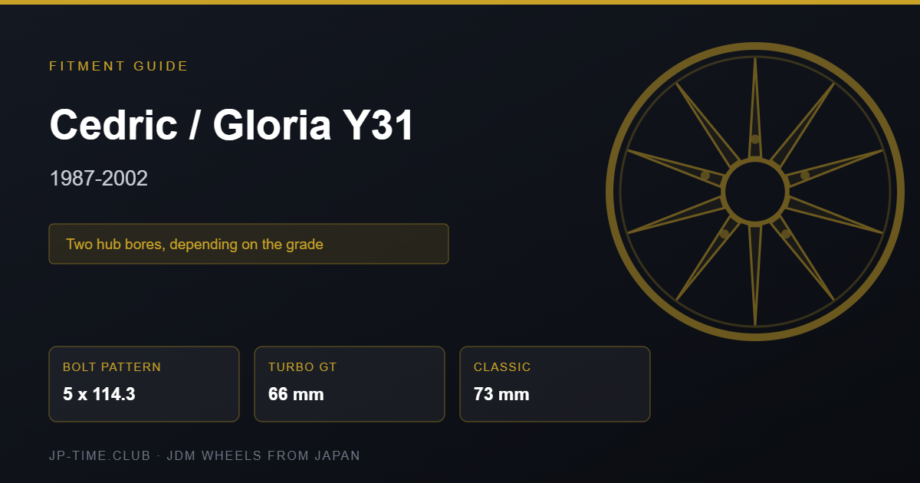
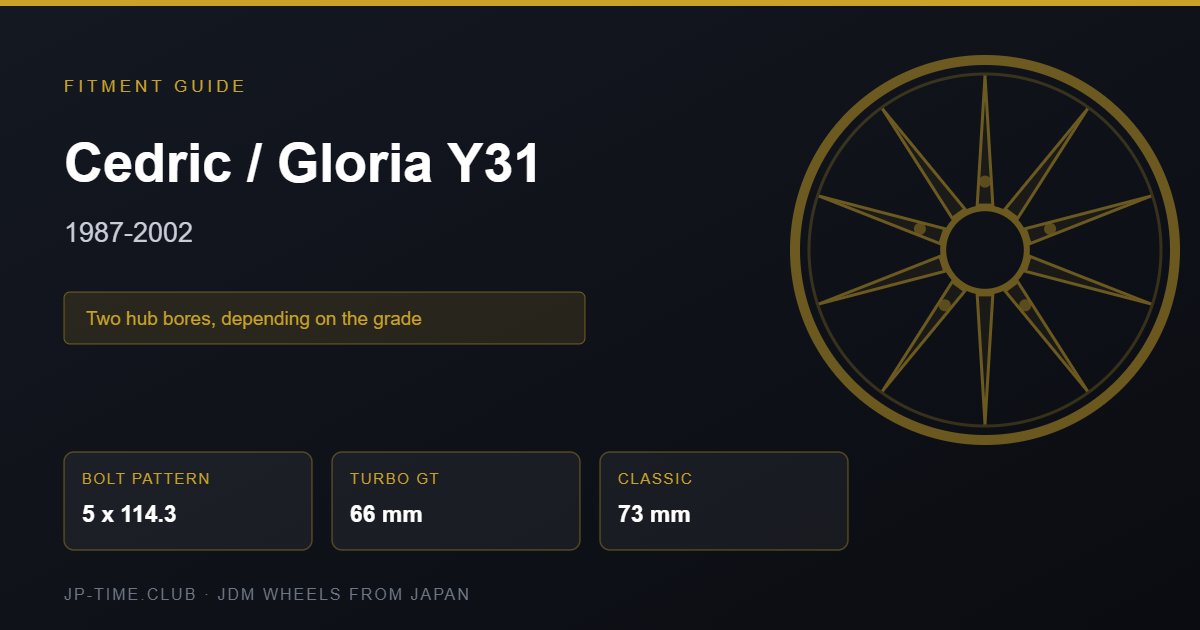
- 5×114.3 throughout. No argument there.
- The hub bore is not one number. The turbo Gran Turismo grade reads 66 mm. The naturally aspirated Classic reads 73 mm. Same model, same year range, different figure.
- RS Watanabe tells buyers to bore wheels to φ73 for a Y30 or Y31 — which matches the non-turbo cars, not the turbo.
- The very last Broughham grade reads “under investigation”, so the database itself does not know.
The Finding That Matters
We expected to publish one hub bore for the Y31 and instead found two, from the same database, on grades built in the same period.
The Gran Turismo Super SV with the RB20DET turbo reads PCD 114.3, five holes, 66 mm. The 2.0 Classic, naturally aspirated, reads PCD 114.3, five holes, 73 mm. That is a seven-millimetre difference in the register, which is far too large to be a rounding artefact.
Independently, RS Watanabe’s own matching data tells customers that a Y30 or Y31 needs its wheels bored to φ73 to fit. That instruction only makes sense against a 73 mm hub — the non-turbo figure.
Our reading is that this is a genuine grade-dependent difference, and that the turbo cars got a different hub assembly along with their different brakes. We are labelling it as a reading rather than a fact, because no source says so outright. What we can say with confidence is that you cannot buy hub rings for a Y31 on the strength of the model name. Find out which grade you have.
Factory Specification
| Grade | Chassis | Period | Wheel | Tyre | PCD / Holes / Bore |
|---|---|---|---|---|---|
| 2.0 Turbo Gran Turismo Super SV (RB20DET) | E-Y31 | 1990.10–1991.06 | 15×6J +40 | 215/60R15 | 114.3 / 5 / 66 |
| Sedan 2.0 Classic | E-Y31 | 1998.06–1999.08 | 14×5.5J +40 | 195/70R14 | 114.3 / 5 / 73 |
| Sedan 2.0 Broughham | GF-Y31 | 1999.08–2002.06 | 14×5.5J +40 | 195/70R14 | 114.3 / 5 / under investigation |
| Y32 and Y33 (for comparison) | — | — | — | — | 114.3 / 5 / not published |
Why the Y31 Ran So Long
Note the dates in that table. The Y31 was replaced by the Y32 for private buyers in 1991, but Nissan kept the Y31 body in production until 2002 for the commercial and fleet market — which in Japan means taxis and company cars.
That is why you will see Y31 Cedrics with 1999 and 2001 registration dates, and why the late cars are simple 14-inch Classic and Broughham grades rather than turbo Gran Turismos. Neither database labels these grades as fleet-spec, so we are giving you that as background rather than as sourced fact.
For a buyer it matters in one practical way: a late Y31 is a very different car from an early one, and the wheel data above suggests it may be a different hub too.
Sizing
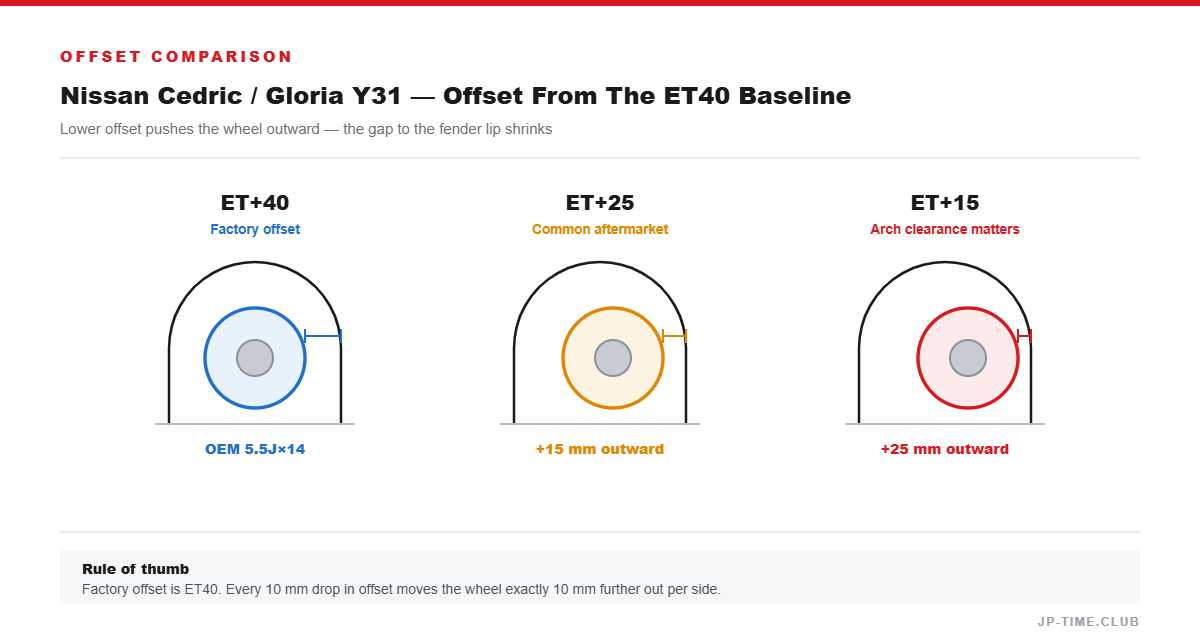
The Gran Turismo’s 15×6J at +40 is the enthusiast baseline. VIP-style builds typically go to 18 or 19 inch at +15 to +35, which is a big move outboard from +40.
Get the bore right first. If you have a turbo car at 66 mm, a wheel bored 73 mm needs a 66 mm ring. If you have a Classic at 73 mm, a wheel bored 66 mm will not physically go on. That asymmetry is why this article leads with the bore rather than the offset.
Importing
Y31 production ran from 1987 to 2002. Cars built through August 2001 are US-eligible now; the final months of Broughham production follow through to 2027. The turbo Gran Turismo grades are all comfortably eligible.
What We Could Not Verify
- Y32 and Y33 hub bore. RS Watanabe attaches no machining note to them, which suggests their stock bore already suits common wheels, but no source gives a figure.
- Y34 entirely — no wheel data found in any source we checked.
- Which specific grades were taxi or fleet specification. Neither database uses that label.
- Whether the 66 versus 73 split is genuinely turbo-versus-NA or something else. Two data points are a pattern, not a proof.