The Short Version
- 5×114.3 on both the 13B and the 20B. The engine makes no difference to the fitment.
- The chassis codes are JC3SE (13B) and JCESE (20B) — both with a trailing E that shorthand usually drops.
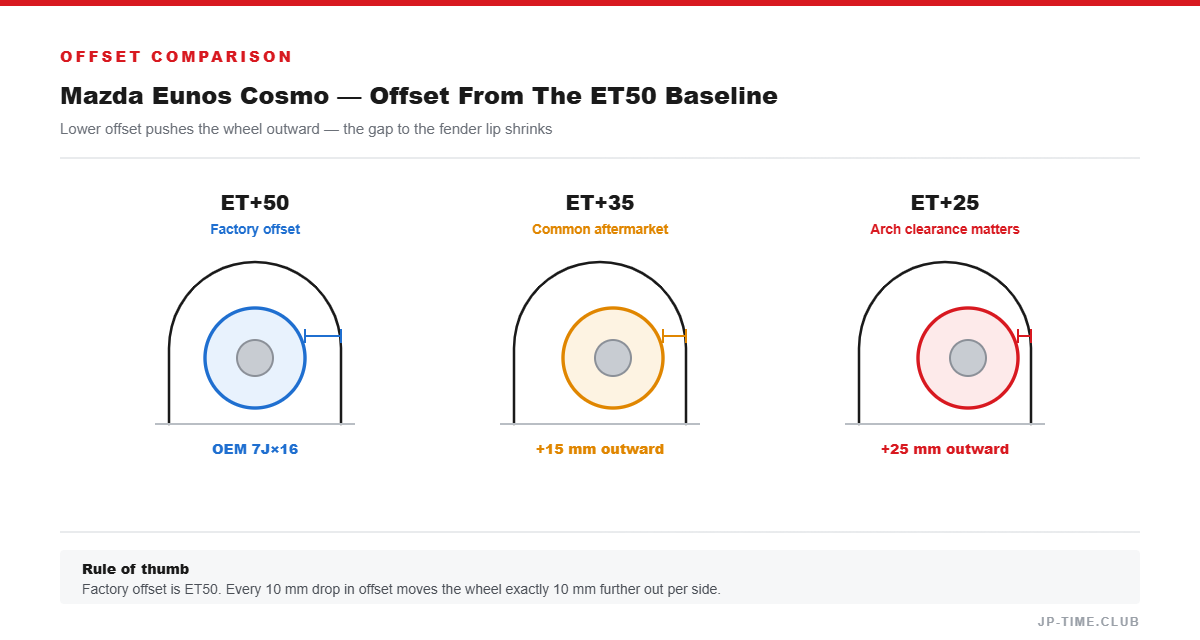
- Wheel size follows the trim, not the rotor count: Type S and SX get 16×7J +50, Type E gets 15×6J +50.
- On the hub bore, two sources say different things — and both are worth knowing.
The Hub Bore, Reported Honestly
Our own notes carried “approximately 67 mm, inferred”. We wanted that resolved and here is what resolution looks like.
The Japanese factory database says it does not know. We opened one 13B grade page and one 20B grade page and both carry the explicit 調査中 marker — under investigation — in the hub bore cell.
RS Watanabe says 67 mm. Their single Cosmo row carries the note ハブ穴φ67加工: hub hole machined to 67. That is not a factory specification either — it is a statement about their own wheel, telling you they bore it to 67 to fit this car.
Those are two different kinds of statement and we are publishing them side by side rather than merging them into a single confident number. A wheel maker machining to 67 mm is strong practical evidence that the hub is around 67 mm. It is not the factory saying so.
One ambiguity worth flagging: RS Watanabe carries only one Cosmo row, labelled JCESE — the 20B code. Whether they intend it to cover the 13B cars too is not stated. The factory database treats the two engines identically on everything else, so we would expect it to, but the page does not say.
Factory Specification
| Engine | Chassis | Grade | Wheel | Tyre | PCD / Holes / Bore |
|---|---|---|---|---|---|
| 13B twin-rotor turbo | E-JC3SE | Type S / Type SX | 16×7J +50, front and rear | 225/50R16 | 114.3 / 5 / under investigation |
| 13B | E-JC3SE | Type E | 15×6J +50 | — | 114.3 / 5 / not re-confirmed |
| 20B three-rotor twin-turbo | E-JCESE | Type S / Type SX | 16×7J +50 | — | 114.3 / 5 / not re-confirmed |
| 20B | E-JCESE | Type E / Type E CCS | 15×6J +50 | 215/60R15 | 114.3 / 5 / under investigation |
Trim Decides the Wheel, Not the Engine
This is counterintuitive and worth stating. The 20B Type E runs the same 15×6J +50 as the 13B Type E. The 13B Type S runs the same 16×7J +50 as the 20B Type S.
So the three-rotor car does not automatically get bigger wheels. If you are buying a 20B and want the 16-inch fitment, you want a Type S or SX, and the wheels from a 13B Type S are the correct part.
Note also that every grade is square — front and rear identical — on a heavy rear-drive coupe where you might expect otherwise.
Sizing
+50 on a 7J is deep for a car of this size and weight, and most Cosmos you see have moved. RS Watanabe’s own recommendation is 16×7J at +27, with a maximum of 16×8J at +30 — more than 20 mm outboard of factory.
That gives you the range. Anywhere between +27 and +50 is defensible; the factory end looks tucked and the Watanabe end fills the arch.
Importing
The Eunos Cosmo ran from March 1990 to June 1996. The whole model is past the US 25-year mark. It was never sold outside Japan, and the 20B remains the only three-rotor engine Mazda ever put in a production car — which is most of the reason anyone imports one.
What We Could Not Verify
- A factory hub bore. The database says unresearched; the 67 mm figure is a wheel maker’s machining target.
- Hub bore cells for the 13B Type E and 20B Type S grades specifically. We opened one page per engine.
- Whether RS Watanabe’s single JCESE row is intended to cover the 13B cars.
- Factory tyre size for the 15×6J trims on the 13B.