The Short Version
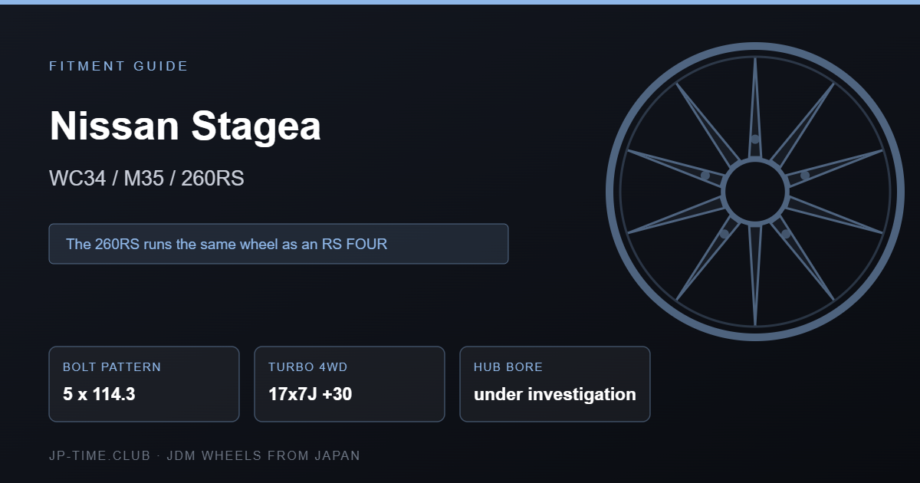
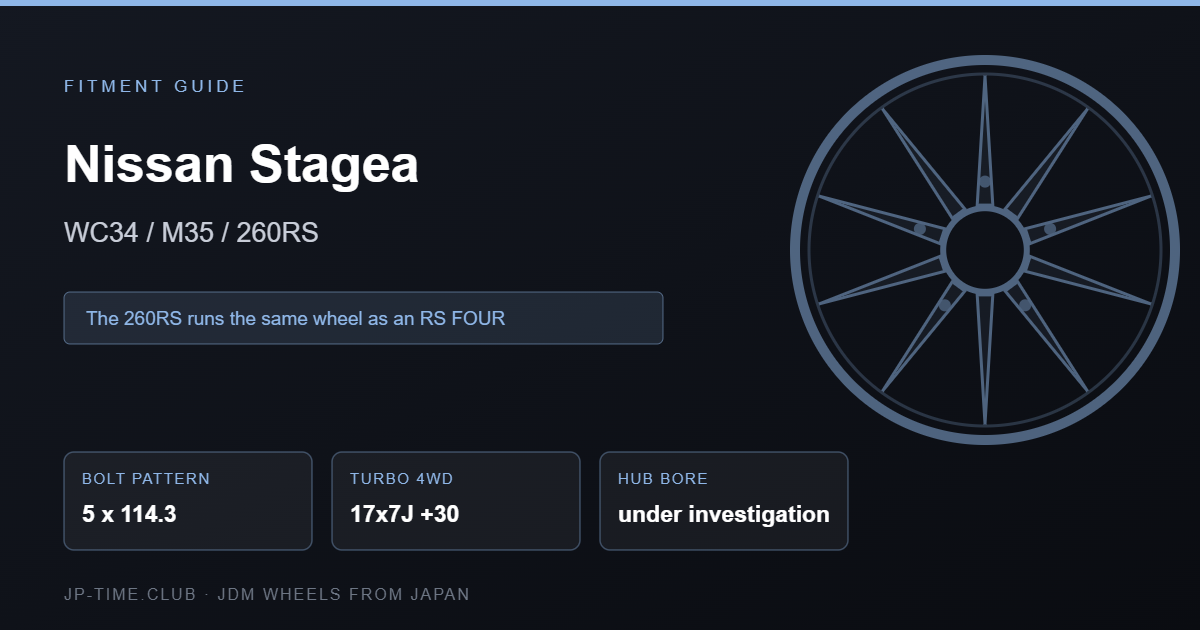
- 5×114.3 on every Stagea — WC34 and M35, two- and four-wheel drive, turbo and not.
- The 260RS uses the same wheel as an ordinary RS FOUR: 17×7J at +30. The only factory difference is a wider tyre.
- The hub bore is marked “under investigation” on both Japanese databases, for every grade including the 260RS.
- Base 2WD cars run 16 inch at +40. The turbo four-wheel-drive cars run 17 inch at +30.
The 260RS Question
The 260RS is the Autech-built Stagea with RB26DETT power and R33 GT-R running gear, and it is the grade people import. The natural assumption is that GT-R hardware means GT-R fitment.
It does not, at least not in any way the factory data shows. The 260RS reads 5×114.3 on 17×7J at +30 — identical to the ordinary 25t RS FOUR S turbo four-wheel-drive grade. Same pattern, same wheel, same offset.
The one difference we found is the tyre: the 260RS runs 225/50R17 against the RS FOUR S’s 215/50R17. Ten millimetres of section width on the same rim.
So if you are buying wheels for a 260RS, you are buying wheels for a Stagea. The GT-R connection does not change what bolts on.
Factory Specification
| Generation | Chassis | Period | Grade | Wheel | Tyre | PCD / Holes / Bore |
|---|---|---|---|---|---|---|
| WC34 | GF-WHC34 | 2000.12–2002 | 20RS, 2WD | 16×7J +40 | 205/55R16 | 114.3 / 5 / under investigation |
| WC34 | GF-WGNC34 | 2000.12–2002 | 25t RS FOUR S, 4WD turbo | 17×7J +30 | 215/50R17 | 114.3 / 5 / under investigation |
| WC34 Autech | E-WGNC34改 | 1997.08–1998.08 | 260RS, RB26DETT | 17×7J +30 | 225/50R17 | 114.3 / 5 / under investigation |
| WC34 Autech | GF-WGNC34改 | 1998.08–2000.06 | 260RS, later batch | 17×7J +30 | 225/50R17 | 114.3 / 5 / under investigation |
| M35 | GH-M35 | 2001–2007 | 250RX, 2WD | 16×6.5J +40 (17×7J +45 optional) | 205/65R16 | 114.3 / 5 / under investigation |
The Bore Nobody Publishes
Both Japanese databases print 調査中 — under investigation — in the hub bore field for every WC34 and M35 grade we checked, including the 260RS. We confirmed this on both sites independently, so it is not a rendering artefact.
A figure of 66.1 mm circulates for this era of Nissan, and it is probably right — it is the standard Nissan register on cars either side of this one. We did not verify it on a primary source, so we are not printing it.
Practically: if you are ordering hub rings for a Stagea, measure the register or ask us. It is a two-minute job and it beats guessing.
Two Wheel Families
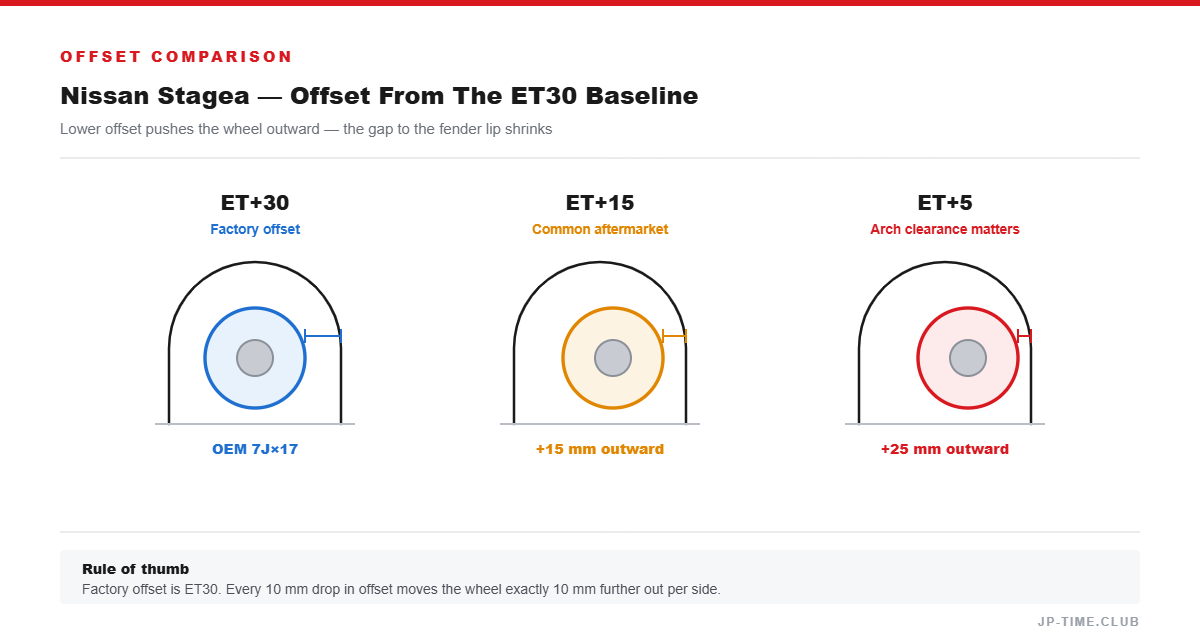
The pattern across the range is clean. Naturally aspirated two-wheel-drive cars run 16 inch at +40. Turbo four-wheel-drive cars run 17 inch at +30. That is a 10 mm offset difference and an inch of diameter.
Both bolt to either car, but a +40 wheel on an RS FOUR will tuck noticeably, and a +30 wheel on a 20RS will sit proud. Match the drivetrain, not the model name.
For aftermarket work, the RS FOUR and 260RS baseline of 17×7J +30 leaves room to go to 18×8.5J or 19×8.5J in the +20 to +35 range. This is a wagon that is often built VIP-style or as a fast estate, and the arches accommodate both.
Importing
The WC34 ran 1996–2001 and is past the US 25-year mark in full, including both 260RS production batches — the 1997–98 cars and the 1998–2000 ones. The M35 launched in 2001, so only its first months qualify now, with the rest following through to 2032.
The Stagea was never sold in North America under any name, and the 260RS in particular — an RB26 wagon — has no equivalent anywhere.
What We Could Not Verify
- Hub bore for any Stagea grade. Explicitly marked unresearched on both databases.
- The M35 350RX V6 grade, whose page we located but did not open.
- Whether the 260RS shares the R33 GT-R’s hub bore, which we could not test because neither figure is published.