The Short Version
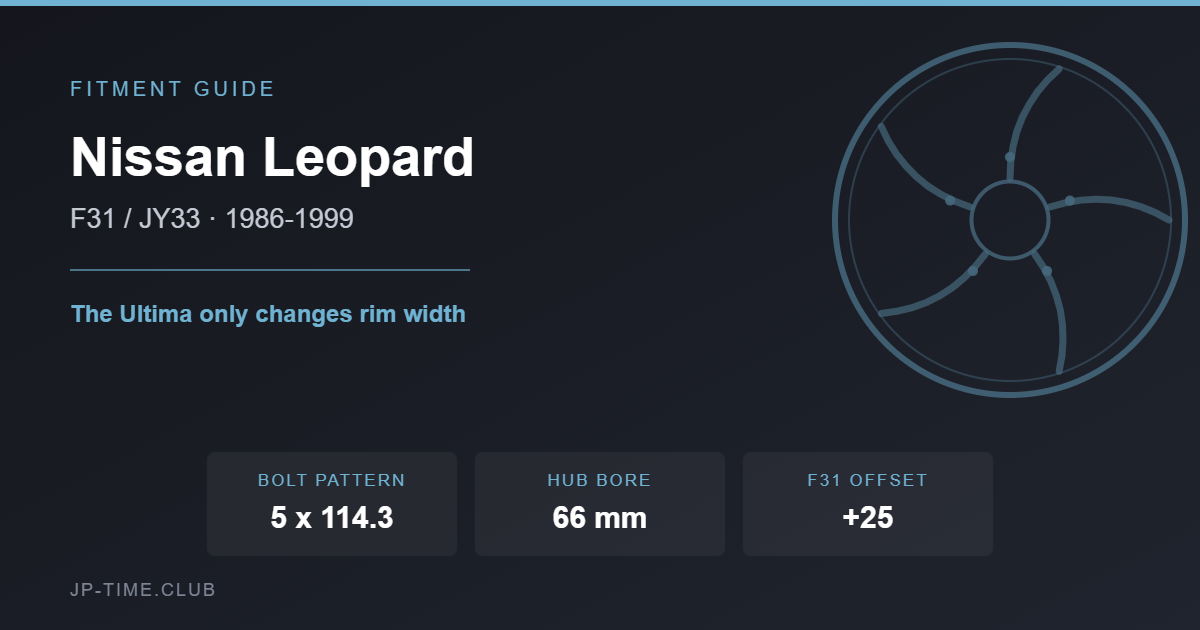
- 5×114.3 on a 66 mm bore on both the F31 and the later JY33.
- The F31 sits at +25. A low factory offset by Japanese standards, and the reason it looks right on wide wheels.
- The 3.0 Ultima only gains half an inch of rim. Same PCD, same bore, same offset.
- Nothing is staggered.
The Offset Is the Interesting Number
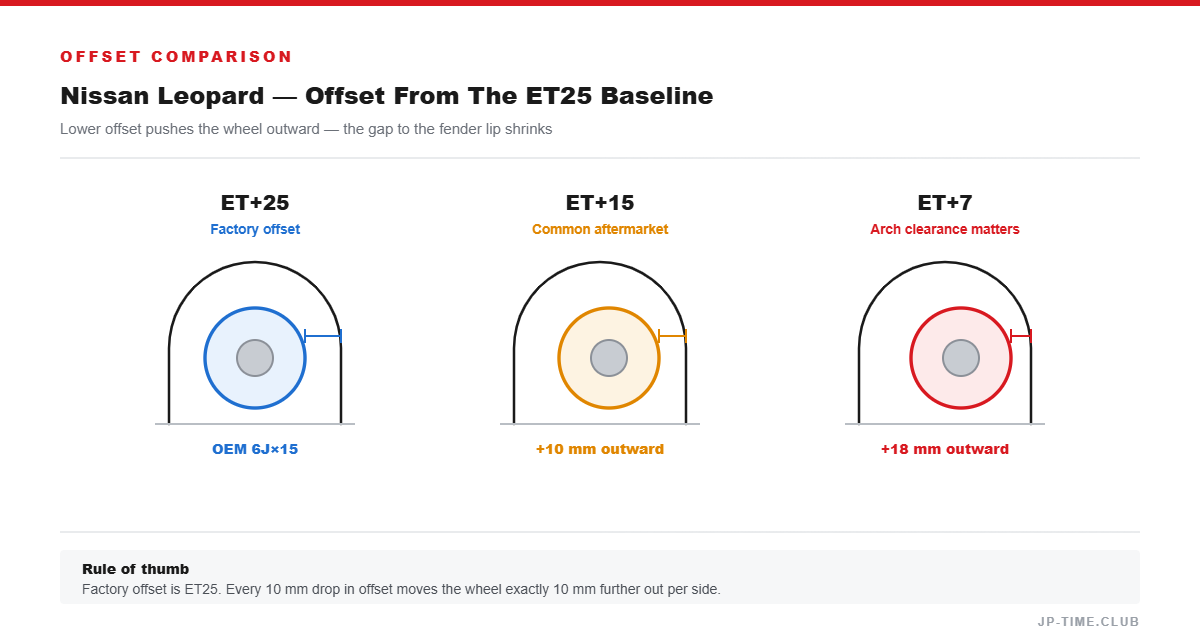
Most Japanese saloons of the late 1980s sit at +40 to +50. The F31 Leopard is at +25, and that single figure explains a great deal about why the car wears aftermarket wheels as well as it does.
Twenty-five millimetres of positive offset on a 6J or 6.5J fifteen-inch rim puts the wheel face close to the arch line from the factory. Owners moving to a 17 or 18-inch wheel are not fighting a deep-dish deficit the way they would on a Soarer Z20 at +50.
Factory Specification
| Chassis | Period shown | Grade | Wheel | Tyre | PCD / Holes / Bore |
|---|---|---|---|---|---|
| E-GF31 | 1988.08–1992.08 | 2.0 XJ (V20E) | 6J×15 +25 | 205/60R15 | 114.3 / 5 / 66 |
| E-GF31 | 1988.08–1992.08 | 2.0 XS V20 Twin Cam Turbo | 6J×15 +25 | 205/60R15 | 114.3 / 5 / 66 |
| E-GF31 | 1988.08–1992.08 | 3.0 Ultima V30 Twin Cam | 6.5J×15 +25 | 215/60R15 | 114.3 / 5 / 66 |
| E-GF31 | 1988.08–1992.08 | 3.0 Ultima V30 Twin Cam Turbo | 6.5J×15 +25 | 215/60R15 | 114.3 / 5 / 66 |
| E-JY33 and variants | 1996.03–1999.06 | XJ 2.0 / 2.5 / XJ FOUR, XV, XV-G, XR 3.0, XV Grand Sport | 7J×16 +40 | 215/55R16 | 114.3 / 5 / 66 |
The Ultima Is Not a Different Car Underneath
The 3.0 Ultima, with the VG30DE or the turbocharged VG30DET, is the grade everybody wants. Its fitment differs from the 2.0 XJ family car by exactly half an inch of rim width — 6.5J instead of 6J — and ten millimetres of tyre section.
Same bolt pattern, same bore, same +25 offset. So Ultima wheels fit an XJ and XJ wheels fit an Ultima, and neither is worth paying a premium for on fitment grounds.
The JY33 Went Conventional
The 1996 JY33 Leopard — effectively a Cedric/Gloria derivative rather than a Z-platform car — keeps 5×114.3 / 66 mm but moves to 7J×16 at +40, uniformly across every grade including the 2.5 four-wheel-drive XJ FOUR and the XV Grand Sport.
That is fifteen millimetres more offset than the F31. JY33 wheels on an F31 will tuck noticeably; F31 wheels on a JY33 will stand proud. Both bolt up.
Sizing an F31
The Leopard shares its 66 mm bore with almost every rear-drive Nissan of the era — the Cefiro A31, the C33 Laurel, the Z32 — so the wheel pool is enormous.
Given the +25 starting point, a common target is 17×8J to 17×9J in the +15 to +30 range. Going below about +10 starts to need arch work. Going above +40 will look like you fitted wheels off a different car, because you did.
Importing
The F31 ran from 1986 and is entirely eligible. North America received a version of it as the Infiniti M30, so parts knowledge exists there, but the JDM car has grades the M30 never got — particularly the V20 twin-cam turbo and the full Ultima range.
The JY33 was never exported and becomes eligible on a rolling basis from 2021 onward, so most of it is available now.
What We Could Not Verify
- 1986 and 1987 F31 data. The database’s F31 section begins at 1988.08, despite production starting in 1986. We cannot confirm the earliest cars match.
- Whether the JDM figures differ from the US-market Infiniti M30. We read the Japanese data only.