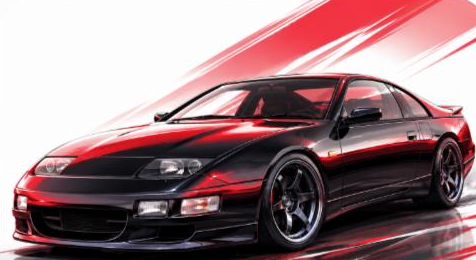
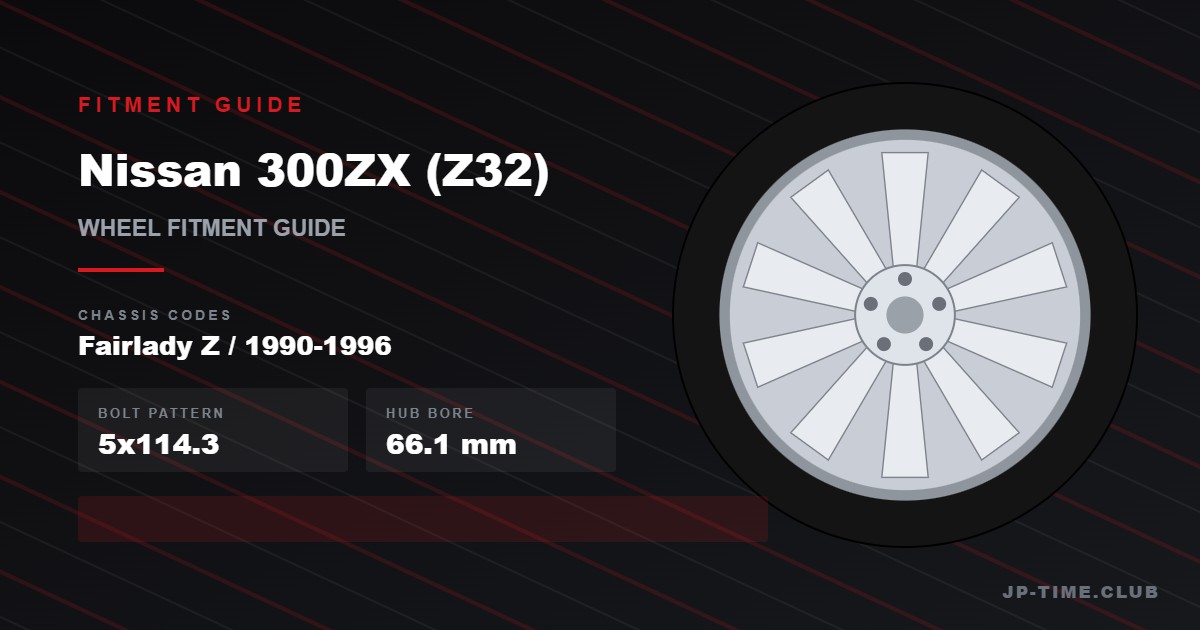
The Z32 300ZX is one of the few Japanese cars of its era that left the factory with a genuinely staggered wheel setup — and the difference between the two versions Nissan sold is bigger than most owners realise.
A naturally aspirated Z32 runs a square 7.5JJx16 ET45 at all four corners. A Twin Turbo runs the same wheel at the front and an 8.5JJx16 ET35 at the rear. That is one inch more rim and ten millimetres less offset — roughly 23 mm further outboard on the rear axle.
Buy a set of “genuine Z32 wheels” without asking which car they came off, and you can easily end up with four fronts.
Section 1: OEM Wheel Specifications
| Model | Bolt Pattern | Hub Bore | Thread | Front Wheel | Rear Wheel | Tyres (F / R) |
|---|---|---|---|---|---|---|
| 3.0 Naturally Aspirated | 5×114.3 | 66.1 mm | M12x1.25 | 7.5JJx16 ET45 | 7.5JJx16 ET45 | 225/50R16 / 225/50R16 |
| 3.0 Twin Turbo (MT) | 5×114.3 | 66.1 mm | M12x1.25 | 7.5JJx16 ET45 | 8.5JJx16 ET35 | 225/50R16 / 245/45R16 |
| 3.0 Twin Turbo (AT) | 5×114.3 | 66.1 mm | M12x1.25 | 7.5JJx16 ET45 | 8.5JJx16 ET35 | 225/50R16 / 245/45R16 |
Bolt pattern, hub bore and thread size are identical across the entire Z32 range. Only the rear wheel differs, and only on the Twin Turbo.
Section 2: Offset Comparison & Fender Clearance Visualization
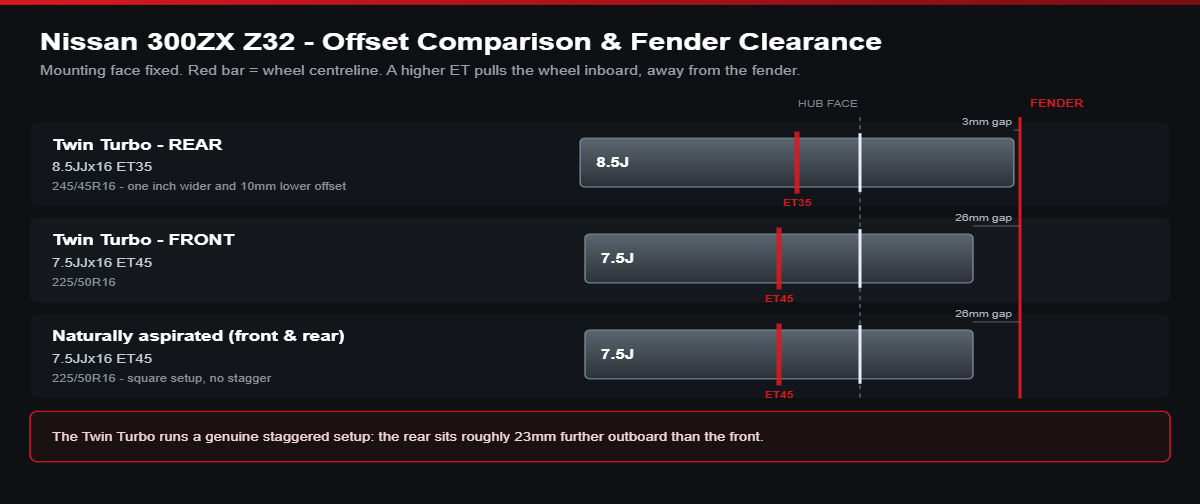
Section 3: Rear-Out Stagger — and Why It Matters When You Buy
Across this series we have catalogued three factory approaches to staggering. The Z32 belongs to the first, and it is the most aggressive expression of it on a Japanese car of the period:
- Rear-out — wider rear rim and lower rear offset. Z32 Twin Turbo, BMW E46 M3, E90 M3, GT-R R35, Porsche Cayman.
- Rear-in — wider rear rim but higher rear offset, keeping the wheel tucked. BMW F80 M3, Mercedes-AMG C63, Porsche 911.
- Width only — same offset front and rear, different widths, or no stagger at all. BMW E36 M3, G80 M3, Toyota MR2 SW20, RX-7 FD, and the naturally aspirated Z32.
The practical point for a buyer: on a rear-out car, a front wheel fitted to the rear will look visibly sunken and will change the rear track by nearly 50 mm across the axle. It is not a cosmetic detail.
A Japanese-market Z32 on deep-lip multi-piece wheels — the classic way to exploit the rear arch this car was designed with. — via @@nagashion
Section 4: The 66.1 mm Hub Bore
The Z32 uses Nissan’s standard 5×114.3 / 66.1 mm / M12x1.25 combination, shared with the S14, S15, R32 GT-R, R33, R34 and 350Z. In practice that means:
- Skyline GT-R wheels fit. An R33 or R34 GT-R 9J ET30 will bolt straight on and is a popular period-correct upgrade. See our R34 guide.
- Silvia wheels fit, though at ET40–45 they sit conservatively on a car this wide. See our S15 guide.
- Toyota wheels (60.1 mm) do not fit at all. Same bolt pattern, hub too large for the wheel.
- Evo and RX-7 FD wheels (67.1 mm) bolt on but sit 1 mm loose — use hub-centric rings.
Section 5: Popular Aftermarket Sizes
The Z32 is a wide car with generous arches, and it responds well to a substantial jump in wheel size:
- 18×9 ET30 front / 18×10 ET25 rear — the classic modern Z32 fitment. 235/40R18 and 275/35R18. Fills the arches without body work on most cars at stock ride height.
- 18×9.5 ET22 front / 18×10.5 ET15 rear — aggressive street setup. Fender roll and camber expected, particularly at the rear.
- 17×8.5 ET30 / 17×9.5 ET22 — keeping a smaller diameter for tyre budget and sidewall. A sensible choice on a car that rides on a 30-year-old suspension design.
- 16-inch — only on the naturally aspirated car. The Twin Turbo’s four-piston front calipers need 17 inches as a practical minimum.
Brake clearance is the constraint that catches Twin Turbo owners. The factory 16-inch wheel clears the turbo car’s brakes because it was designed around them; most aftermarket 16s were not.
Section 6: Weight
A Twin Turbo Z32 weighs around 1,560 kg — heavy for its era and heavy for a two-seat sports car. Combined with 300 hp and four-wheel steering on HICAS cars, that puts real load through the wheel.
Check for the JWL and VIA stamps on any used Japanese wheel before you buy. Both marks together indicate a wheel built and independently verified to Japan’s light-alloy standard — and on a car this heavy, that is worth more than the styling.
Related Fitment Guides
- Nissan 350Z — the successor
- Nissan 370Z — and the generation after that
- Nissan Skyline R33 — the same 66.1 mm bore
- Nissan Z (RZ34) — fifty years, same studs
Every guide in this series is built the same way: verified factory specifications, an offset diagram, and an honest account of what fits and what does not.
Seen on the road
Which wheels are you looking for? Tell us the wheel, the size and the fitment — send us a request and we will go and find it.
Wheel identification is taken from the hashtags the owner applied to their own post.
Buying Wheels for Your Z32
Ask two questions before anything else: naturally aspirated or Twin Turbo, and are these fronts or rears? Then diameter, width, offset and bore. The Z32 is a rewarding car to fit wheels to precisely because the factory got the proportions right — the aftermarket only has to respect them.
Looking for a specific set? We specialise in genuine Japanese wheels — RAYS, Volk, Enkei, SSR, WORK, BBS Japan and the rare discontinued sets that never left the country. Tell us the wheel, the fitment, the year — our team searches our networks until we find it.
Specifications in this guide reflect factory equipment for Japanese-market vehicles. Trim levels, optional wheel packages and market-specific variants can differ. Always confirm the fitment against your own car before purchase.