
What This Page Is
We were asked for Isuzu Gemini fitment data. We could not find any, and rather than quietly dropping the vehicle from our list we are publishing the negative result, because it is genuinely useful to know where the data ends.
Neither Database Covers Isuzu
Every fitment figure on this site comes from the two Japanese factory wheel databases. They are the sources the Japanese trade uses, and between them they cover the domestic market thoroughly.
We checked both manufacturer indexes in full:
- One lists Lexus, Toyota, Nissan, Honda, Mitsubishi, Mazda, Daihatsu, Subaru, Suzuki, BMW, Audi and Volvo.
- The other lists Lexus, Toyota, Nissan, Honda, Mitsubishi, Mazda, Daihatsu, Subaru and Suzuki.
Isuzu appears on neither. Not in the current-model section, not in the discontinued-model section. This is not a case of us failing to find the right page. Isuzu passenger cars are simply not in the data set.
What We Are Not Going to Do
There are plenty of places that will give you a number for a Gemini. Fitment calculators, aggregator sites, search-engine summaries — all of them will confidently produce a PCD and a hub bore.
We are not going to repeat those figures, for a specific reason. Over this series we have caught those sources being wrong repeatedly, on cars where we could check: a wrong PCD for one Nissan, an invented bore for another, and the ubiquitous 64.1 mm attached to cars nobody has ever measured. When we can verify, we frequently find them wrong. When we cannot verify, there is no reason to think they are suddenly right.
An unverified number on a wheel purchase is worse than no number, because it stops you checking.
What You Should Do Instead
The Gemini is not a difficult car to measure. You need a caliper or a steel rule and about ten minutes.
- Count the studs. Four or five.
- Measure the bolt circle. On a four-stud pattern, measure centre-to-centre between two studs directly opposite each other — that is your PCD. On a five-stud pattern, measure from the centre of one stud to the outer edge of the hole two positions away, which approximates the circle closely enough to distinguish 100 from 114.3.
- Measure the hub register — the raised machined circle at the centre of the hub that the wheel sits on. That diameter is your bore.
- Measure the factory wheel’s offset if you still have one.
Our hub bore reference goes through this in more detail, with the common failure modes.
Why the Gap Exists
Isuzu withdrew from the Japanese passenger-car market in 1993, and the last Gemini — by then a rebadged Honda Domani — ended in 2000. The company has been commercial vehicles and diesel engines ever since.
The wheel databases are maintained commercially, and the commercial case for cataloguing a passenger-car line that ended a generation ago, from a manufacturer that no longer makes passenger cars, is thin. That is not a criticism. It does mean that Isuzu owners are on their own in a way that Toyota and Nissan owners are not.
The same is true of a handful of other vehicles we have hit — the original Daihatsu Rocky F300, for example, which is absent from both databases despite Daihatsu being well covered otherwise.
What We Do Know, and Where From
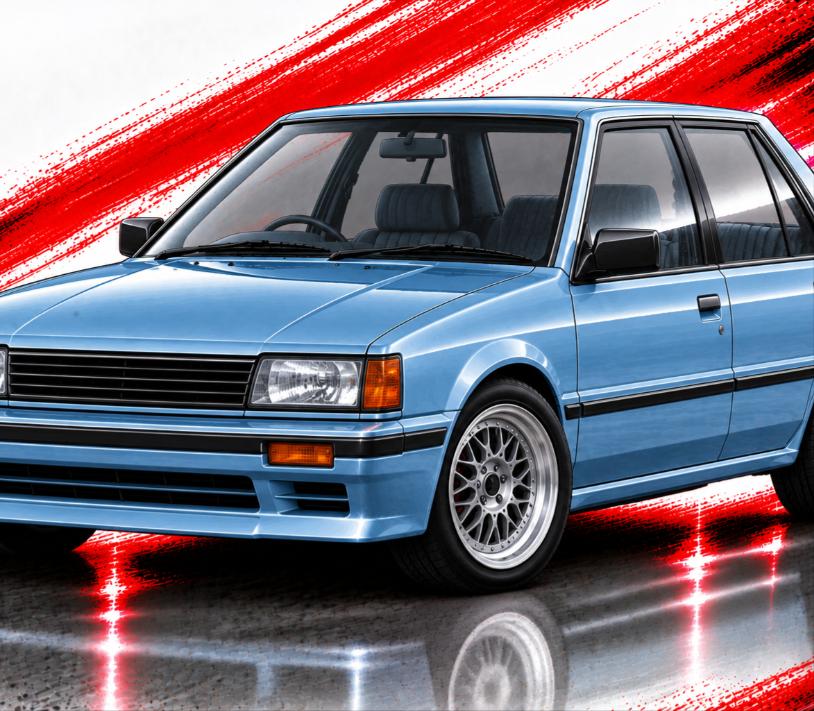
We can tell you what the Gemini is, since none of this depends on the wheel databases. The JT150 generation from 1985 was Isuzu’s front-drive compact, engineered alongside General Motors’ T-body programme, which is why relatives of it were sold in North America under Geo and Isuzu badges. The Irmscher and ZZ grades were the sporting versions, the latter associated with chassis work by Lotus during the period Lotus was GM-owned.
We are not going to convert any of that into a bolt pattern. Platform sharing is not fitment sharing — we have documented too many cases where badge-engineered twins diverge, and where the same chassis code carries two different bolt patterns, to make that leap.
If You Have the Data
If you own a Gemini and you measure it, we would like to hear the figures, and we will publish them with credit and with a note saying they came from an owner rather than a factory table. That is a weaker source than we normally use, and we would label it that way — but it is a great deal better than nothing, which is where this page currently stands.
What We Could Not Verify
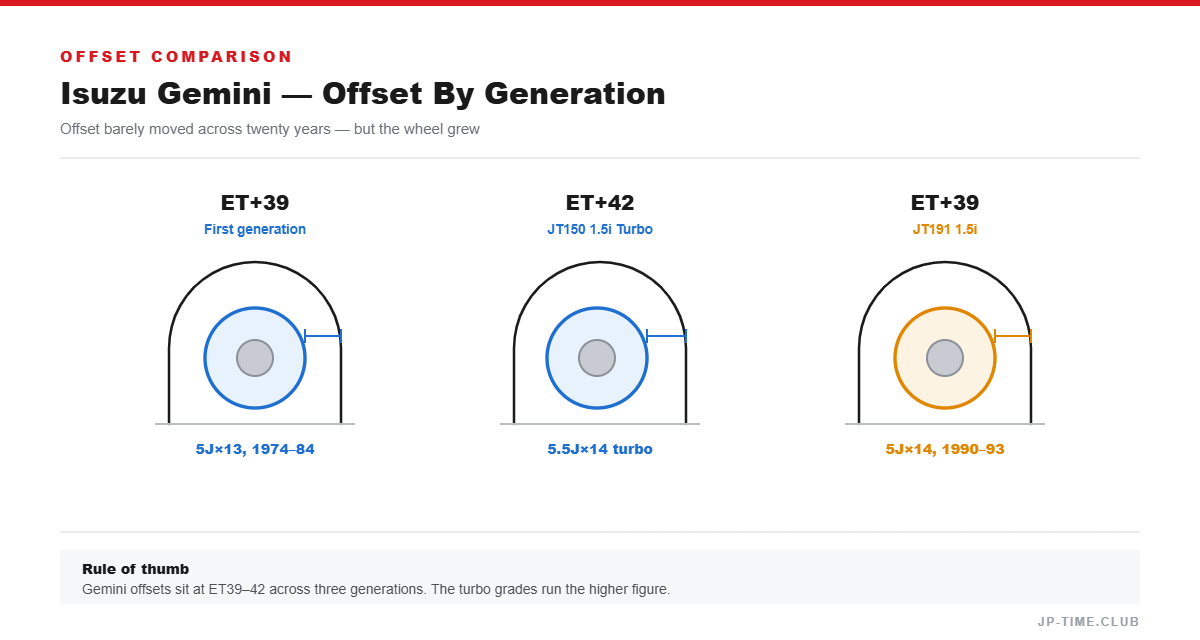
- Everything. Bolt pattern, hole count, hub bore, wheel size, offset and tyre size, for the JT150, JT190, JT641 and the later Gemini, including the Irmscher and ZZ grades.