The Short Version
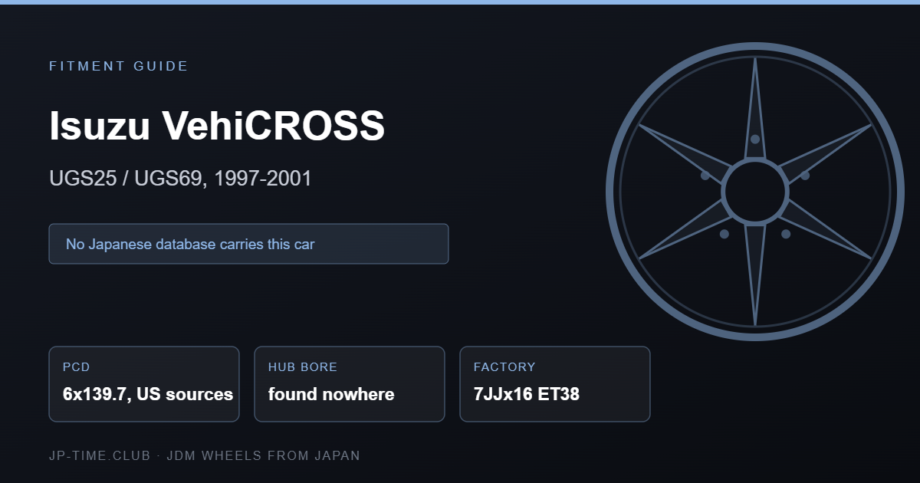
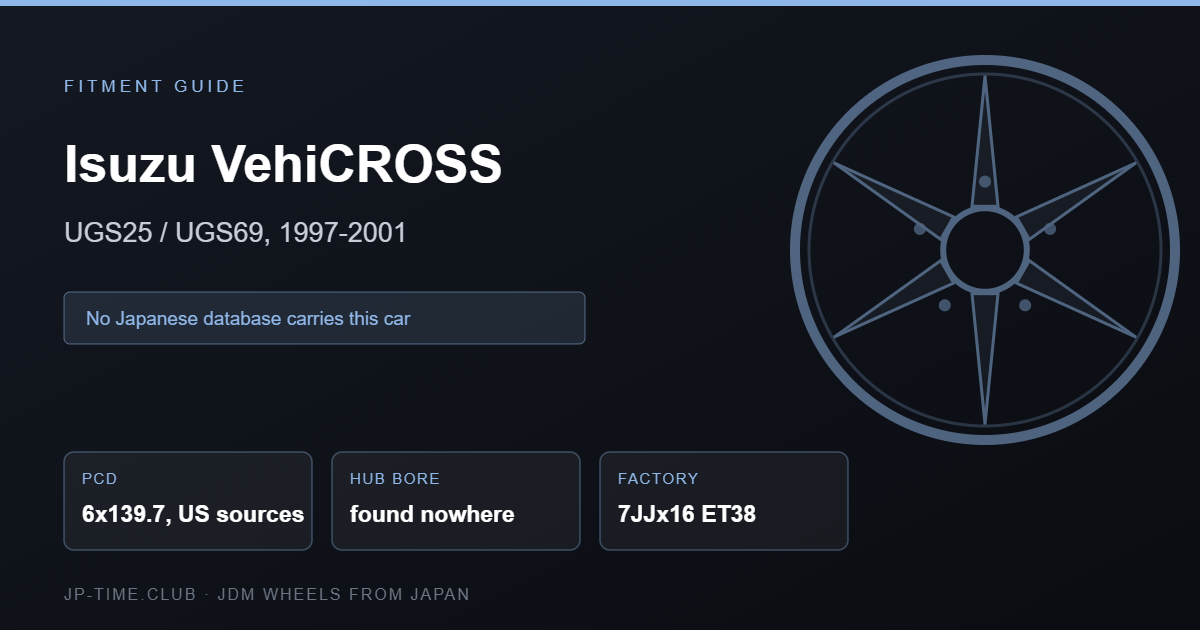
- No Japanese factory database carries the VehiCROSS. Not one. We checked all three.
- Even the crowd-sourced international database leaves the bolt pattern and centre bore fields blank for all three trims.
- The 6×139.7 figure comes entirely from US aftermarket sources — but it converges with what we know about the platform.
- No hub bore exists anywhere. Not a number, not even an “under investigation” marker, because the car is not in the databases to have one.
A Car That Fell Through Every Database
This is the thinnest sourcing situation we have published, and we are being upfront about it because a VehiCROSS is a heavy body-on-frame vehicle where getting the wheel wrong is not cosmetic.
Here is what we actually found:
- RS Watanabe’s Isuzu matching page — last updated in 2014, the stalest of all their manufacturer pages — lists the 117 Coupé, the Gemini, the Piazza, the Aska, the Bellett and the Mu. No VehiCROSS. No Bighorn either.
- The Japanese factory wheel database covers Isuzu only patchily. We found the Bighorn filed, oddly, under Subaru; there is no VehiCROSS entry at all.
- The international crowd-sourced fitment database does have a VehiCROSS page — and leaves both the bolt pattern and the centre bore fields completely empty for the JDM UGS25DW, the limited edition and the US 3.5i. Only tyre, rim and offset are populated.
So the 6×139.7 figure that circulates comes from US aftermarket wheel retailers. That is not nothing — several independent retailers agree, and they sell wheels against it — but it is not a factory citation.
Why We Still Think 6×139.7 Is Right
Convergence rather than citation. The VehiCROSS is built on a shortened Bighorn chassis, and we have the Bighorn confirmed at 6×139.7 from a Japanese factory table. The Isuzu Mu is confirmed at 6×139.7 by RS Watanabe. US retailers independently give the VehiCROSS the same figure.
Three lines of evidence pointing the same way is reasonably solid. It is still not a factory specification, and we are labelling it as such.
What the Sources Do Give
| Market | Chassis | Years | Wheel | Tyre | PCD / Bore |
|---|---|---|---|---|---|
| JDM | E-UGS25DW | 1997–2000 | 7JJ×16, ET38 | 245/70R16 | 6×139.7 (US sources) / no bore anywhere |
| JDM Limited Edition | GF-UGS25DW | 1999 | 7JJ×17 ET38, 7.5JJ×18 ET33 | 245/65R17, 245/60R18 | as above |
| US | — | 1999–2001 | ET38 | 245/70R16, 245/60R18 | 6×139.7 (US aftermarket consensus) |
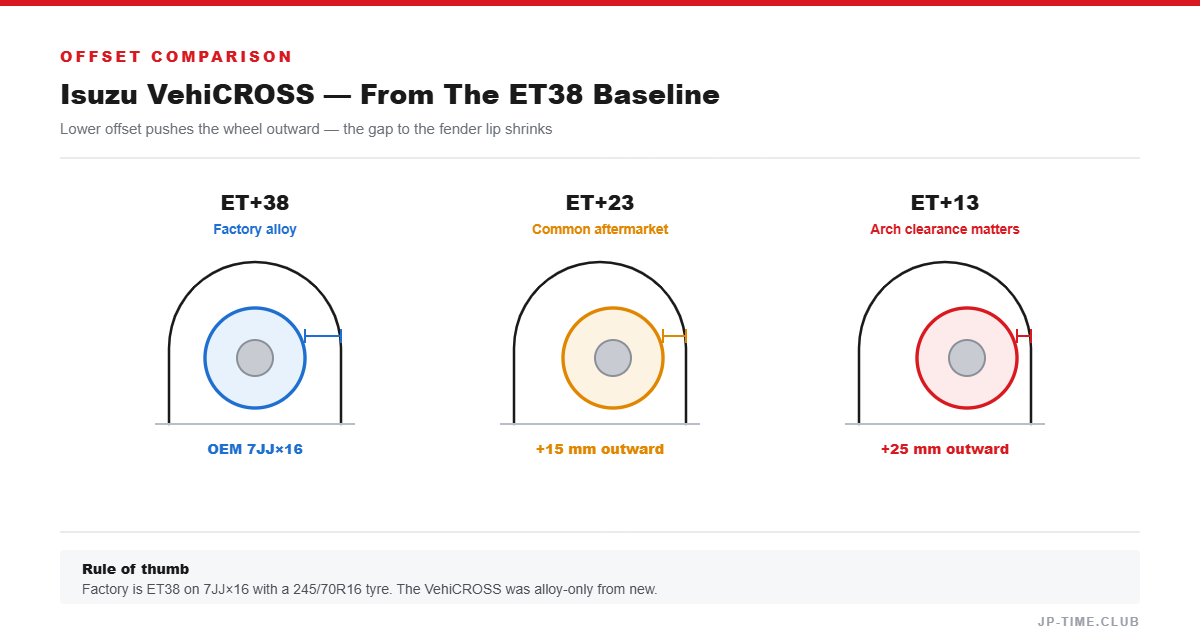
The 18-inch Limited Edition at ET33 is worth noting — it sits five millimetres further out than the standard car, which on a vehicle with these arches is visible.
What to Do
Count the studs and measure the register. On a VehiCROSS that is not a fallback, it is the primary method, because there is no published figure to check against.
The good news is that the VehiCROSS was sold new in the United States from 1999 to 2001, so a US owner can measure a local car easily. Send us the numbers and we will publish them with credit — this is a guide that genuinely wants filling in.
Importing
JDM production ran 1997–2000, so the whole run is past the US 25-year mark. But the US had the car locally, so importing a JDM one is a choice about specification rather than availability. The 3.2-litre JDM cars and the 1999 Limited Edition are the ones worth the trouble.
What We Could Not Verify
- Bolt pattern from any Japanese primary source. The car is not tabulated in any of them.
- Hub bore, from any source in any market. Not a figure, not a marker, nothing.
- Whether the JDM and US cars share a wheel specification beyond the shared offset figure.