
The Short Version
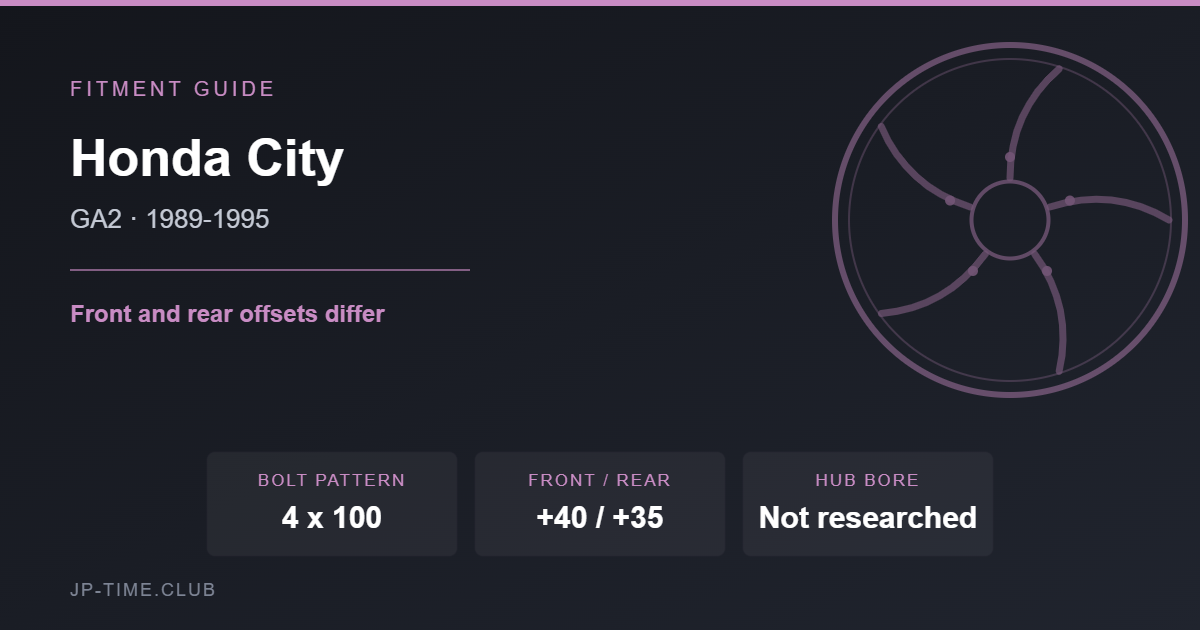
- 4×100 on 4J×13. Small wheels on a small car.
- Front and rear offsets differ: +40 or +45 front, +35 rear. On identical wheel dimensions.
- The hub bore has never been researched.
- The 1981–1986 first-generation City and the Turbo II are not in the database at all.
A Staggered Offset With Nothing Else Staggered
We keep a reference on Japanese cars that are staggered from the factory, and it needs a new category for this one.
The GA2 City runs 4J×13 at both ends. Same diameter, same width, same tyre — 165/65R13 all round. And the offset differs front to rear on every single grade:
| Grades | Front | Rear | Difference |
|---|---|---|---|
| CE, Fit, CE Fit | 4J×13 +40 | 4J×13 +35 | 5 mm |
| CR-i, CZ-i, Select | 4J×13 +45 | 4J×13 +35 | 10 mm |
This is the quietest kind of staggered fitment there is. Nothing about the wheel tells you — not the diameter, not the width, not the tyre. Only the stamped offset does, and on a 13-inch steel wheel most people never look.
The practical consequence is that a set of four City wheels is not four identical wheels. Rotating them front-to-back changes the track. It is five to ten millimetres per corner, which on a car this small and light is not nothing.
If you are buying a used set, check that you are getting two of each. If you are buying aftermarket, you are choosing a single offset and accepting that one axle will not be where Honda put it — splitting the difference at around +38 is the pragmatic answer.
Factory Specification
| Chassis | Period | Grades | Wheel F / R | Tyre | PCD / Holes / Bore |
|---|---|---|---|---|---|
| E-GA2 | 1989.02–1995.12 | CE, Fit, CE Fit | 4J×13 +40 / +35 | 165/65R13 | 100 / 4 / Not researched |
| E-GA2 | 1989.02–1995.12 | CR-i, CZ-i, Select | 4J×13 +45 / +35 | 165/65R13 | 100 / 4 / Not researched |
The Half of the Car That Is Missing
We have to be straight about this, because the City that people actually want is the one we cannot document.
The first-generation City (AA/VF, 1981–1986) — the tall boxy one, the one with the Turbo and the flared-arch Turbo II “Bulldog”, the one that came with a Motocompo folding scooter in the boot — does not appear in either Japanese factory wheel database. Not as a blank row, not marked unresearched. The model is absent.
We searched both sites for the AA and VF chassis codes, for GA1, and for turbo grades. Zero matches on both.
So we cannot tell you the Bulldog’s bolt pattern, bore or offset, and we are not going to infer it from the GA2 — the two cars are five years and one complete redesign apart, and we have been burned by that kind of inference before. If you own one, measure it. Our hub bore reference covers the method, and we would genuinely like to hear the figures.
And No Bore for the Car We Do Have
On the GA2 the bore cell is empty on every row, and the individual grade page confirms 調査中 — under investigation.
Honda’s small-car figure is 56.1 mm and that is what a City almost certainly uses. But “almost certainly” is how wrong numbers propagate, so we are not printing it as fact. Measure the hub; it takes two minutes.
Buying
4×100 is one of the most common patterns in existence, so wheels are not the problem — 13-inch wheels are. The size has largely left the aftermarket, and what remains is period Japanese stock, which is exactly right for this car and getting scarce.
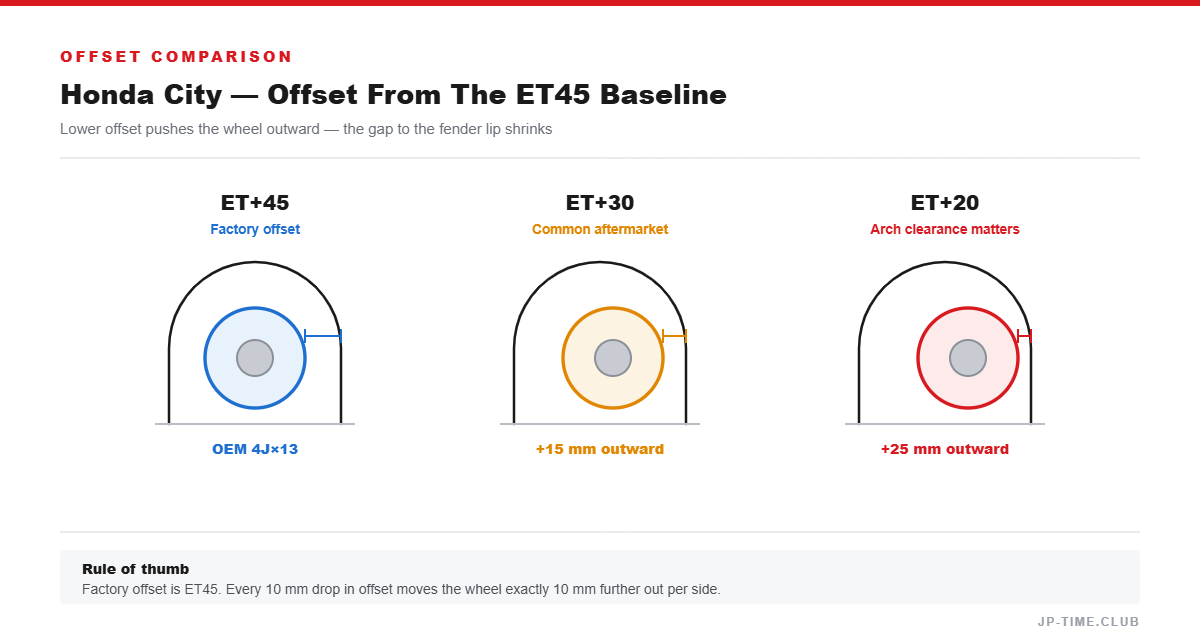
Going to 14 inch opens the selection considerably. Watch the offset: most 14-inch 4×100 wheels are made in the +35 to +45 band, which suits, but the City has almost no arch clearance and very little suspension travel to spare.
Check the bore against whatever you measure. 4×100 wheels are bored 54.1 for Toyota, 56.1 for Honda and 59.1 for Nissan, and a Toyota-bored wheel will not go on a Honda hub.
Importing
The GA2 ran to December 1995 and the whole generation is now eligible for US import. The first-generation City and the Turbo II are long past 25 years and are the ones with real collector interest.
Neither generation was sold in North America. The GA2 reached some export markets, but not as a City.
What We Could Not Verify
- The entire first-generation City (AA/VF, 1981–1986), including the Turbo and Turbo II Bulldog. Absent from both databases.
- Any GA1 chassis data. Also absent.
- Hub bore for the GA2. Marked unresearched.
- Whether the front-rear offset split reflects genuinely different left and right hardware or a difference in how the front and rear axles are specified. The figures are unambiguous; the engineering reason is not stated.