
Why This Page Exists
A set of four matching wheels looks like the default. On a surprising number of Japanese cars it is wrong — the factory fitted something different at the back, and buying four identical wheels means the car no longer has the setup its engineers specified.
This page collects every staggered factory fitment we have verified, and sorts them by how they are staggered, because that turns out to matter.
Staggered by Width
The common case. Same diameter, wider at the rear.
| Car | Front | Rear |
|---|---|---|
| Chaser JZX90 Tourer V | 16×6.5J +50 | 16×7.5J +55 |
| Crown Athlete V | 16×6.5J +50 | 16×7.5J +50 |
| Verossa VR25 | 17×7J +50 | 17×7.5J +50 |
| Fairlady Z33 base | 18×8J +30 | 18×8.5J +33 |
| KPGC110 Kenmeri GT-R | 14×8J −6 | 14×8.5J −13 |
| Fairlady Z S30 | A14-70 (+3) | B14-75 (+1.5) |
Note the Supra A80 RZ too, at 17×8J front and 17×9.5J rear — an inch and a half of difference.
Staggered by Diameter
Rarer, and it means a set is genuinely four different wheels rather than two pairs.
- Honda Beat — 13×4.5J +35 front, 14×5J +45 rear. A mid-engined kei car, and the most extreme example on this page relative to its size.
- Toyota MR-S, from the August 2000 update — 15×6J front, 16×7J rear. The earlier cars are 15 inch at both ends but still staggered by width.
- Z33 Version Nismo — 18×8J front, 19×8.5J rear.
Staggered by Offset, Dramatically
The one that catches people who only check the size.
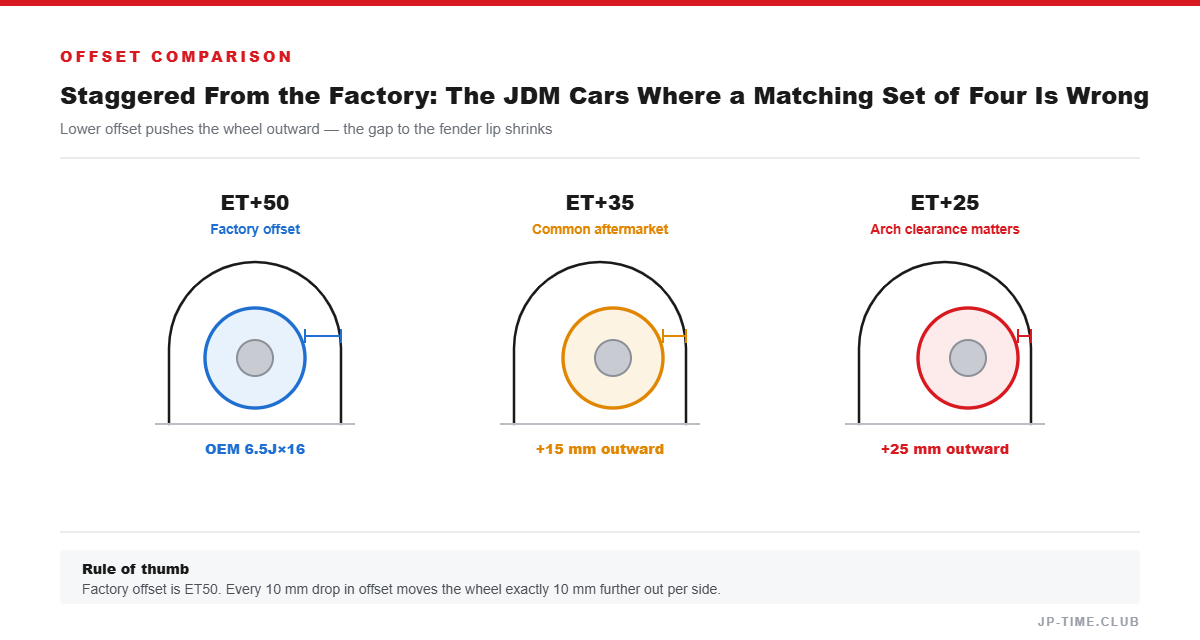
The Z34 base grade runs 18×8J at +43 front and 18×9J at +15 rear. Twenty-eight millimetres of offset difference between the axles, on the base car.
The Z34 Version NISMO goes further: 19×9.5J at +40 front, 19×10.5J at +23 rear.
If you buy a square set at the front figure, the rear will sit nearly three centimetres further in than the car was designed for.
Staggered by Tyre Only
Our favourite category, because nothing about the wheel tells you.
- Mazda Bongo Friendee — the same 15×6J at +40 all round, with 195/70R15 front and 215/65R15 rear.
- Altezza Gita wagon — the same 17×7J at +50, with 215/45R17 front and 225/45R17 rear.
- Mitsubishi GTO — the opposite case, and worth including for contrast: a wide, heavy, four-wheel-drive turbo car that everyone assumes is staggered and is not. Same wheel and same tyre at both ends.
On the tyre-only cars, a previous owner putting four matching tyres on is invisible until you look at the sidewalls.
The One That Changed Partway Through
The RX-7 FD3S deserves its own note. It was square on 8J at both ends throughout its 16-inch life — Type X, Type R, Type RB, Bathurst, all of them.
Staggered fitment arrives with the Type RS-R in October 1997: 8J front and 8.5J rear on 17-inch, carrying through the Type RS, Type RZ and all three Spirit R trims to the end of production.
So “is an FD staggered” has two answers, and the grade decides.
How to Use This
- Establish the grade before you buy a set. On several cars here — the Chaser, the FD3S, the Z33 — the base grade is square and the top grade is not.
- Check the tyre sizes, not just the wheels, on vans and wagons.
- If you are buying four matching wheels for a staggered car deliberately, that is a legitimate choice — plenty of people do it for tyre-cost reasons. Just make it knowingly, and understand you are changing the balance the car was set up with.
- On mid-engined cars, keep the stagger. The Beat and the MR-S carry real weight bias and the factory setup is not decorative.