
The Short Version
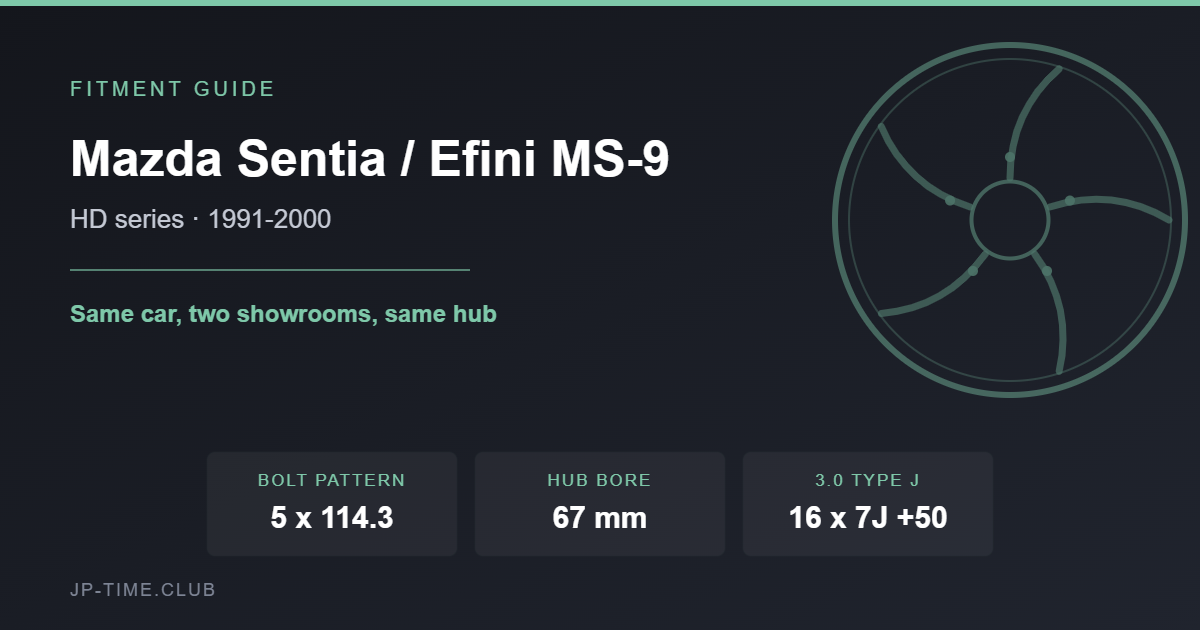
- 5×114.3 on a 67 mm bore — published, not unresearched.
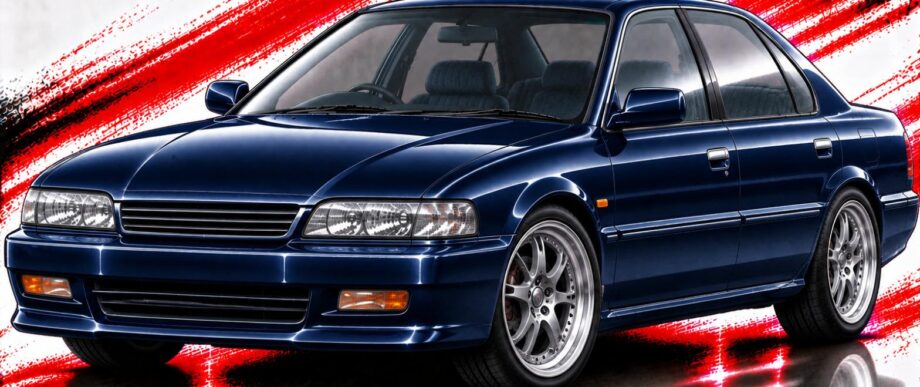
- Sentia and Efini MS-9 are the same car, sold simultaneously through two dealer channels.
- The 3.0 V6 Type J gets 16×7J against 15×6J on the 2.5.
- The “Luce” in the database is a different, older car. Do not read across.
Two Badges, Sold at the Same Time
The usual assumption is that Mazda renamed the Luce as the Sentia and then again as the Efini MS-9. That is not what happened.
The Sentia and the Efini MS-9 share chassis codes — E-HD5S, HD5P, HDEP, HDES — and their production windows overlap. The MS-9 rows are dated 1993.06 to 1994.06, sitting inside the Sentia’s 1991-onward range. They were sold concurrently through the Mazda and Efini dealer channels, in the way Japanese manufacturers did constantly in that period.
Both pages give identical figures: 114.3 mm, 5 holes, 67 mm bore. So an MS-9 wheel is a Sentia wheel.
Factory Specification
| Badge | Chassis | Period | Grade | Wheel | Tyre | PCD / Holes / Bore |
|---|---|---|---|---|---|---|
| Sentia | E-HD5S | 1991.05–1992.08 | 2.5 Limited | 15×6J +50 | — | 114.3 / 5 / 67 |
| Sentia | E-HD5P | 1994.01–1995.11 | 2.5 Type J | 15×6J +50 | 205/65R15 | 114.3 / 5 / 67 |
| Sentia | E-HDEP | 1994.01–1995.11 | 3.0 Type J | 16×7J +50 | 215/55R16 | 114.3 / 5 / 67 |
| Sentia | E-HDES | — | 3.0 Type J-X | 16×7J +50 | — | 114.3 / 5 / 67 |
| Sentia | GF-HEEA, HEEP | later | 3.0 Limited, Limited G, Exclusive (incl. 4WS) | 15×6J +50 | — | 114.3 / 5 / 67 |
| Efini MS-9 | E-HD5S, HDES | 1993.06–1994.06 | 2.5 Type SE / II / III, 3.0 Type J / III | 15×6J +50 | 205/65R15 | 114.3 / 5 / 67 |
The Bore Is Actually There
Worth noting after a run of vehicles where it is not. The Sentia and MS-9 pages give a real 67 mm, not a blank and not 調査中.
67 mm is the Mazda large-car standard, shared with the RX-7 FD3S, the RX-8, the Capella and the Eunos Cosmo. So the whole large-Mazda wheel pool is open to you, and a Cosmo wheel — which is a very handsome thing — will bolt straight to a Sentia.
It is not Nissan’s 66 or Toyota’s 60. A 66 mm-bored wheel will not pass over a 67 mm hub; a 67 mm wheel on a 66 mm Nissan hub will fit loosely, which is the dangerous direction.
The 3.0 Gets a Real Upgrade
The V6 3.0 Type J and Type J-X step to 16×7J at +50 on 215/55R16, against 15×6J on 205/65R15 for the 2.5. A full inch of diameter and a full inch of width.
Nothing is staggered — we checked all 36 Sentia rows and all 11 MS-9 rows, and every one is square front to rear.
The Luce Trap
A naming warning, because it will cost you money if you get it wrong.
The database has a Luce page, and it is not this car. It covers the earlier HC-series Luce — chassis E-HC3S, HCEP, HCFS, HCSS, with rows dated 1989 to 1990 — including the 13B rotary turbo and V6 turbo grades. That is the 1986–1991 predecessor, a different vehicle on a different platform.
Its bore shows as blank, so even if you wanted to read across, there is nothing to read. If you are shopping for an HD-series big Mazda saloon, the pages you want are Sentia and Efini MS-9.
Importing
The Sentia launched in May 1991 and the MS-9 in 1993; both are past 25 years in full. Neither was sold in North America — the closest was the Mazda 929, which shared the platform but not the JDM grades.
The 3.0 Type J and the 4WS-equipped Exclusive are the interesting ones. These are large, comfortable, unusual cars that almost nobody imports, which is part of the appeal.
What We Could Not Verify
- Whether the MS-9 was ever offered with the 16×7J Type J wheel. It does not appear in the eleven catalogued MS-9 rows, but eleven rows is thin coverage and the grade name exists on that page.
- Hub bore for the older HC-series Luce. Blank on its page, and out of scope here.
- Tyre sizes for several Sentia grades, left blank.