
The Short Version
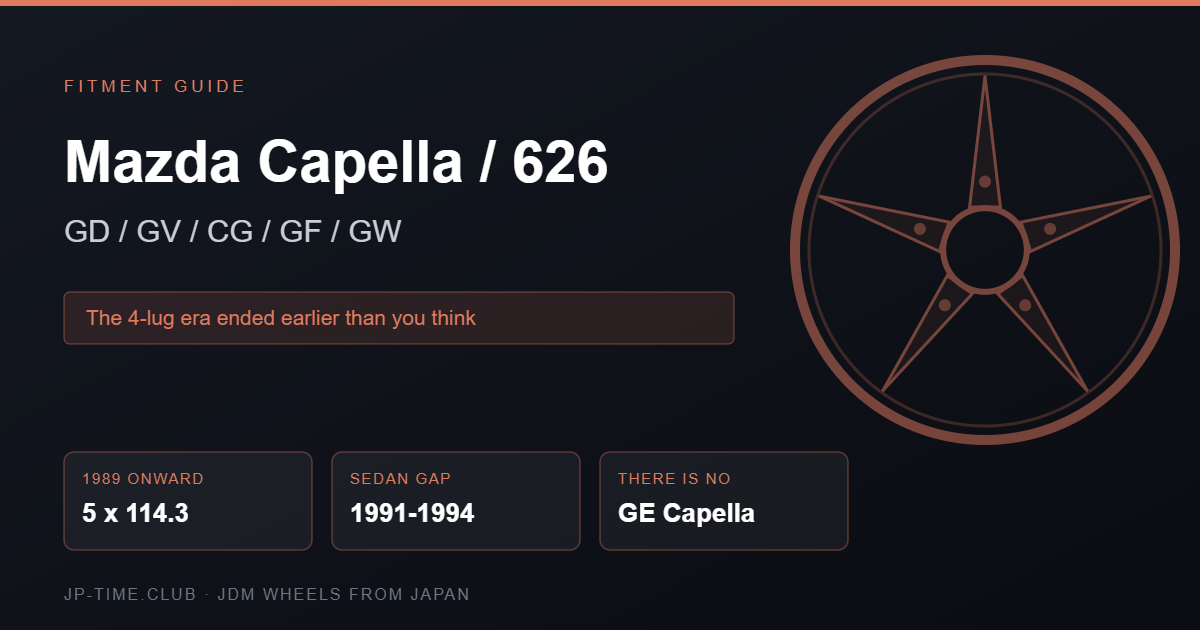
- Every Capella grade in the Japanese factory tables is 5×114.3. That is true from the earliest record the database holds, June 1989, right through to the end of production in 2002.
- There is no 1997 bolt-pattern change. That claim circulates widely and it is wrong.
- The four-lug Capella is real, but it belongs to the early 1980s — and the Japanese tables do not reach back that far, so we will not print a number for it.
- The hub bore is not published for the Capella at any point. The field is blank on every grade, every generation.
- There is no GE-chassis Capella. GE belongs to a different family of cars. Details below, because this trips people up constantly.
The Changeover Everybody Puts in the Wrong Decade
Ask around and you will be told the Capella went to five studs in 1997, when the GF arrived. We went to check that and found the opposite: the Japanese factory database’s earliest Capella record is June 1989, and it already shows 5×114.3, five holes. So does every record after it — the GD sedan, the GV wagon and cargo, the mid-1990s CG-platform sedan, the GF sedan and the GW wagon. Every grade. No exceptions.
The four-lug Capella did exist. It belongs to the rear-drive cars of the 1970s and early 1980s and to the GC generation that followed the switch to front-wheel drive in September 1982. Aggregator databases list those as 4×110 and then 4×114.3, and that is probably right — but the Japanese factory tables we rely on do not go back that far, and we are not going to launder someone else’s aggregate into a specification. If your Capella is older than 1987, measure it.
What we can tell you with confidence is where the boundary is not. It is not 1997.
Factory Specification
| Body / generation | Chassis | Period | Wheel | Bolt pattern | Bore |
|---|---|---|---|---|---|
| Sedan / hatch, 5th gen | GD | 1987.05–1991.10 (data from 1989.06) | 4.5J–6J × 13–15, +22 to +50 | 5×114.3 | not published |
| Wagon / Cargo | GV | 1989.06–1994.10 | 5.5J–6J × 14–15, +42 to +50 | 5×114.3 | not published |
| Sedan, 6th gen (CG platform) | CG (E-CG2PP / SP / SR) | 1994.08–1997.08 | 5.5J×14 +45 base, 6J×15 +50 on 2.0 and 4WD | 5×114.3 | not published |
| Wagon | GV / GW | 1994.10–1997.10 | 6J×15 +50 | 5×114.3 | not published |
| Sedan, 7th gen | GF | 1997.08–2002.02 | 5.5J×14 +45 base, 6J×15 +50 on 2.0 and 4WD | 5×114.3 | not published |
| Wagon, 7th gen | GW | 1997.11–2002.04 | 6J×15 +50, 6J×16 +50 on Sport and V-RX | 5×114.3 | not published |
There Is No GE Capella
This one causes more wasted searching than anything else about the car. GE is not a Capella chassis code. It belongs to the Cronos family — the Cronos itself, the Eunos 300, the Efini MS-6, the MX-6 and the Ford Probe.
What actually happened is that the Capella sedan went away. From October 1991 to August 1994 there was no Capella sedan at all; only the GV-chassis wagon and cargo continued. When the sedan returned in August 1994 it used a narrowed version of the GE architecture, filing under its own CG codes to stay inside Japan’s 5-number registration class. Related, but not the same car and not the same code.
So if you are cross-shopping wheels between an MX-6 and a Capella: the bolt pattern matches at 5×114.3, and the MX-6’s 67 mm bore is confirmed in the same database. The Capella’s is not. Matching PCD is not the same as matching hub, so measure before you assume the two swap.
Offsets, and the Wide Spread on the GD
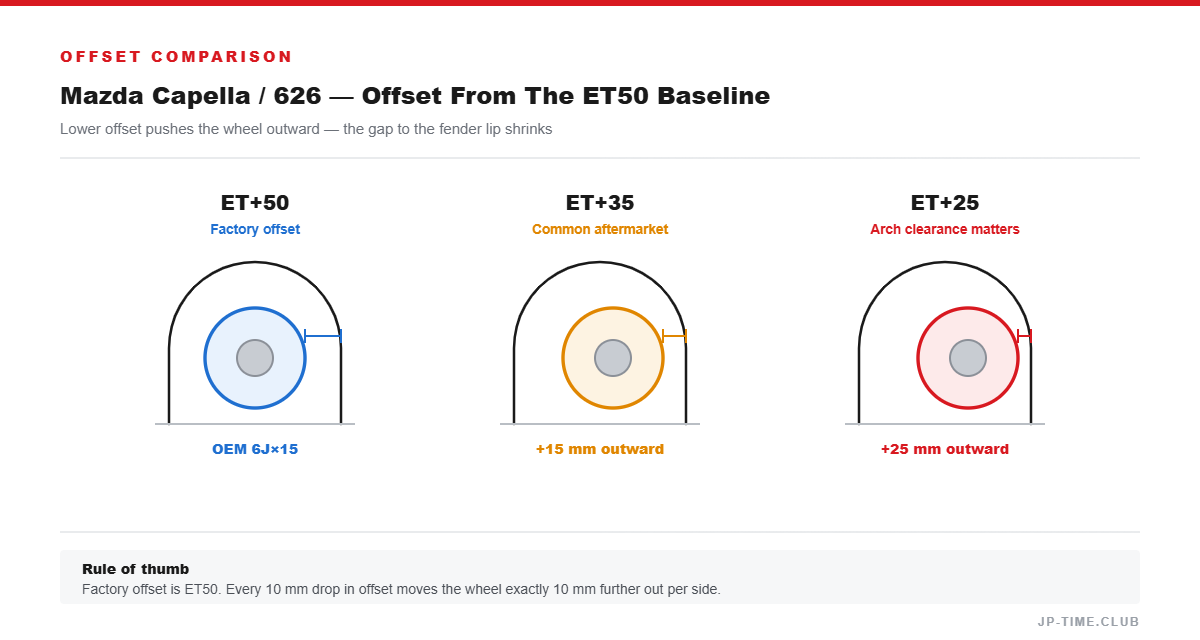
The later cars are simple. From the mid-1990s on, the Capella sits at +45 on a 5.5J×14 for base grades and +50 on a 6J×15 for the 2.0-litre and four-wheel-drive cars. The 7th-generation wagon adds a 6J×16 +50 on the Sport and V-RX.
The GD generation is messier, with the database showing anything from 4.5J×13 to 6J×15 and offsets from +22 to +50 depending on grade. That is a 28 mm spread, which is enormous. On a GD, the grade matters as much as the model does — do not buy from a generic “fits Capella” listing.
For upsizing on the later cars, 16×7 in the +42 to +50 band is the comfortable window. Because the bore is unpublished, order hub-centric rings only after you have measured, or ask us and we will check against a physical wheel.
Importing to the United States
Mazda sold this car in the US as the 626 for its entire life, so US-market examples are already local and the 25-year question does not arise for them. For a JDM Capella, anything built up to August 2001 is eligible now, with the last few months of GF and GW production following through to 2027.
The grades worth importing are the ones the US never got — the wagons in particular, and the four-wheel-drive grades.
What We Could Not Verify
- Hub bore for any Capella generation. Blank on every grade page we checked, on two independent Japanese databases.
- GC-generation (1982–1987) bolt pattern, from a Japanese primary source. Aggregators say 4×114.3; we did not confirm it.
- Pre-1982 rear-drive Capella bolt pattern. Aggregators say 4×110; we did not confirm it.
- The 1987–1989 portion of the GD run, which precedes the database’s earliest record.
- Whether the Capella ever shared a hub bore with the GE-platform MX-6 and Cronos. The PCD matches; the bore is unconfirmed on the Capella side.