The Short Version
- The FD2 Civic Type R is 5×114.3 with a 64 mm hub bore. The two Japanese wheel databases we checked both give 18×7.5J at +60 on 225/40R18 tyres.
- The Type R Euro (FN2) is the same on paper except the offset. Same pattern, same bore, same width, same tyre — but +55, not +60.
- So a wheel listed for one is five millimetres off on the other. The listing title will often say only “Civic Type R”.
A Sedan and a Hatchback Sharing a Name
The FD2 and the FN2 are different cars built in different countries, and both were sold new in Japan as the “Civic Type R”.
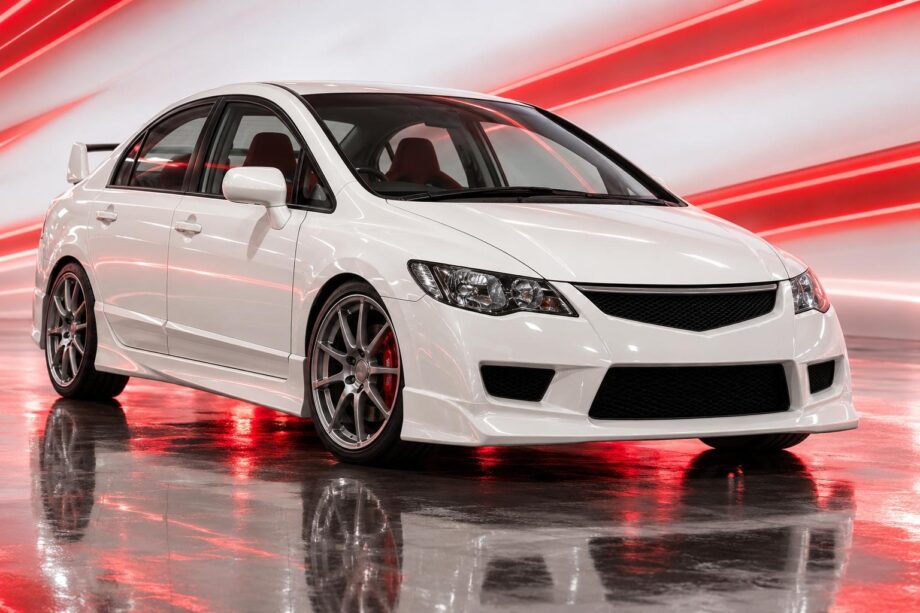
The FD2 is the four-door sedan. Honda’s launch release lists it with 18-inch lightweight aluminium wheels, black wheel nuts and Potenza RE070 tyres in 225/40R18 88Y. Japanese Wikipedia gives the Japanese sales start as March 2007 and describes it as built at Honda’s Suzuka plant. The two wheel databases list its production period as March 2007 to August 2010.
The Type R Euro is the hatchback. Honda’s November 2009 release says it was built by Honda of the UK Manufacturing and exported to Japan in a limited run of 2,010 cars, with its own 18-inch lightweight aluminium wheels on the same 225/40R18 88Y tyre size. Japanese Wikipedia also records a second Japanese run of 1,500 cars in 2010. The databases list its period as November 2009 to October 2010 and give it the chassis code ABA-FN2.
Factory Specification
| Car | Chassis | Period | Body | Wheel | Tyre | PCD / Holes / Bore |
|---|---|---|---|---|---|---|
| Civic Type R | ABA-FD2 | 2007–2010 | 4-door sedan | 18×7.5J +60 | 225/40R18 | 114.3 / 5 / 64 |
| Civic Type R Euro | ABA-FN2 | 2009–2010 | Hatchback | 18×7.5J +55 | 225/40R18 | 114.3 / 5 / 64 |
Read from two Japanese wheel databases, Spec Tank and Cars Japan. We opened the FD2 and FN2 pages on both ourselves, and they agree with each other on every figure in the table. Front and rear are the same on both cars. The tyre size and load/speed rating (225/40R18 88Y) also match Honda’s own release for each car.
What This Means When Shopping
A 5×114.3 pattern with a 64 mm bore is the same Honda performance hub our EK9 guide covers, so both Civics sit in a large pool of Honda wheels. The same guide notes that most ordinary Civics are four-lug, so filter listings on the pattern rather than the model name.
The trap is the offset. A lower number puts the wheel further out, so an FN2 wheel (+55) on an FD2 (+60) would sit 5 mm further out than the factory wheel, and an FD2 wheel on an FN2 would sit 5 mm further in. We have not measured clearance on either car, so we cannot say whether that 5 mm rubs, fouls the arch or makes no visible difference. The arithmetic only tells you which way it moves.
If an aftermarket wheel has a centre bore larger than 64 mm, it needs a hub-centric ring to centre on the hub. Our hub bore guide explains how to measure the bore yourself rather than trusting a listing.
Sizing
Both cars leave the factory on 18×7.5J with a 225/40R18 tyre. Honda’s FD2 release also lists Brembo aluminium four-piston front calipers, which is the first thing to check against any spoke design before you buy a set.
Both databases also publish tyre-width and offset simulation tables for these cars. Those are calculated clearance figures, not fitment tests on a real car, so we do not repeat them here as recommendations.
Importing
The FD2 went on sale in Japan in March 2007. In the US, the 25-year import exemption (49 CFR 591.5(i)) applies to a vehicle that is 25 or more years old, and the age is counted from the date of manufacture. On that reading no FD2 can qualify before early 2032, and we have not verified the month the first cars were built. The Euro went on sale in Japan in November 2009, so it comes later still. We did not check the import rules of other countries for this guide.
What We Could Not Verify
- The hub bore to a tenth of a millimetre. Both Japanese databases print 64 mm. One English-language enthusiast guide prints 64.1 mm. Both round to the same figure, and we cannot say which is exact.
- Special editions. We did not check whether limited or tuner-built versions of either car use different wheels.
- Wheel weight and material. Honda calls the wheels “lightweight aluminium” but the databases record neither weight nor construction.
- The wheel-nut seat. Honda says the FD2 uses black wheel nuts, but none of the sources state the seat type.
- The 2010 second run of the Euro. The databases give one entry for the whole period; we did not check whether the 2010 cars differ.
- Real-world clearance of any aftermarket wheel on either car.
Looking for a specific set? We specialise in genuine Japanese wheels — RAYS, Volk, Enkei, SSR, WORK, BBS Japan and the rare discontinued sets that never left the country. Tell us the wheel, the fitment, the year — our team searches our networks until we find it.