The Short Version
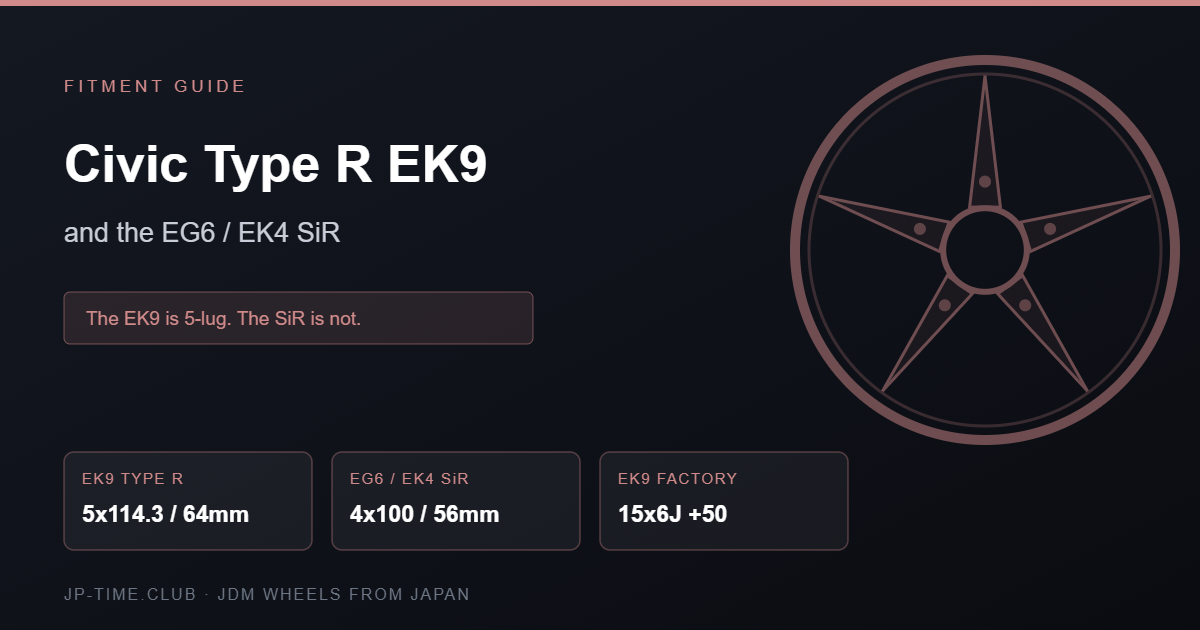
- The EK9 Civic Type R is 5×114.3 with a 64 mm hub bore. Five studs, not four.
- The EG6 and EK4 SiR are 4×100 with a 56 mm bore. A completely different hub.
- So ordinary Civic wheels do not fit an EK9, and EK9 wheels do not fit a SiR.
- EK9 factory wheel: 15×6J at +50. SiR: 15×5.5J at +45.
The Type R Got a Different Hub
This is the single most important thing to know about buying wheels for an EK9, and it catches people constantly, because every other Civic of the era is four-lug.
We opened the factory page ourselves for the GF-EK9 Type R. It reads: PCD 114.3 mm, 5 holes, hub bore 64 mm. The same numbers come back on the pre-facelift E-EK9, on the Type R-X, and on the bare-bones motorsport base grade.
The EG6 SiR, the EG6 SiR-II and the EK4 SiR — pre-facelift and facelift alike — all read 4×100 with a 56 mm bore.
Honda gave the Type R the bigger brakes and the five-lug hub that goes with them, exactly as it did on the 98-spec DC2 Integra Type R. So the EK9 belongs to the five-lug Honda family, not the Civic one.
Factory Specification
| Car | Chassis | Period | Grade | Wheel | Tyre | PCD / Holes / Bore |
|---|---|---|---|---|---|---|
| Civic SiR | E-EG6 | 1991–1995 | 3-door SiR / SiR-II 5MT | 15×5.5J +45 | 195/55R15 | 100 / 4 / 56 |
| Civic SiR | E / GF-EK4 | 1995–2000 | 3-door SiR 5MT | 15×5.5J +45 | 195/55R15 | 100 / 4 / 56 |
| Civic Type R | E-EK9 | 1997–1998 | Type R 5MT | 15×6J +50 | 195/55R15 | 114.3 / 5 / 64 |
| Civic Type R | E-EK9 | 1997–1998 | Type R motorsport base 5MT | 15×6J +50 | 195/55R15 | 114.3 / 5 / 64 |
| Civic Type R | GF-EK9 | 1998–2000 | Type R and Type R-X 5MT | 15×6J +50 | 195/55R15 | 114.3 / 5 / 64 |
Note that the tyre is the same on all of them — 195/55R15. Only the rim width, the offset and the hub differ. So you cannot tell an EK9 wheel from a SiR wheel by the tyre on it.
What This Means When Shopping
The EK9’s 5×114.3 / 64 mm combination is the standard Honda performance-car hub. It is shared with the 98-spec DC2 Integra Type R, the DC5, the EP3 Civic Type R, the Accord Euro R and the S2000. That is a large and well-supplied pool.
The trap runs the other way. If you are shopping listings described as “Civic wheels”, most of them will be 4×100 — because most Civics are. Filter on the pattern, not the model.
64 mm hub rings are needed with most aftermarket 5×114.3 wheels, which are commonly bored 73 mm.
Sizing
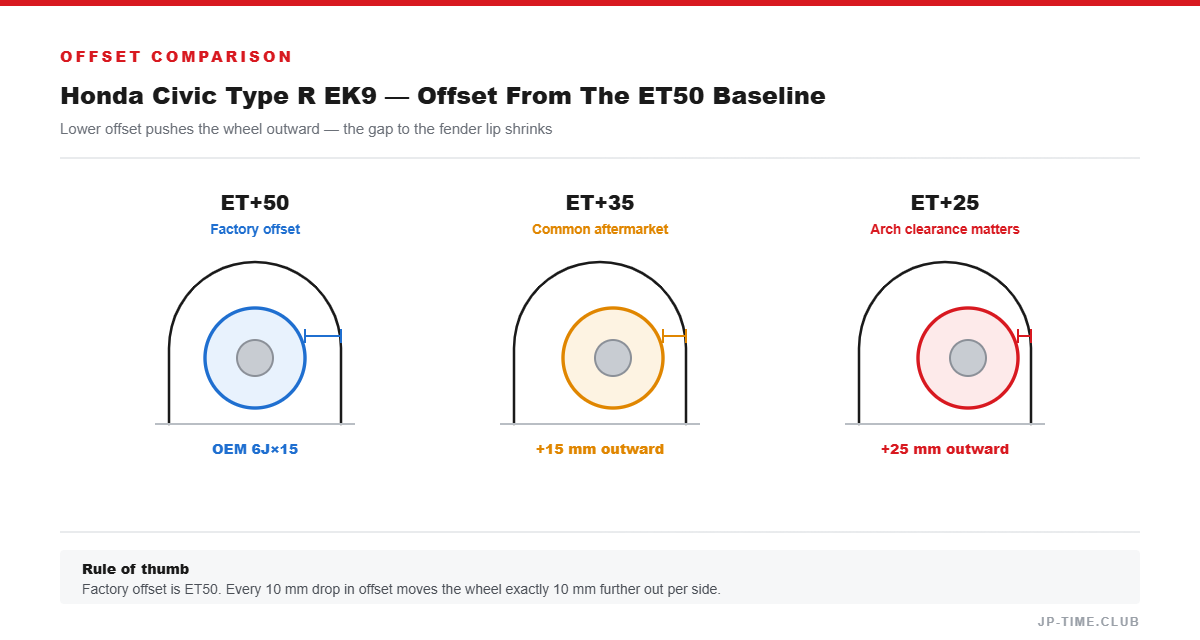
The EK9 leaves the factory on 15×6J at +50, which is narrow and deep by modern standards. The car weighs about 1,040 kg and revs to 8,400, so wheel weight matters more than width.
The practical window is 16×7J or 17×7.5J in the +38 to +48 range. Below about +35 you are into fender work on a car whose arches are subtle.
For the SiR at +45 on a 5.5J, the equivalent window is 15×6.5J to 16×7J at +38 to +45, in 4×100.
Importing
The EG6 ran 1991–1995, the EK4 1995–2000 and the EK9 1997–2000. All of them are past the US 25-year mark, including the EK9 in full.
None of these was sold in North America. The US got the Civic Si of the era, which is a different specification, and never got a Type R until much later.
What We Could Not Verify
- Whether the non-SiR EK4 Si and base grades share the SiR’s 4×100 / 56 mm figures. We checked the SiR grades.
- Wheel material, which the database does not record. The claim that the motorsport base grade came on steel is not something we can confirm from this source.
Seen on the road
Which wheels are you looking for? Tell us the wheel, the size and the fitment — send us a request and we will go and find it.
Wheel identification is taken from the hashtags the owner applied to their own post.
Looking for a specific set? We specialise in genuine Japanese wheels — RAYS, Volk, Enkei, SSR, WORK, BBS Japan and the rare discontinued sets that never left the country. Tell us the wheel, the fitment, the year — our team searches our networks until we find it.