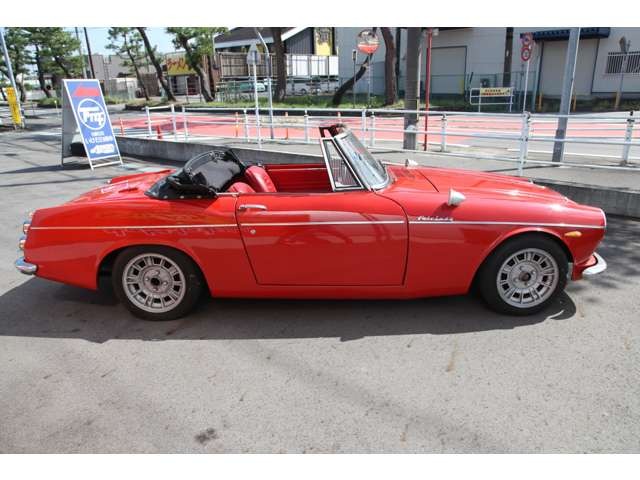
Taizo’s streetside find this week is a bright red Datsun Fairlady 1500 (SP310) — the rare, low-windscreen roadster, fitted with a stainless-steel exhaust, twin SU carburetors, a visible lowering job, and a set of aftermarket multi-spoke “sunburst”-style alloy wheels carrying a black-and-silver “P” center cap. It is one of the cars that started everything for Nissan’s sports car line, and more than sixty years later it is still turning heads.
History
The Fairlady debuted at the 1961 Tokyo Motor Show and reached dealers in late 1962, built on a shortened, reinforced version of the Bluebird 310 platform. It was Nissan’s first genuinely sporting production car, and the name itself is said to come from Nissan president Katsuji Kawamata’s fondness for the Broadway musical “My Fair Lady.” SP310 was the Japan-market right-hand-drive designation; SPL310 was the export left-hand-drive version — mechanically the same car. Production ran from October 1962 to January 1965, after which the model grew into the 1600 (SP/SPL311).
From 1962, Datsun’s West Coast dealer racing program used the Fairlady to score the marque’s first SCCA class win (driver Paul Jaremko), and Bob Sharp’s success running Fairladys/1600s/2000s in G Production became an early proving ground for the factory support that later grew into BRE. The lineage from this car through the 1600 and 2000 (SR311) leads directly to the S30 Fairlady Z / 240Z of 1969.
Identification Notes
A detail worth flagging for anyone cross-shopping early Fairladys: the low-windscreen body was not a special trim level unique to the 1500. It was shared across the 1500, 1600, and the early SR311 (2000), and only changed to a taller, more upright windscreen on later SR311s around 1968. So “rare, low-windscreen car” is accurate as a description of this individual example — the 1500 is itself a low-production survivor — but it should not be read as a 1500-specific model-year change.
Engine
Power comes from Nissan’s G15 engine, a 1,488cc OHV four shared with the contemporary Cedric line. In standard domestic single-carburetor form it made roughly 70-71 PS. From around June 1963, mainly on export-spec cars, a factory-fitted twin SU carburetor setup lifted that to roughly 80-85 PS. That means the twin-SU setup on this particular car is not a modern hot-rod addition — it is a period-correct, factory-sanctioned specification being reproduced or retained on a car built for (or updated to) export tune.
Wheels and Fitment: What We Could Not Verify
The car wears aftermarket multi-spoke wheels with a black center cap and a silver script “P” logo. We looked for a confirmed bolt pattern, hub bore, and offset for the SP310/SPL310 and could not find a reliable primary source — enthusiast references we could access (including the 311s.org technical pages) either returned errors or did not cover this generation’s fitment data with citable specifics. We also could not confirm the wheel brand behind the “P” logo; it resembles the kind of badging used by Panasport on period-correct classic roadster wheels, and 311s.org’s wheel technical notes do reference Panasport fitment for classic Datsun roadsters, but we could not verify the specific model or logo design against a primary source. We are deliberately not publishing a PCD, hub bore, or offset number for this chassis, and we describe the wheel as “Panasport-style” rather than naming the brand outright, because we could not confirm either point to our own standard.
Trivia
- The Fairlady name has stuck with Nissan/Datsun’s sports car line ever since — all the way to today’s Fairlady Z.
- This car’s chassis effectively started as a modified Bluebird 310 platform, built up into something far sportier.
- Early SCCA and West Coast dealer racing success with the Fairlady helped lay the groundwork for Nissan’s later, more formal motorsport efforts in the U.S.
Sources
- Wikipedia: Datsun Sports
- automobile-catalog: Datsun Fairlady 1500 SP310
- Curbside Classic: 1963 Datsun Fairlady 1500 SP310
- Wikipedia: Nissan G engine
- datsun.org: Nissan in Competition
Have a Datsun Fairlady 1500, 1600, or 2000 you’re sourcing period-correct or modern wheels for? Browse our current JDM wheel stock at JP-Time.Club, direct from Japan.