
The Short Version
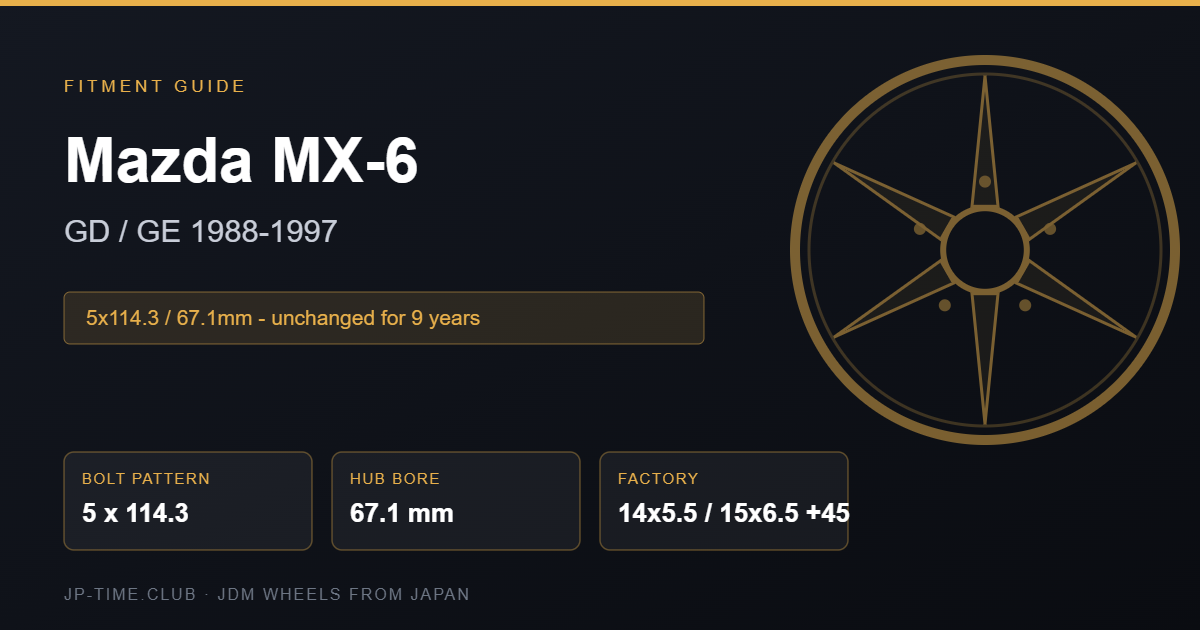
- Bolt pattern: 5×114.3. Hub bore 67 mm as printed in the Japanese databases (67.1 mm in the usual industry notation).
- Nothing changes across the JDM run. Every grade from January 1992 to June 1996 — 2.0 V6, 2.5 V6, Mazdaspeed version, and the 4WS package — carries the same PCD and the same bore.
- Wheel size steps with the engine, not the option list. 2.0 V6 cars got 5.5J×14 +45. 2.5 V6 cars got 6.5J×15 +45. The one exception is the short-run Mazdaspeed version at 6J×15 +45.
- 4WS does not change fitment. The 4WS-package 2.5 (E-GE5B) runs the identical 6.5J×15 +45 as the non-4WS car.
- The first-generation GD car is not covered by the Japanese databases we use. See the caveat below before buying for a 1988–1991 car.
Factory Specification by Grade
| Period | Grade | Chassis | Wheel (F/R) | PCD | Holes | Bore |
|---|---|---|---|---|---|---|
| 1992.01–1994.06 | 2WD 2000 V6 5MT / 4AT | E-GEEB | 5.5J×14 +45 | 114.3 | 5 | 67 |
| 1992.01–1994.06 | 2WD 2500 V6 5MT / 4AT | E-GE5B | 6.5J×15 +45 | 114.3 | 5 | 67 |
| 1994.06–1994.08 | 2WD Mazdaspeed version 5MT | E-GEES | 6J×15 +45 | 114.3 | 5 | 67 |
| 1994.06–1996.06 | 2WD 2000 V6 (incl. Special Package) | E-GEES | 5.5J×14 +45 | 114.3 | 5 | 67 |
| 1994.06–1996.06 | 2WD 2500 V6 | E-GE5S | 6.5J×15 +45 | 114.3 | 5 | 67 |
| 1994.06–1996.06 | 2WD 2500 V6 (4WS package) | E-GE5B | 6.5J×15 +45 | 114.3 | 5 | 67 |
Why the Chassis Code Moves and the Wheels Do Not
The MX-6 chassis codes look busier than they are. E-GEEB and E-GEES are both the 2.0 V6; the letter changes at the June 1994 running change, not because anything under the wheel changed. E-GE5B and E-GE5S are the same story for the 2.5. Confusingly, E-GE5B also comes back after the facelift as the code for the 4WS-package 2.5.
The useful conclusion for a wheel buyer is that none of it matters. Across four years, five chassis codes and the whole grade ladder, the MX-6 is one fitment: 5×114.3, 67 mm bore, +45 offset front and rear. If a seller tells you a particular MX-6 grade needs a different bolt pattern, they are wrong.
The 4WS Question
Quadruple-steering MX-6s attract a premium and a lot of forum speculation. On the wheel side there is nothing to speculate about: the Japanese database lists the 4WS-package 2.5 (E-GE5B, 1994.06–1996.06) at 6.5J×15 +45 with the same 114.3 PCD and 67 mm bore as the standard 2.5. The rear steering rack changes the geometry behind the hub, not the hub itself.
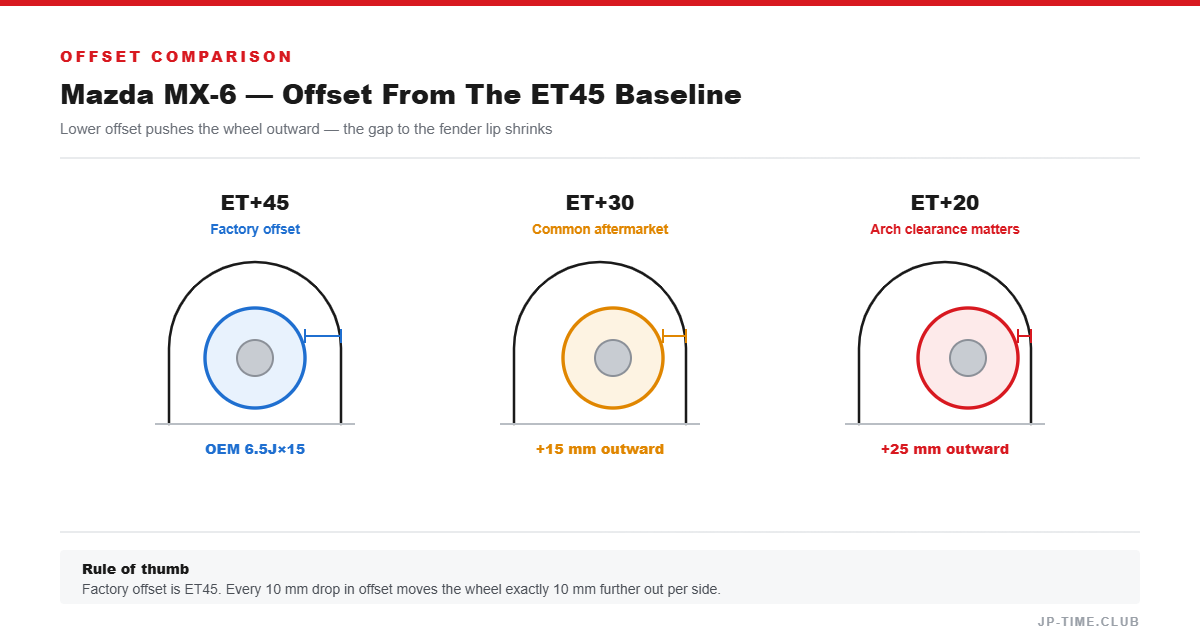
What 4WS does change is how sensitive the car is to a big offset change at the rear. If you drop from +45 to something like +25 on a 4WS car, you are moving the contact patch relative to a rear axle that steers. That is a handling question rather than a bolt-up question, but it is worth knowing before you commit to a deep-dish set.
Siblings: 626, Capella and the Ford Probe
The GE-generation MX-6 shares its platform with the Mazda 626 / Capella of the same period and with the second-generation Ford Probe (1993–1997), which was built alongside it at the AutoAlliance plant in Flat Rock, Michigan. Aftermarket fitment databases list the 1992–1997 626 and the 1993–1997 Probe on the same 5×114.3 / 67.1 mm combination, which is consistent with genuine platform sharing.
We list that as a strong indication rather than a verified fact, because we confirmed it from aggregator data rather than from a Japanese factory table. Practically, it means a set of JDM MX-6 wheels is very likely to bolt onto a second-generation Probe — but check the caliper clearance yourself before you buy, especially on the Probe GT.
The GD Caveat — Read This If Your Car Is Pre-1992
The Japanese wheel databases we rely on carry the MX-6 only from January 1992. There is no factory table on those sites for the 1988–1991 first-generation (GD) car. We could have copied a figure from an English aggregator and presented it as fact. We are not going to.
If you own a 1988–1991 MX-6, measure your own hub before ordering. Count the studs, measure across the pattern, and measure the centre hub itself — from the inside face of the hub flange, not the outside lip of the wheel, which is a wider counterbore and tells you nothing. Send us the numbers and we will match wheels to them.
Sizing Up from Factory
The standard 2.5 V6 fitment of 6.5J×15 +45 is conservative by modern standards, and the arches have room. The common upsizes people run are 16×7 and 17×7 to 17×7.5 in the +35 to +45 range, usually on 205/50R16 or 215/45R17. Going wider than 7.5J at the front normally needs a mild fender roll and an offset in the +38 to +45 band to keep the tyre off the strut.
Because the bore is 67 mm and most Japanese aftermarket wheels are bored larger — 73 mm is a very common aftermarket bore — you will usually need 67 mm hub-centric rings. Order them with the wheels. A hub-centric ring is a two-dollar part that stops a wheel being centred by its lug nuts alone, and on a 30-year-old car with 30-year-old wheel studs that matters.
Importing to the United States
The MX-6 is a rare case where the 25-year rule is irrelevant. Mazda sold the car new in the US throughout both generations, so US-market examples are already here and legal, and the entire JDM production run — which ended in June 1996 — passed the 25-year mark years ago. Either way you are clear.
The practical consequence is that JDM-market wheels bolt straight onto a US-market MX-6. The bolt pattern, bore and offset are the same car. If you are chasing a period-correct Japanese wheel for a US car, this is one of the easiest fitments there is.
What We Could Not Verify
- Factory wheel width and offset for the 1988–1991 GD generation, from any Japanese primary table.
- Bolt pattern and hub bore for the GD generation from a Japanese primary table. Aggregator data exists; we do not treat it as sufficient.
- Factory wheel specification for the GD-era turbocharged grade.
- The 626 / Capella and Ford Probe fitment match, at Japanese-primary-source level. Treated as strongly indicated, not confirmed.
How We Sourced This
The grade-by-grade table above is read directly from Japanese factory wheel-size databases in the original Japanese — the same tables Japanese wheel shops use when they quote a customer. That is why the chassis codes, the June 1994 running change and the short-run Mazdaspeed version appear here and generally do not appear in English-language fitment guides.
Where a figure is not in those tables, we say so above instead of filling the gap. If you have a factory catalogue scan or a build plate for a GD-generation car, we would like to see it.