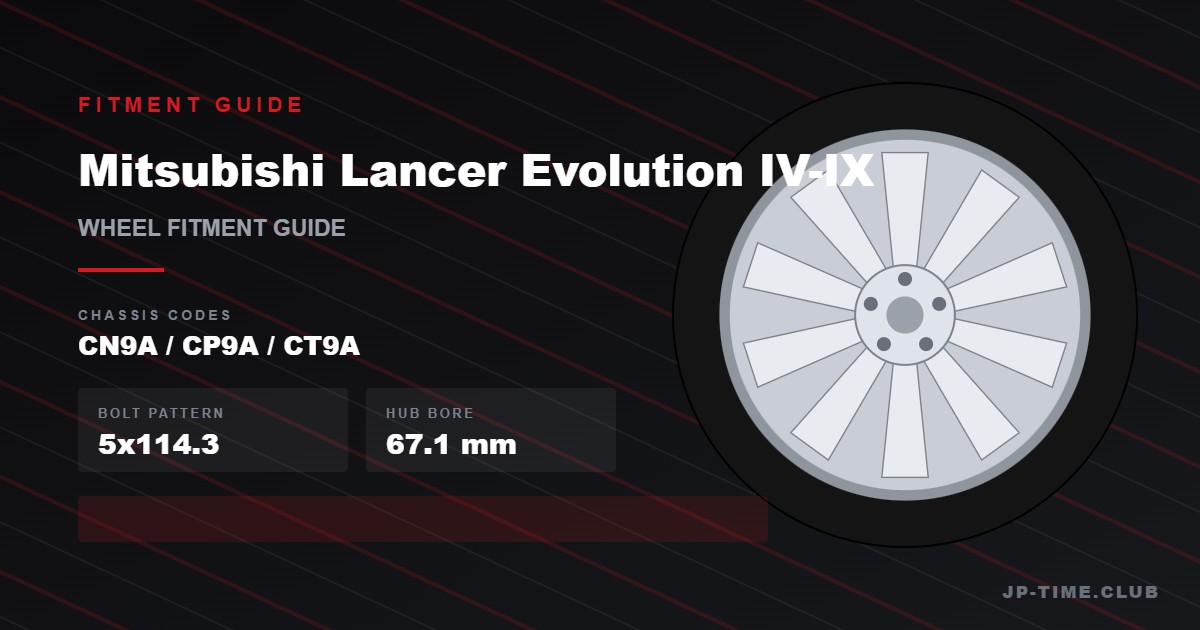
Eleven years, six generations, three chassis codes — and one wheel fitment. From the 1996 Evo IV through the 2007 Evo IX, Mitsubishi never changed the Lancer Evolution’s bolt pattern, hub bore, thread size or factory offset. 5×114.3, 67.1 mm hub, M12x1.5, ET38. If you are shopping for a set of wheels for an Evo, that is a remarkably forgiving starting point.
It is also the reason people get caught out. Because the numbers never moved, buyers assume every Evo wheel fits every Evo. It doesn’t — and the trap is not the bolt pattern. It’s the RS.
Section 1: OEM Wheel Specifications by Generation
| Generation | Chassis Code | Model Years | Bolt Pattern | Hub Bore | OEM Wheel (front & rear) | OEM Tyre |
|---|---|---|---|---|---|---|
| Evo IV | CN9A | 1996-1997 | 5×114.3 | 67.1 mm | 6Jx15 ET46 (RS) | 205/60R15 |
| Evo V | CP9A | 1998 | 5×114.3 | 67.1 mm | 7.5Jx17 ET38 (GSR) 6Jx15 ET46 (RS) |
225/45R17 205/60R15 |
| Evo VI | CP9A | 1999-2000 | 5×114.3 | 67.1 mm | 7.5Jx17 ET38 (GSR) 6Jx15 ET46 (RS) |
225/45R17 205/60R15 |
| Evo VII | CT9A | 2001-2003 | 5×114.3 | 67.1 mm | 8Jx17 ET38 (GSR / GT-A) | 225/45R17 |
| Evo VIII | CT9A | 2003-2005 | 5×114.3 | 67.1 mm | 8Jx17 ET38 (GSR / GT-A) 6Jx15 ET46 (RS) |
235/45R17 205/65R15 |
| Evo IX | CT9A / CT9W | 2005-2007 | 5×114.3 | 67.1 mm | 8Jx17 ET38 (GSR / GT / GT-A) 6Jx15 ET46 (RS) |
235/45ZR17 205/65R15 |
Thread size is M12x1.5 across all generations listed. CT9W is the Evo IX Wagon, which shares the sedan’s fitment.
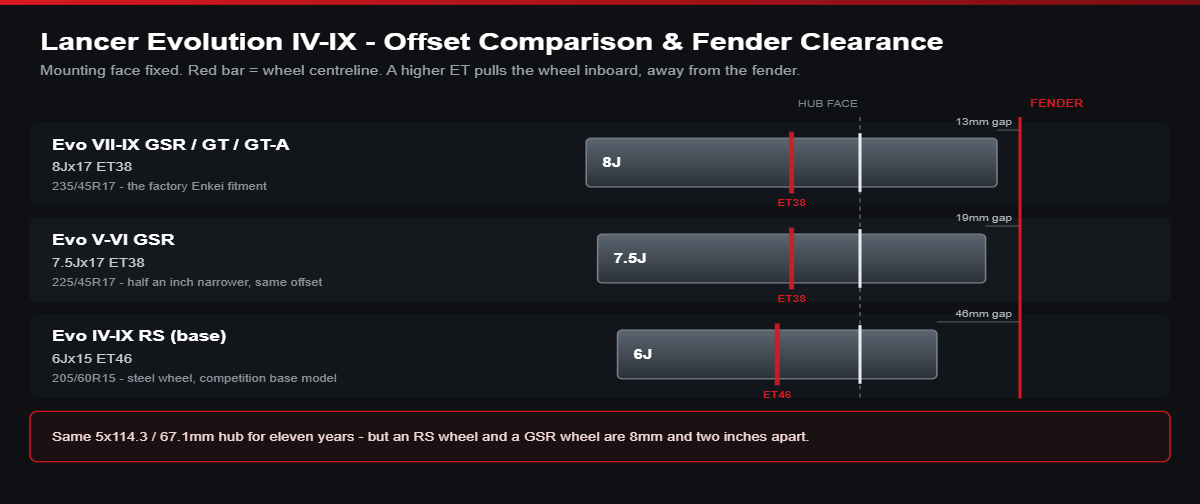
Section 2: Offset Comparison & Fender Clearance Visualization
Section 3: The GSR / RS Split — The Only Real Fork in the Road
Every generation from Evo IV to Evo IX was sold in two very different states of tune. The GSR was the road car: proper trim, air conditioning, ABS, and a set of 17-inch alloys. The RS was the homologation shell: steel wheels, no rear wiper, thinner glass, and a seam-welded body ready for a rally shop to finish.
Those two cars left the factory on wheels that are 8 mm apart in offset and two inches apart in diameter:
- GSR: 7.5Jx17 ET38 (Evo V-VI) or 8Jx17 ET38 (Evo VII-IX)
- RS: 6Jx15 ET46, steel
This matters when you buy secondhand. A seller listing “genuine Evo wheels, 5×114.3, straight off the car” is telling you the truth and still not telling you what you need to know. An ET46 15-inch steel wheel will bolt onto an Evo IX without complaint and look like it has been swallowed by the arches. Conversely, an 8Jx17 ET38 GSR wheel on an RS is a genuine upgrade — but check the brakes first, because 15-inch wheels do not clear the Brembo package that many RS cars were optioned with.
Always ask which trim the wheels came off. Not just which generation.
Section 4: The 67.1 mm Hub Bore — Not the Number You Expect
Most Japanese performance cars centre on 60.1 mm (Toyota), 66.1 mm (Nissan) or 56.1 mm (Subaru). The Evo uses 67.1 mm, a size far more common on European cars — and, in Japan, on the Mazda RX-7 FD3S.
Two practical consequences:
- Aftermarket wheels are usually bored larger and centred with rings. A 73 mm or 73.1 mm bore with a 73–67.1 hub-centric ring is the normal arrangement. Fit the rings. Lug-centric mounting on a 300 hp AWD car is not where you want to economise.
- Do not confuse it with 66.1 mm Nissan wheels. A 66.1 mm wheel physically will not go over an Evo hub, even though the bolt pattern is identical to an S14, S15 or R34. This is the single most common failed fitment we see in 5×114.3 cross-shopping.
If you have read our RX-7 FD3S guide, you already know the FD shares both the 5×114.3 pattern and the 67.1 mm bore — but runs ET50. An FD wheel on an Evo will tuck 12 mm further in than the factory GSR wheel.
Section 5: Popular Aftermarket Sizes
The Evo’s stock ET38 sits in the middle of the aftermarket’s comfort zone, which is why the platform has such a deep catalogue of period-correct fitments. Common choices among owners:
- 17×8 ET35–ET38 — the safe, factory-equivalent replacement. Fits stock tyre sizes, no rubbing, no spacers. Volk TE37, Enkei RPF1 and Advan RG-D are all widely used here.
- 17×9 ET35 — roughly 12 mm more poke per side than stock. Works with 255/40R17 on most cars; may need a light fender roll on lowered examples.
- 18×9.5 ET38 — the Evo X look on an Evo IX. Requires attention to tyre diameter to keep the speedometer honest.
- 15×8 ET25–ET30 — gravel and tarmac rally sizing. Only clears the smaller factory brakes; will not clear Brembos.
The offset numbers to watch: below ET30 you are into fender-roll territory on standard arches, and below ET20 you are building a wide-body car, not fitting wheels to one.
Section 6: Cross-Platform Compatibility
Sharing 5×114.3 with half of Japan makes the Evo look like an easy fit. In practice, the 67.1 mm bore narrows the field considerably:
- Nissan (S14, S15, R33, R34, 350Z): same PCD, 66.1 mm bore — will not fit without machining. See our Silvia S15 guide.
- Toyota (Supra, MR2, Celica): same PCD, 60.1 mm bore — will not fit.
- Mazda RX-7 FD3S: same PCD, same 67.1 mm bore — fits, but at ET50 it sits noticeably inboard.
- Subaru WRX STI (2005-2007): same PCD, 56.1 mm bore — will not fit. The Evo’s great rival is not wheel-compatible with it. See our WRX STI guide.
The rule that keeps coming up across this series holds here too: a shared bolt pattern is a starting point, not a fitment.
Section 7: A Note on the Evo X
The Evo X (CZ4A, 2007-2017) keeps the same 5×114.3 pattern, the same 67.1 mm bore and the same ET38 — it simply widened the rim to 8.5Jx18 on the GSR and 6.5Jx16 ET46 on the RS. Note that the RS/GSR offset split survived the generation change intact. Evo X wheels bolt straight onto an Evo IX and vice versa, with brake clearance and tyre diameter the only real considerations. It is one of the cleanest cross-generation swaps in the JDM world.
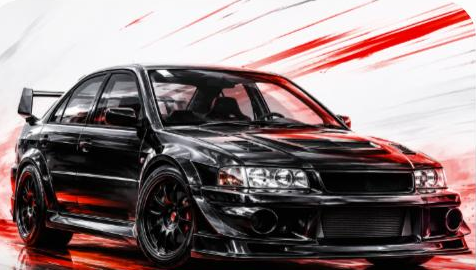
A clean Evo IX sitting on the factory ET38 fitment — the reference point for everything in this guide. — via @@awd_iv9n
Related Fitment Guides
- Mitsubishi Lancer Evolution X — the generation that followed
- Subaru WRX STI — the rival, and not compatible
- Mazda RX-8 — the same 67.1 mm bore
- Mazda RX-7 FD3S — and the same again
Every guide in this series is built the same way: verified factory specifications, an offset diagram, and an honest account of what fits and what does not.
Seen on the road
Which wheels are you looking for? Tell us the wheel, the size and the fitment — send us a request and we will go and find it.
Wheel identification is taken from the hashtags the owner applied to their own post.
Buying Wheels for Your Evo
Before you commit to a set, you need four numbers and one word: diameter, width, offset, bore — and trim. Get those and the Evo is one of the easiest cars in Japan to shoe. Miss the bore, or assume an RS wheel is a GSR wheel, and you will be listing a set for sale a fortnight later.
Looking for a specific set? We specialise in genuine Japanese wheels — RAYS, Volk, Enkei, SSR, WORK, BBS Japan and the rare discontinued sets that never left the country. Tell us the wheel, the fitment, the year — our team searches our networks until we find it.
Specifications in this guide reflect factory equipment for Japanese-market vehicles. Trim levels, optional wheel packages and market-specific variants can differ. Always confirm the fitment against your own car before purchase.