
The Short Version
- The practical way to tell a Panasport from a Watanabe: count the pieces. The Panasport G7 C-series is three-piece. The classic Watanabe eight-spokes are one-piece castings.
- Panasport is not all one construction. The G7 line is three-piece; the Formula One line is one-piece cast.
- We could not resolve the ownership question between the Japanese and American operations, and we want to be upfront about that.
The Question Everyone Actually Has
Two Japanese eight-spoke wheels, both classics, both fitted to the same cars, constantly confused in listings. How do you tell them apart?
Neither company addresses this on its own site, so we are not going to invent a styling rule about spoke taper or dish profile. What we can do is answer it from construction, which is documented by both manufacturers.
A genuine RS Watanabe eight-spoke or R-Type is a one-piece casting. Watanabe’s own company history says so. No rim-to-centre joint, no barrel fasteners. The exceptions are three named products — the 2009 New RS8, the 2022 Forging R, and the 2024 RS8R made with WORK — and none of them is a classic eight-spoke.
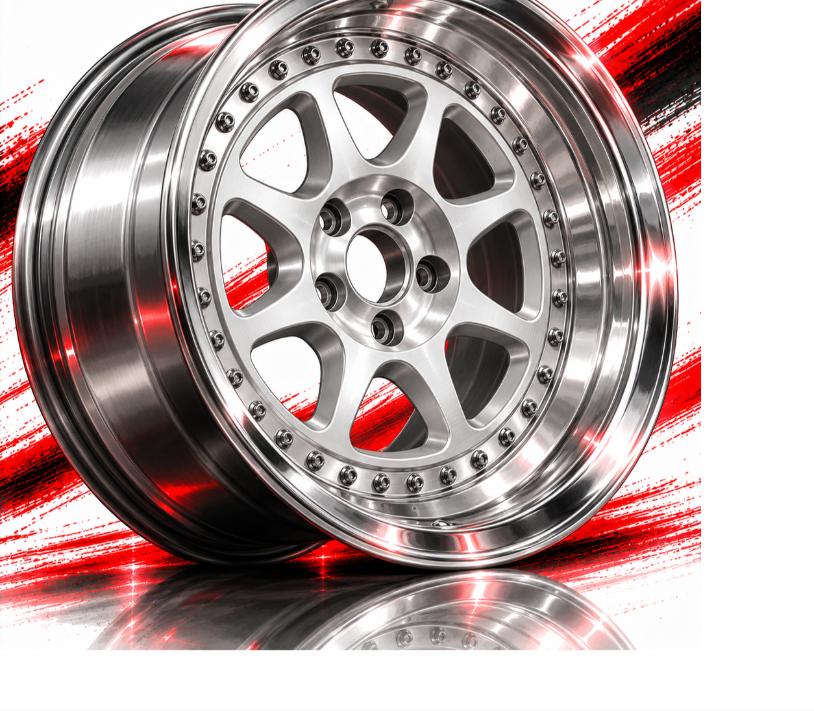
A genuine Panasport G7-C8R or C8S is three-piece. Panasport’s own catalogue states the construction as cast disc plus rolled rim, three-piece. That means a visible rim joint and, typically, visible fasteners around the barrel.
So: joint and fasteners on an eight-spoke means Panasport, not Watanabe. A seamless one-piece eight-spoke means Watanabe, or something claiming to be. That single check settles most listings.
The Panasport Lines
Panasport’s current catalogue splits into two families, and they are built differently.
| Line | Models | Construction | Sizes | PCD range |
|---|---|---|---|---|
| RACING / G7 | C5C, C5C2, C5R, C8R, C8S, C4C | 3-piece — cast disc, rolled rim | 15–17 inch | 95.25–130 mm |
| FORMULA ONE | FSE, FF, FFP, FS, C8FE, C8FE-X | 1-piece cast | 15 inch (FSE) | 95.25–120.65 mm |
Specifics worth having:
- G7-C8R — 15 and 16 inch, PCD 95.25 to 120.65 mm, 4-hole, three-piece.
- G7-C8S — 15 to 17 inch, PCD 95.25 to 130 mm, 4 or 5-hole, three-piece.
- FORMULA ONE FSE — 15 inch, PCD 95.25 to 120.65 mm, 4-hole, one-piece cast.
Note the PCD ranges. 95.25 mm is 3.75 inches, and 120.65 mm is 4.75 inches — these are imperial patterns, which tells you a great deal about the era and the vehicles Panasport was originally serving. If you are shopping for a modern metric-PCD Japanese car, check carefully that the size you want is offered in your pattern.
“C8” denotes the eight-spoke face. “C5” denotes the five-spoke and mesh designs. “G7” reads as the current platform name rather than a model.
The Ownership Question We Could Not Answer
This was the thing we most wanted to settle, and we did not manage it. Here is exactly what we found and exactly where we stopped.
There are two Japanese web presences, both presenting themselves as the official Panasport homepage. They list the same Tokyo address and the same telephone number, which strongly suggests continuity of one company across two site generations — but neither site explains the relationship or the transition.
- The older site’s company page names the operator as Panasport Racing Inc., a yūgen-gaisha, founded December 1981, capital ¥7,000,000, 14 employees, with a named representative director.
- The current site names the operator jointly as Panasport Racing Inc. / BMB Technical Research Ltd., and lists a related company. Neither site explains how these entities relate.
On the American side, we hit a genuine technical wall. The US-facing Panasport site is built with a 1990s page tool and its text is baked into image files. Every page we fetched returned only images, and a live browser render came back blank. We could not read a single sentence of its own account of itself.
A third-party business directory — secondary, and we are labelling it as such — lists a Panasport Racing Wheels operation in Torrance, California, with a president whose surname matches the Japanese company’s representative director. That is suggestive of a family connection. It is not evidence of a corporate one.
So: we cannot tell you whether Panasport Japan and the American Panasport are the same company, a licensing arrangement, or independent operations sharing a name. The primary source needed to answer it is technically unreadable, and we would rather say that than pick the version that sounds tidiest.
Why This Matters for a Buyer
It is not academic. If you are buying a wheel described as a Panasport, “which Panasport” may determine what you are getting, who warranties it, and whether the specification you read applies.
Our practical advice is the same as always: buy on the specification of the physical wheel in front of you — the size, the PCD, the bore, the construction and the markings — rather than on the brand story. That advice is more important here than usual, precisely because we cannot give you a clean brand story.
What We Could Not Verify
- The legal relationship between the Japanese and American Panasport operations. Unresolved.
- The relationship between the two Japanese corporate names and the related company listed alongside them.
- Whether the American site represents a currently operating business. Its content is unreadable by every method we tried.
- Any manufacturer statement on how to distinguish Panasport from Watanabe. Neither company addresses it; our construction-based method above is our inference from their published construction data, not their advice.
- Whether the older Japanese site is still maintained.