
The Short Version
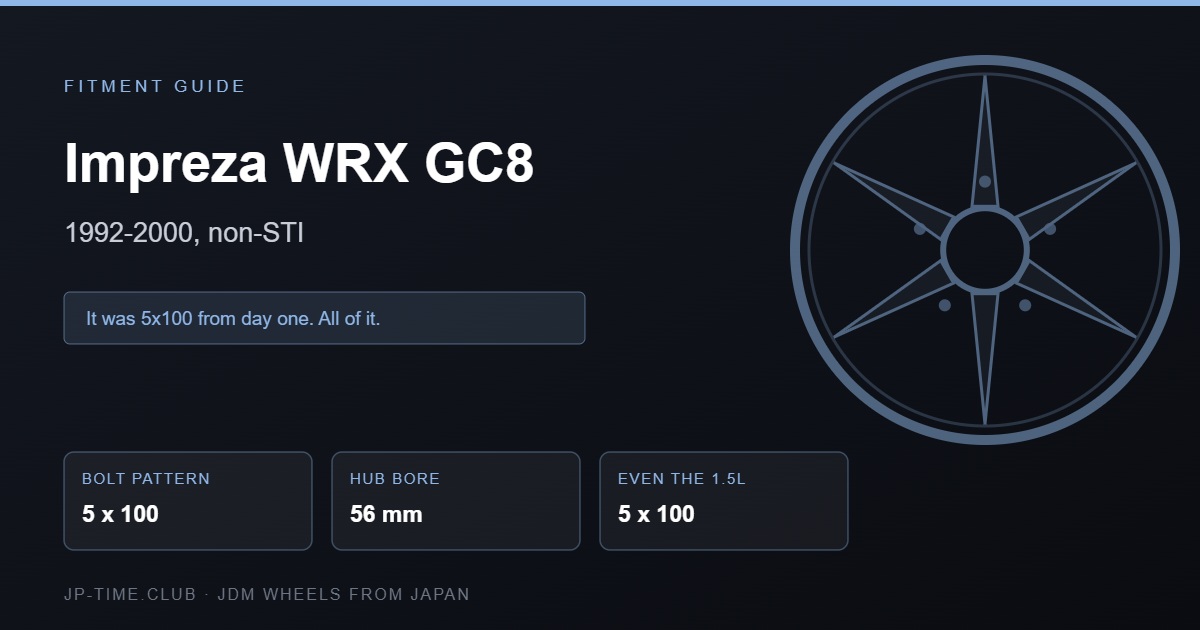
- Every GC8 is 5×100 with a 56 mm hub bore. From the November 1992 launch to the last GF-GC8 in 2000.
- There is no 4×100 GC8 WRX. We could not find one anywhere in the Japanese factory record, and we looked specifically for it.
- Even the base 1.5-litre non-turbo sedan is 5×100. We opened that page ourselves to be sure.
- Offset is +55 across the entire run. What changes is diameter: 15×6J on early cars, 16×6.5J on late WRX, 17×7J on the 22B.
The Myth We Went to Confirm and Could Not
We started this guide expecting to document a changeover. The received wisdom is that early GC8 Imprezas were 4×100 and that Subaru moved to 5×100 partway through. We wanted the date.
There is no date, because as far as the Japanese factory record goes there is no changeover. We checked the full month-by-month grade index from November 1992 to August 2000 and opened fifteen individual grade pages spanning the run — the launch WRX, the WRX Type RA, the 1994 STI Version, the 1998 22B-STi, the 1999 and 2000 WRX. Every one reads PCD 100, five holes, 56 mm bore.
Then we went looking for the cheapest possible Impreza on the platform, on the theory that if a 4-lug car existed anywhere it would be there. The E-GC1 1.5-litre two-wheel-drive sedan — the base car, on 13-inch wheels — is also 5×100, 56 mm. We opened that page ourselves.
So: if you have seen a 4×100 Impreza of this generation, we would like to know the chassis code and market, and we will publish it. What we will not do is repeat a changeover date that the factory record does not support.
The bolt-pattern change people are probably half-remembering is the later one — Subaru moved the Impreza to 5×114.3 in the mid-2000s, well after the GC8 was gone. That is a real change. It just is not this car.
Factory Specification
| Period | Grade | Chassis | Wheel | Tyre | PCD / Holes / Bore |
|---|---|---|---|---|---|
| 1992.11–1994.10 | WRX | E-GC8 | 15×6J +55 | 205/55R15 | 100 / 5 / 56 |
| 1992.11–1994.10 | WRX Type RA | E-GC8 | 15×6J +55 | 205/55R15 | 100 / 5 / 56 |
| 1994.01–1994.09 | STI Version | E-GC8 | 15×6J +55 | 205/55R15 | 100 / 5 / 56 |
| 1998.03–1998.09 | 22B-STi Version | E-GC8改 | 17×7J +55 | 235/40R17 | 100 / 5 / 56 |
| 1998.09–1999.09 | WRX (non-STI) | GF-GC8 | 16×6.5J +55 | 205/50R16 | 100 / 5 / 56 |
| 1999.09–2000.08 | WRX (non-STI) | GF-GC8 | 16×6.5J +55 | 205/50R16 | 100 / 5 / 56 |
| 1992.11–1994.01 | CF 1.5 (base, non-turbo) | E-GC1 | 13×5J +50 | 165SR13 | 100 / 5 / 56 |
WRX Versus STI
We publish a separate WRX STI guide, so here is the overlap stated plainly: at every model year we checked, the non-STI WRX and the STI share the identical bolt pattern, hub bore, and in most years the identical factory wheel size and offset as well — 16×6.5J at +55.
The exceptions are the limited runs. The 22B got 17×7J. Cars like the S201 and the Type R V-Limited had their own wheels. If you are buying for a plain WRX, the STI numbers transfer; if you are buying wheels that came off a limited edition, check the width before assuming.
The Type RA is worth a note because the name implies something special. Mechanically it is the plain WRX with the interior stripped out for competition. Its wheel fitment is identical to the standard WRX at every year we checked.
+55 Is the Whole Story
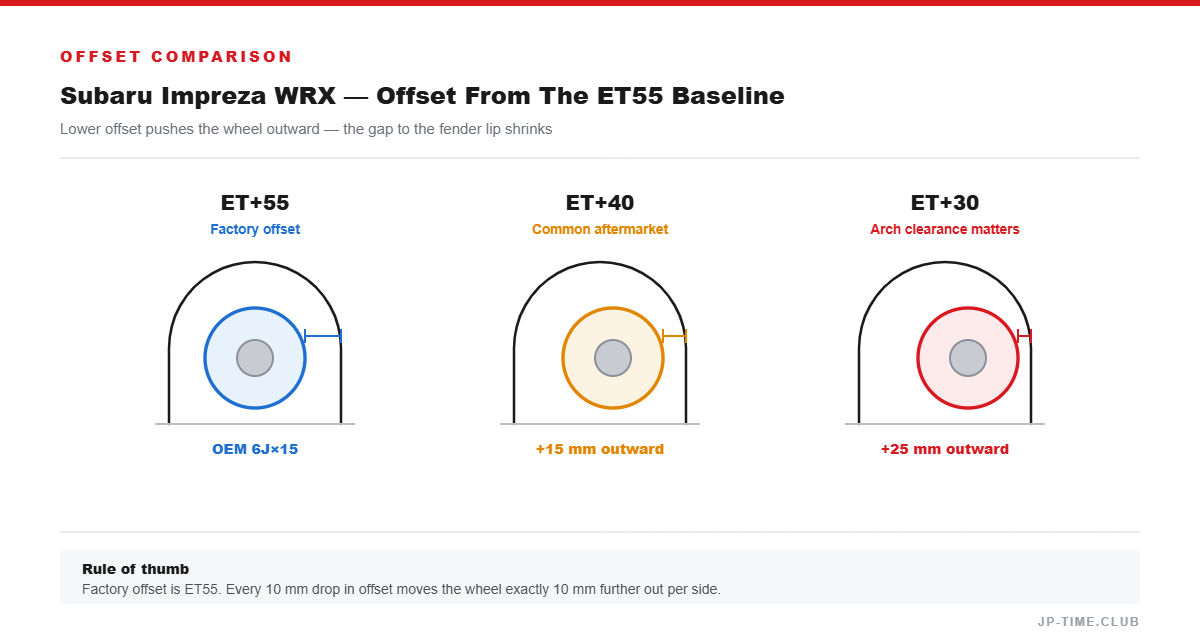
Subaru held +55 for eight years across every grade. That is unusually consistent, and it means anything you buy for a GC8 should be judged against that number.
+55 is deep. The practical aftermarket window is 17×7.5J to 17×8J in the +45 to +53 range, which brings the face out only slightly and keeps the tyre inside the arch on a car whose arches are not generous. Going to +38 or below on an 8J will need fender work, and on a rally-derived car with the GC8’s suspension geometry, moving the wheel outboard changes scrub radius in ways you will feel through the steering.
56 mm hub rings are required with essentially any aftermarket 5×100 wheel, since most are bored for the 5×100 Volkswagen and Toyota world at 57.1 mm or larger.
Importing
The GC8 ran from 1992 to 2000, so the entire generation is eligible for US import, including the 22B. The US got the Impreza in this era but never the WRX or the STI, which is exactly why these cars leave Japan in the numbers they do.
The grades worth the trouble are the ones the US never saw at all: the Type RA, the STI Versions, and the 22B if you can find one and afford it.
What We Could Not Verify
- The existence of any 4×100 GC8 in any grade or market. We looked for it specifically and found nothing.
- Hole count and bore on every individual model year. We confirmed fifteen grade pages spanning the run; the intermediate years were read from the summary index, which shows size and offset but not PCD.
- Export-market WRX variants. This guide covers the Japanese factory record only.
Seen on the road
Which wheels are you looking for? Tell us the wheel, the size and the fitment — send us a request and we will go and find it.
Wheel identification is taken from the hashtags the owner applied to their own post.
Looking for a specific set? We specialise in genuine Japanese wheels — RAYS, Volk, Enkei, SSR, WORK, BBS Japan and the rare discontinued sets that never left the country. Tell us the wheel, the fitment, the year — our team searches our networks until we find it.