
Introduction
Fitting wheels to an AMG is a different exercise from fitting a JDM car, and two things catch people out. The first is that Mercedes uses lug bolts, not studs and nuts — there is nothing sticking out of the hub to hang the wheel on while you line it up. The second is that AMG models are staggered from the factory, and the rear offset is higher than the front, not lower. Get either of those wrong and the wheels either will not mount or will not sit correctly.
Section 1: OEM Wheel Specifications
Every C63 and E63 in this guide shares the same core hardware: 5×112 bolt pattern, 66.6 mm hub bore, M14 x 1.5 lug bolts, 130 Nm torque. What changes between models is width and offset — and those change per axle.
| Model | Chassis | Years | Front Wheel | Rear Wheel | Front Tyre | Rear Tyre |
|---|---|---|---|---|---|---|
| C63 AMG | W204 (facelift) | 2011–2014 | 8Jx18 ET45 | 9Jx18 ET54 | 235/40ZR18 | 255/35ZR18 |
| C43 4MATIC | W205 | 2015–2023 | 7.5Jx18 ET33 | 8.5Jx18 ET49 | 225/45ZR18 | 245/40ZR18 |
| C43 4MATIC | W205 | 2015–2023 | 7.5Jx19 ET33 | 8.5Jx19 ET52 | 225/40ZR19 | 255/35ZR19 |
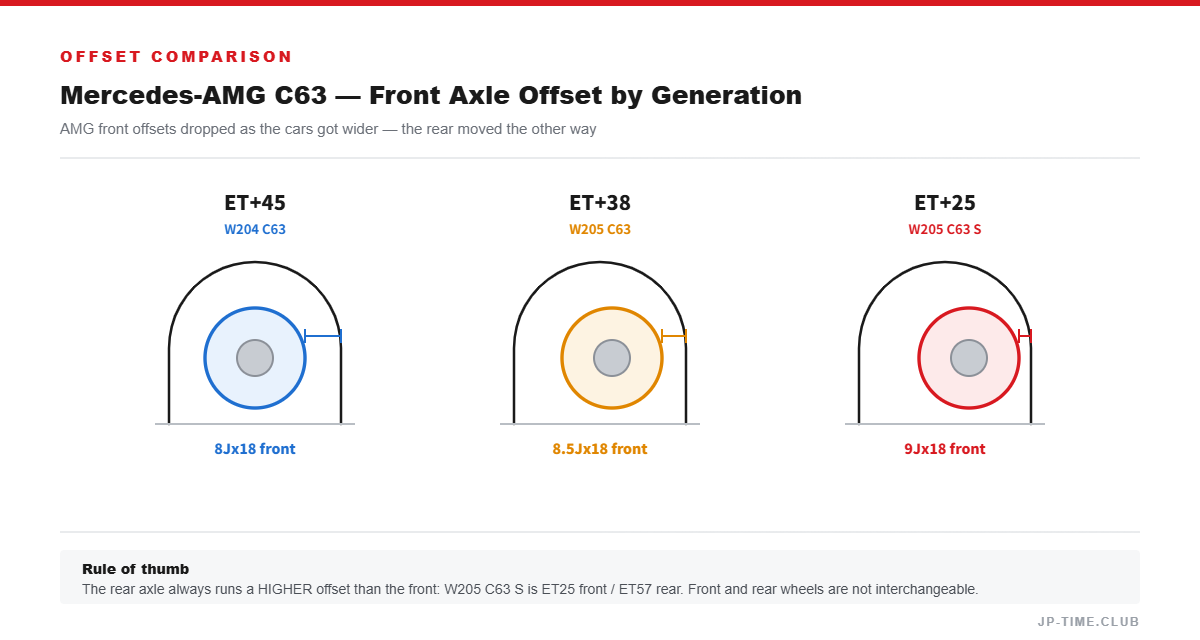
| C63 | W205 | 2015–2023 | 8.5Jx18 ET38 | 9.5Jx18 ET56 | 245/40ZR18 | 265/40ZR18 |
| C63 S | W205 | 2015–2023 | 9Jx18 ET25 | 10.5Jx18 ET57 | 255/40ZR18 | 285/35ZR18 |
| C63 S | W205 | 2015–2023 | 9Jx19 ET25 | 10.5Jx19 ET57 | 255/35ZR19 | 285/30ZR19 |
| E63 AMG | W212 (facelift) | 2013–2016 | 9Jx18 ET37 | 9.5Jx18 ET52 | 255/40ZR18 | 285/35ZR18 |
| E63 AMG | W212 (facelift) | 2013–2016 | 9Jx19 ET37 | 9.5Jx19 ET52 | 255/35ZR19 | 285/30ZR19 |
| E63 | W213 | 2017–2020 | 8Jx19 ET20 | 9Jx19 ET49 | 245/40ZR19 | 275/35ZR19 |
| E63 S | W213 | 2017–2020 | 9.5Jx19 ET25 | 10Jx19 ET55 | 265/40ZR19 | 295/35ZR19 |
| E63 S | W213 | 2017–2020 | 9.5Jx20 ET25 | 10Jx20 ET55 | 265/35ZR20 | 295/30ZR20 |
Read that table by axle, not by car. A W205 C63 S runs 9Jx18 ET25 at the front and 10.5Jx18 ET57 at the rear — a 32 mm offset difference and 1.5 J of extra width. Front and rear wheels are not interchangeable, you cannot rotate them side to side, and a “set of four” listing that quotes one offset is either a non-AMG wheel or an aftermarket square setup.
5×112 is shared with Audi, Volkswagen and Porsche. That gives the AMG platform one of the deepest used-wheel pools in the market — far wider than any single Mercedes model would suggest. Hub bore and offset still need to match, but the search does not have to start and end with Mercedes wheels.
Section 2: Recommended Fitment Ranges
Factory-Faithful
Stay on the axle-specific OEM figures in the table above. The safest approach on these cars is to buy a wheel explicitly sold as a staggered AMG-fitment set, because the factory numbers are unusual enough that generic 5×112 stock often will not sit right.
- Front: ET45 (W204) down to ET20 (W213 E63) depending on model
- Rear: ET49 to ET57 across the range — consistently higher than the front
- Hub bore: 66.6 mm. Audi and VW wheels are commonly 57.1 mm and will not fit without the correct spigot arrangement
Aftermarket and Lowered Fitment
The common aftermarket route on AMG cars is a wider square or reverse-staggered setup with spacers to fine-tune the face. Because the factory rear offset is already high, rear spacers are near-universal on lowered builds — that is not a shortcut, it is how these cars are set up.
- Spacers are normal here. With ET57 at the rear, a 15–25 mm spacer simply brings the wheel back to the arch
- Bolt length matters. Because Mercedes uses bolts rather than studs, adding a spacer means you need longer bolts with the correct thread engagement — this is a safety item, not a detail
- These are scene norms, not manufacturer specifications. Measure your own car
Instagram Search Keywords
Post counts verified July 2026:
Model Tags:
- #C63AMG (1.0M)     #C63S (625K)
- #E63AMG (437K)     #MercedesAMG (6.1M)

Chassis Tags:
- #W204 (613K)   #W205 (499K)
- #W212 (486K)   #W213 (283K)

Wheel Brand Tags:
- #BBSWheels (1.1M)  #WORKWheels (1.9M)
- #RAYSWheels (776K)
Section 3: Real-World Build References
Both builds below name the wheel fitted. Reference images for style and stance — not verified measurements of the ranges above.
A clear example of how much wider the rear runs on these cars — via @adhi_kz
Lowered W213 on the factory 5×112 pattern — via @moe63s
Section 4: Selection Tips and Cautions
- Lug bolts, not nuts. M14 x 1.5. Budget for correct-length bolts whenever wheel thickness or spacers change, and confirm the seat type (ball vs taper) matches the wheel. Using the wrong seat is a wheel-off failure mode.
- Buy staggered sets, not four matching wheels. Unless you are deliberately going square, a genuine AMG fitment set has different front and rear part numbers.
- 66.6 mm hub bore. Audi/VW 5×112 wheels are usually 57.1 mm and will not centre on a Mercedes hub. Check this before assuming the shared bolt pattern is enough.
- 130 Nm torque. Use a torque wrench. Over-torquing bolts into an alloy hub thread is an expensive mistake.
- 4MATIC models. All-wheel-drive variants differ in weight and sometimes in brake package — verify caliper clearance separately if you are reducing diameter.
Fitment verification checklist:
- ✓ Confirm 5×112 and 66.6 mm hub bore — not the 57.1 mm Audi/VW bore
- ✓ Confirm front and rear offsets separately
- ✓ Confirm bolt length and seat type, especially with spacers
- ✓ Verify load rating against a 1,700–2,000 kg kerb weight
- ✓ Check caliper clearance before going below the factory diameter
Conclusion
The AMG platform is generous once you understand its two quirks. Work axle by axle rather than car by car, respect the bolt-versus-stud difference when calculating hardware, and remember that the 5×112 pattern opens up Audi, VW and Porsche stock as well as Mercedes — provided the hub bore matches. Start from the factory figures in the table above and adjust from there.
Looking for genuine 5×112 staggered sets from Japan? Submit a Request and we will search our networks in Japan for the sizes and offsets you need.
Related Fitment Guides
- BMW M3 G80 — 5×112 and 66.6 mm — now shared with BMW
- Audi A7 & S7 — the same 5×112 pool
- Porsche 911 — the other rear-in German chassis
- MINI Cooper — the F56 moved to this same pattern
Every guide in this series is built the same way: verified factory specifications, an offset diagram, and an honest account of what fits and what does not.