Introduction
The F80 is the last M3 built on BMW’s long-running 5×120 bolt pattern, and it does something none of its predecessors did: it runs a higher offset at the rear than at the front. Every M3 before it went the other way. If you are transferring wheels from an E90 or E46, that reversal is the detail that catches people out.
Section 1: OEM Wheel Specifications
All F80 M3s use 5×120 with a 72.6 mm hub bore, M12 x 1.5 lug bolts and 140 Nm torque — note the torque increase over the 115 Nm of the E46 and E90.
| Diameter | Years | Front Wheel | Rear Wheel | Front Tyre | Rear Tyre | Hub Bore |
|---|---|---|---|---|---|---|
| 18-inch | 2014–2018 | 9Jx18 ET29 | 10Jx18 ET40 | 255/40ZR18 | 275/40ZR18 | 72.6 mm |
| 20-inch | 2014–2018 | 9Jx20 ET29 | 10Jx20 ET40 | 265/30ZR20 | 285/30ZR20 | 72.6 mm |
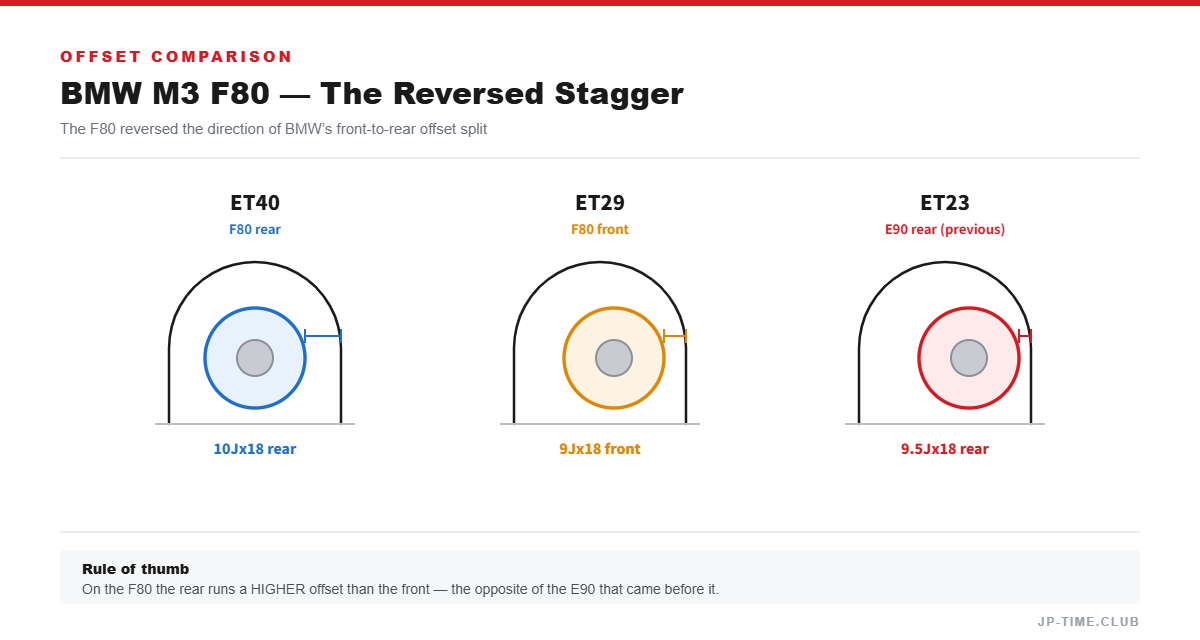
Front ET29, rear ET40. The rear wheel is both wider (10J against 9J) and set 11 mm further inboard. This is not a typo in the listing — it is how BMW packaged the F80’s rear axle.
How the M3 offsets moved across four generations
- E46: front ET47, rear ET26 — a 21 mm split, rear further out
- E90/E92: front ET29, rear ET23 — a 6 mm split, rear slightly further out
- F80: front ET29, rear ET40 — an 11 mm split, rear further in
All three are 5×120 with a 72.6 mm hub bore, so wheels from any of them will physically bolt to any other. None of them will sit the same way.
Section 2: Recommended Fitment Ranges
Factory-Faithful
Verified OEM: ET27–31 front, ET38–42 rear.
- 18-inch: 9J ET29 front, 10J ET40 rear
- 20-inch: 9J ET29 front, 10J ET40 rear — the same widths and offsets, larger diameter
- 140 Nm torque. Higher than the earlier M3s; use a torque wrench
Aftermarket Fitment
- Rear spacers are common precisely because the factory rear offset is high. As with any lug-bolt car, spacers require correctly lengthened bolts with full thread engagement
- Do not assume E90 rear wheels will look right. At ET23 they sit 17 mm further out than the F80’s factory rear
- These are scene norms, not manufacturer specifications. Measure your own car
Instagram Search Keywords
Model Tags:
- #BMWM3 (7.4M)   #F80M3   #F80
- #M3F80          #BMWM

Wheel Brand Tags:
- #BBSWheels (1.1M)   #RAYSWheels (776K)
- #WORKWheels (1.9M)
Section 3: Selection Tips and Cautions
- The rear offset is higher than the front. Confirm which axle a used wheel came from
- 140 Nm torque — higher than E46 and E90
- Lug bolts, M12 x 1.5. Recalculate bolt length with any spacer or wheel thickness change
- 72.6 mm hub bore — shared with E46, E90 and most BMWs of the era
- This is the last 5×120 M3. The G80 that follows moved to 5×112 with a 66.6 mm bore — nothing carries over
- Carbon-ceramic brake option changes caliper clearance; verify before reducing diameter
Fitment verification checklist:
- ✓ Confirm front and rear offsets separately — and which way round they go
- ✓ Confirm the wheels are F80 spec, not E90 or E46
- ✓ Confirm hub bore is 72.6 mm
- ✓ Confirm bolt length and seat type, especially with spacers
- ✓ Check caliper clearance before reducing diameter
Conclusion
The F80 sits at the end of one era and just before another. It shares a bolt pattern with two decades of BMWs, yet arranges its offsets in the opposite direction to the car it replaced — and the generation after it abandons the pattern entirely. Work axle by axle, and check the direction of the stagger before assuming anything.
Looking for genuine JDM wheels in 5×120? Submit a Request and we will search our networks in Japan for the size and offset you need.
Related Fitment Guides
- BMW M3 E90 / E92 — the generation before
- BMW M3 G80 — the move to 5×112
- Mercedes-AMG — the same rear-in thinking
- Porsche 911 — and the same again
- BMW M3 E36 — the M3 that ran equal offsets
Every guide in this series is built the same way: verified factory specifications, an offset diagram, and an honest account of what fits and what does not.