
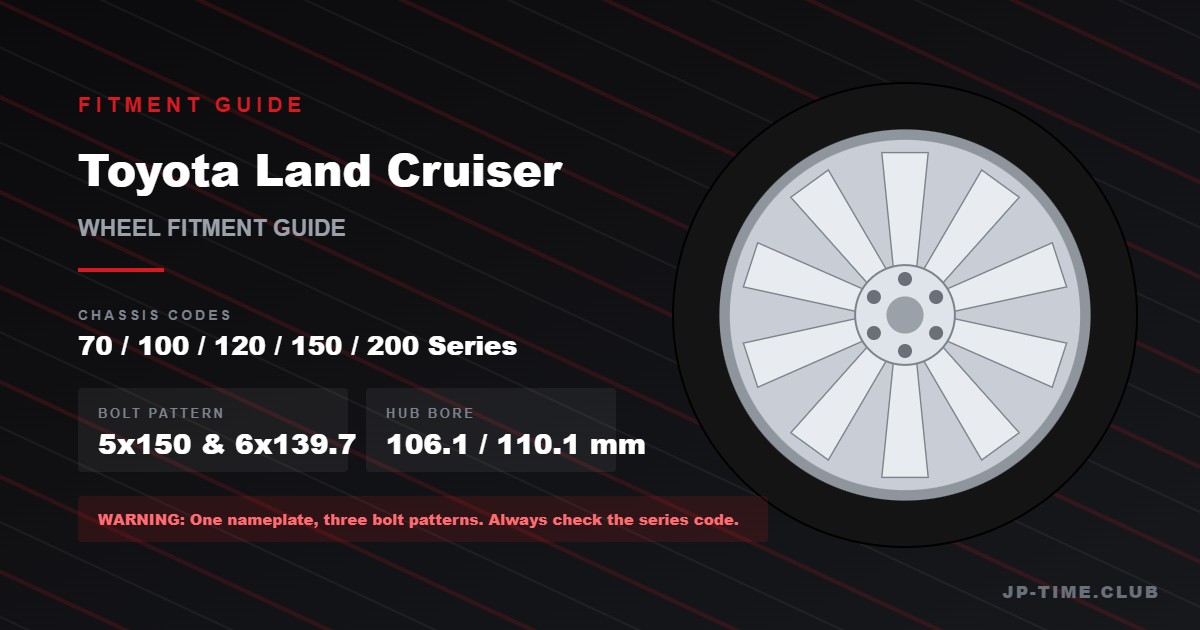
“Land Cruiser” is not a fitment. It is a nameplate that covers two bolt patterns, two hub bores, two thread sizes and offsets from ET-20 to ET60 — an eighty-millimetre range. Almost nothing swaps between a 70 Series, a Prado and a 200 Series.
If you take one thing from this guide: find the series code before you look at a single wheel.
Section 1: OEM Wheel Specifications by Series
| Series | Years | Bolt Pattern | Hub Bore | Thread | OEM Wheel | OEM Tyre |
|---|---|---|---|---|---|---|
| 200 Series | 2007-2021 | 5×150 | 110.1 mm | M14x1.5 | 8Jx17 ET60 8Jx18 ET56 8.5Jx20 ET60 |
285/65R17 285/60R18 285/50R20 |
| 100 Series | 1998-2007 | 5×150 | 110.1 mm | M14x1.5 | 8Jx16 ET60 8Jx17 ET60 8Jx18 ET60 |
275/70R16 275/65R17 275/60R18 |
| 105 Series | 1998-2007 | 6×139.7 | 110.1 mm | M12x1.5 | 8Jx16 ET0 | 275/70R16 |
| 150 Series (Prado) | 2009-2024 | 6×139.7 | 106.1 mm | M12x1.5 | 7.5Jx17 ET25 7.5Jx19 ET25 6.5Jx17 ET15 |
265/65R17 265/55R19 245/70R17 |
| 120 Series (Prado) | 2003-2009 | 6×139.7 | 106.1 mm | M12x1.5 | 7.5Jx17 ET30 | 265/65R17 |
| 70 Series | 1984-2023 | 6×139.7 | 110.1 mm | M12x1.5 | 7Jx15 ET-20 6.5Jx16 ET0 |
31×10.50R15 235/85R16 |
Wheel nut torque is approximately 131 Nm for 5×150 cars (M14x1.5) and 103 Nm for 6×139.7 cars (M12x1.5). The 105 Series is the solid-axle variant of the 100 and uses the 6-lug pattern.
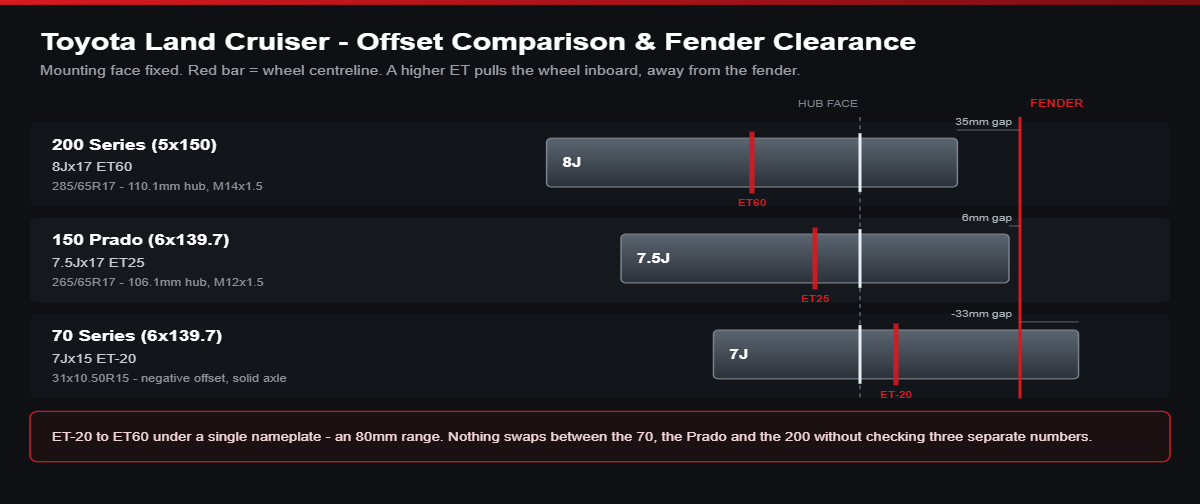
Section 2: Offset Comparison & Fender Clearance Visualization
Section 3: The Two Bolt Patterns
5×150 — the 100 and 200 Series
The full-size, independent-front-suspension Land Cruisers use 5×150 with a 110.1 mm bore and M14x1.5 studs. This is an unusual pattern with a small aftermarket, shared mainly with the Lexus LX470 and LX570 (which are the same vehicles) and the Toyota Tundra and Sequoia of certain years.
Practically, 5×150 means:
- Lexus LX wheels fit directly. This is by far the most common source of factory-quality alternative wheels.
- Nothing from the Prado or 70 Series fits. Different pattern, different bore, different thread.
- The M14x1.5 stud is larger than most Toyotas. Wheels made for M12 fitments will have undersized bolt holes.
6×139.7 — the Prado, 70 Series and 105
The six-lug pattern is far more common globally — it is the standard light-truck pattern used by the Hilux, 4Runner, FJ Cruiser, Nissan Navara, Mitsubishi Pajero and many others. That makes the aftermarket enormous.
But note the hub bore difference within the six-lug family: the 120 and 150 Prado use 106.1 mm, while the 70 and 105 Series use 110.1 mm. A 106.1 mm wheel will not fit a 110.1 mm hub. The error only works in one direction.
A 200 Series on large-diameter aftermarket wheels — the 5×150 pattern with a 110.1 mm bore. — via @@vossen_philippines
Section 4: Why the 70 Series Runs a Negative Offset
An ET-20 wheel places the mounting face inboard of the wheel’s centreline. On a solid-axle vehicle running 31-inch tyres, that is deliberate: it widens the track, it clears the leaf springs and steering components, and it gives the tyre room to articulate without contacting the chassis.
It also means 70 Series wheels look wrong on anything else and nothing else looks right on a 70 Series. If you are shopping for a 70, you are shopping in a specialist corner of the market — typically ET-20 to ET0, 15 or 16 inches, in steel or heavy-duty alloy.
Section 5: Load Rating Is Not Optional Here
This is the section that matters most on this platform. A 200 Series weighs around 2,700 kg before passengers, luggage or a roof rack. A loaded one on a rough surface puts loads through the wheel that no passenger-car wheel is designed for.
Two things to check on any used Japanese wheel for a Land Cruiser:
- JWL-T, not just JWL. JWL is the Japanese light-alloy standard for passenger cars. JWL-T is the truck and bus standard, tested to substantially higher loads. A Land Cruiser wants JWL-T.
- The stated load rating per wheel. Reputable Japanese manufacturers publish it per model and size. For a 200 Series, look for a figure comfortably above the axle load divided by two.
A stylish 22-inch wheel rated for a saloon is a genuinely dangerous item on a 2.7-tonne vehicle. This is the one platform in this series where load rating outranks every other consideration.
Section 6: Realistic Aftermarket Fitments
- 200 Series: 18×9 ET25 to ET35 with a 285/60R18 is the standard off-road-oriented setup. 20×9 ET35 for a road-biased look. Going below ET20 will contact the upper control arm on a car with standard suspension.
- 150 Prado: 17×8 ET20 with 265/70R17 is the common overland fitment. 18×8.5 ET25 for road use.
- 70 Series: 16×8 ET-10 to ET0 with 285/75R16. Steel wheels remain the sensible choice for genuine use.
On all of them, lower offset means more strain on the wheel bearing — a longer lever arm between the tyre contact patch and the bearing. On a heavy vehicle that is not a theoretical concern.
Related Fitment Guides
- Suzuki Jimny — 5×139.7 is NOT 6×139.7
- Toyota Alphard & Vellfire — load rating on a heavy Toyota
- Toyota Sienna — the same question on a minivan
- Lexus LS460 — where 5×120 appears in the Toyota group
Every guide in this series is built the same way: verified factory specifications, an offset diagram, and an honest account of what fits and what does not.
Seen on the road
Which wheels are you looking for? Tell us the wheel, the size and the fitment — send us a request and we will go and find it.
Wheel identification is taken from the hashtags the owner applied to their own post.
Buying Wheels for Your Land Cruiser
Series code, bolt pattern, hub bore, thread, load rating — then diameter and offset. The Land Cruiser is the one vehicle in this series where getting the specification wrong is a safety issue rather than an aesthetic one.
Looking for a specific set? We specialise in genuine Japanese wheels — RAYS, Volk, Enkei, SSR, WORK, BBS Japan and the rare discontinued sets that never left the country. Tell us the wheel, the fitment, the year — our team searches our networks until we find it.
Specifications in this guide reflect factory equipment for Japanese-market vehicles. Trim levels, optional wheel packages and market-specific variants can differ. Always confirm the fitment against your own vehicle before purchase.