

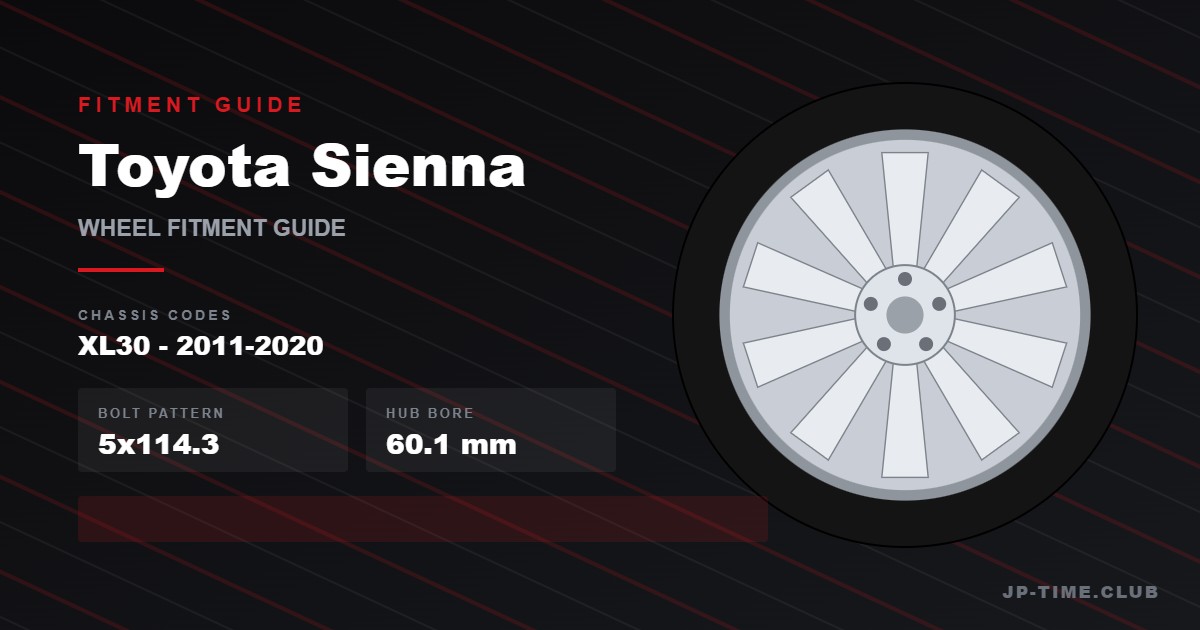
The Sienna is a North American minivan with a Japanese fitment. 5×114.3, 60.1 mm bore, M12x1.5, 103 Nm — the same combination Toyota used on the Supra, the Chaser, the Lexus IS and the Alphard.
That single fact is why a surprising number of Siennas end up on Japanese wheels: the parts pool is enormous, and nothing needs adapting.
Section 1: OEM Wheel Specifications
| Package | Bolt Pattern | Hub Bore | Thread | Torque | Wheel (front & rear) | Tyre |
|---|---|---|---|---|---|---|
| 17-inch (base) | 5×114.3 | 60.1 mm | M12x1.5 | 103 Nm | 6.5Jx17 ET45 | 235/60R17 |
| 17-inch | 5×114.3 | 60.1 mm | M12x1.5 | 103 Nm | 7Jx17 ET35 | 235/60R17 |
| 18-inch | 5×114.3 | 60.1 mm | M12x1.5 | 103 Nm | 7Jx18 ET35 | 235/55R18 |
| 19-inch (SE / Limited) | 5×114.3 | 60.1 mm | M12x1.5 | 103 Nm | 7Jx19 ET35 | 235/50R19 |
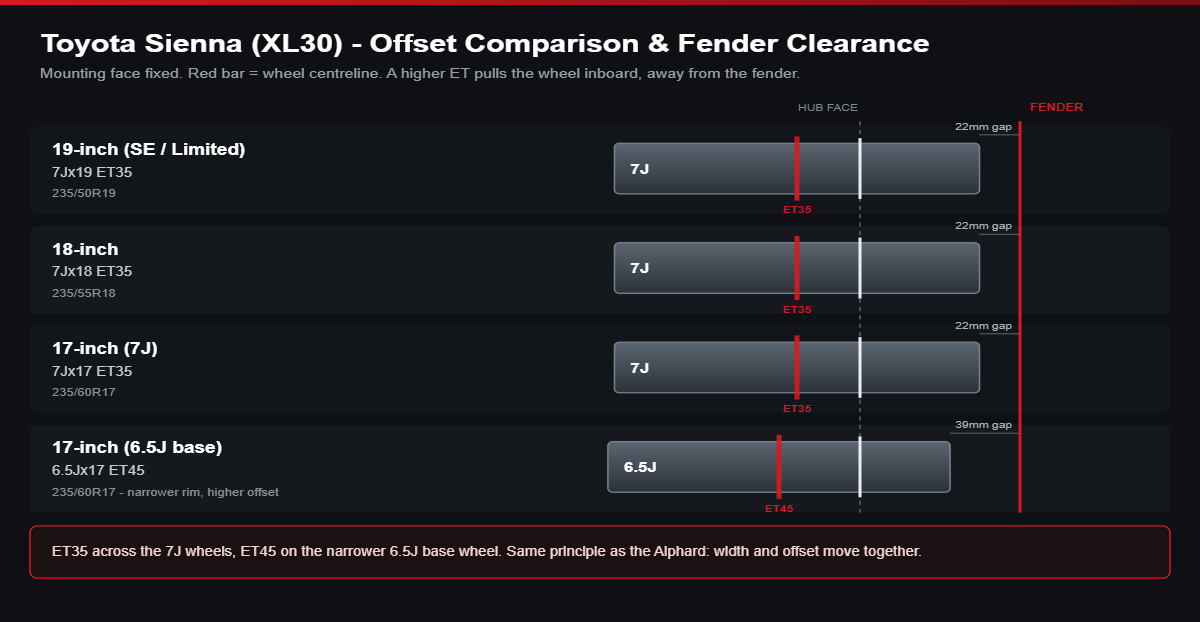
The 6.5-inch base wheel runs ET45; every 7-inch wheel runs ET35. The narrower rim is set further inboard to keep the tyre in the same place.
Section 2: Offset Comparison & Fender Clearance Visualization
Section 3: ET35 Is Already Fairly Low
Compare the Sienna with the Alphard: the Alphard’s 18-inch wheel is 7.5J at ET45, the Sienna’s is 7J at ET35. The Sienna’s wheel sits roughly 16 mm further outboard relative to its hub.
That has a direct practical consequence. On an Alphard there is a great deal of visible room to fill; on a Sienna there is less. Most owners going wider find the front arch liner before they find the fender lip.
Realistic fitments:
- 19×8 ET35–ET40 — a clean upgrade with 245/45R19. No arch work at factory ride height.
- 20×8.5 ET35 — the common aftermarket size. Check front clearance at full lock; the Sienna turns tighter than it looks.
- 20×9 ET30 and lower — lowered cars only, with camber and usually a fender roll.
- 18×8 ET40 — the sensible, ride-preserving option. Cheaper tyres and far more sidewall.
A lowered Sienna running Japanese VIP-style multi-piece wheels — the 5×114.3 / 60.1 mm fitment makes this a direct fit. — via @@toyotasiennapr2
Section 4: Weight and Load Rating
A Sienna weighs roughly 1,950 kg empty and is designed to carry eight people. As with the Alphard and the Land Cruiser, gross vehicle weight is what the wheel has to carry, not the figure on the brochure.
On any used Japanese wheel:
- Check for JWL and VIA stamps on the inside of the spoke face.
- Ask for the published load rating per wheel. Japanese manufacturers state it by model and size.
- Be careful with sports-car wheels. A beautiful 19-inch designed for a 1,300 kg coupe is not rated for a loaded minivan, and it will fit perfectly while being the wrong item.
This is the most common mistake on this vehicle, and it is one where the consequences are not cosmetic.
Section 5: What Fits
The 60.1 mm Toyota bore is the smallest common Japanese hub, which means the Sienna accepts almost everything:
- Any Toyota or Lexus 5×114.3 wheel — Alphard, Supra, Chaser, IS, LS400, Century. See our Lexus IS guide.
- Nissan wheels (66.1 mm) — fit with a 66.1–60.1 hub-centric ring.
- Honda wheels (64.1 mm) and Evo / RX-7 FD wheels (67.1 mm) — fit with rings.
- Nothing with a bore smaller than 60.1 mm — but in the Japanese 5×114.3 world there is essentially nothing smaller.
Offset is the practical filter, not fitment. Aim for ET35 to ET45 and you will be in the right territory.
Related Fitment Guides
- Toyota Alphard & Vellfire — the Japanese equivalent
- Toyota Land Cruiser — the load-rating question
- Lexus IS — the same bolt pattern and bore
- Toyota Century — Toyota’s 60.1 mm world
Every guide in this series is built the same way: verified factory specifications, an offset diagram, and an honest account of what fits and what does not.
Buying Wheels for Your Sienna
5×114.3, 60.1 mm, ET35 as the reference, and a load rating for a full vehicle. The Sienna is one of the easiest vehicles in this series to fit Japanese wheels to — which is exactly why so many of them are wearing them.
Looking for a specific set? We specialise in genuine Japanese wheels — RAYS, Volk, Enkei, SSR, WORK, BBS Japan and the rare discontinued sets that never left the country. Tell us the wheel, the fitment, the year — our team searches our networks until we find it.
Specifications in this guide reflect factory equipment. Trim levels, model years, optional wheel packages and market-specific variants can differ. Always confirm the fitment and load rating against your own vehicle before purchase.