

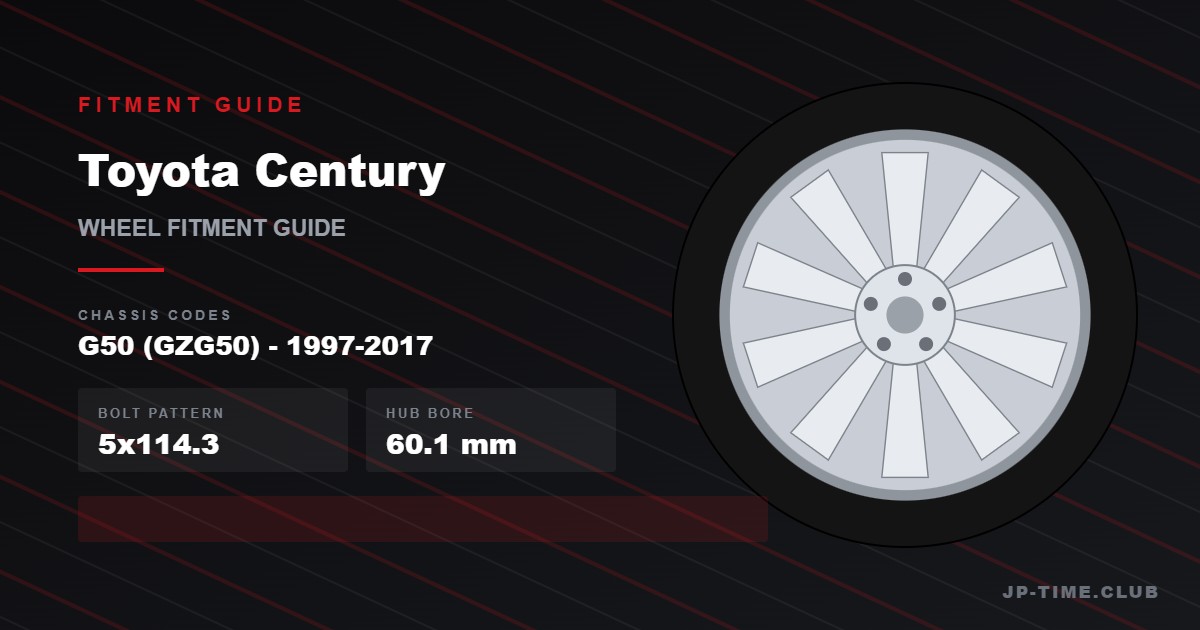
Toyota’s flagship — the only Japanese production car ever fitted with a V12, hand-finished, upholstered in wool because leather was considered too noisy — runs the same wheel as a Lexus LS400.
7JJx16, ET45, 5×114.3, 60.1 mm bore, M12x1.5. Unchanged for twenty years, from 1997 to 2017.
That is not an oversight. It is the entire philosophy of the car: nothing about a Century is intended to draw attention, least of all its wheels.
Section 1: OEM Wheel Specifications
| Model | Chassis Code | Years | Bolt Pattern | Hub Bore | Thread | OEM Wheel / Tyre |
|---|---|---|---|---|---|---|
| Century 5.0 V12 | GZG50 | 1997-2017 | 5×114.3 | 60.1 mm | M12x1.5 | 7JJx16 ET45 / 225/60R16 |
| Lexus LS400 (comparison) | UCF20 | 1994-2000 | 5×114.3 | 60.1 mm | M12x1.5 | 7Jx16 ET45 / 225/60R16 |
| Lexus LS430 (comparison) | UCF30 | 2000-2006 | 5×114.3 | 60.1 mm | M12x1.5 | 7.5Jx17 ET45 |
The G50 Century shares its bolt pattern, hub bore, thread and offset with the LS400 and LS430. Wheels interchange directly between all three.
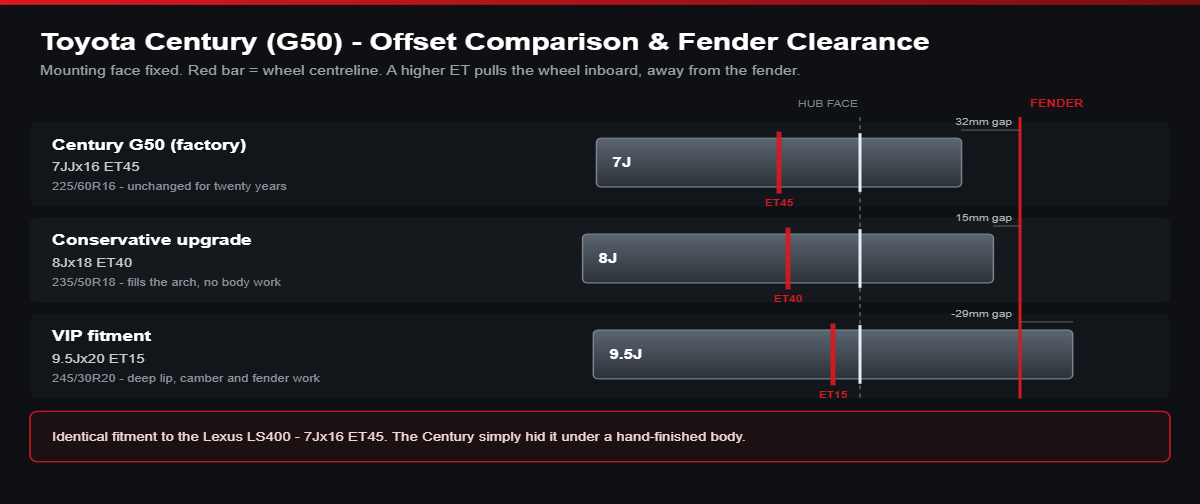
Section 2: Offset Comparison & Fender Clearance Visualization
Section 3: The Restraint Is the Point
A Century is 5,270 mm long and weighs around 2,000 kg. It is wider than an LS400 and taller. And Toyota put a 16-inch wheel on it — with a full-diameter hubcap on most cars, because an exposed alloy would have been ostentatious.
For an owner, this creates a straightforward choice with no middle ground:
- Leave it alone. A correct, unmodified Century on factory wheels is increasingly rare and increasingly valued. The 16-inch wheel is part of what the car is.
- Commit to VIP. The alternative tradition — large-diameter deep-lip multi-piece wheels, air suspension, negative camber — is equally established and equally Japanese.
There is very little appetite for anything in between, and that is worth knowing before you spend money.
A Japanese-market Century on deep-lip wheels — the other tradition this platform supports. — via @@_classic_jdm_
Section 4: What Fits
The Century uses Toyota’s most common combination and is therefore mechanically easy:
- Lexus LS400, LS430, SC430, Soarer, Chaser, Supra, IS wheels all fit directly. See our LS400 guide and LS430 guide.
- Nissan wheels (66.1 mm) fit with a 66.1–60.1 hub-centric ring.
- Evo and RX-7 FD wheels (67.1 mm) fit with rings.
- The LS460 does not share this fitment — it moved to 5×120 with M14x1.5. See our LS460 guide.
Section 5: If You Go Large
Realistic steps, in order:
- 18×8 ET40 with 235/50R18 — a genuinely tasteful upgrade. Keeps the rolling diameter close to factory, fills the arch, requires nothing. Arguably the best-value change you can make.
- 19×8.5 ET35 with 245/40R19 — more presence, still no body work at standard ride height.
- 20×9.5 ET15 with 245/30R20 — full VIP. Air suspension, camber, rolled or pulled arches.
Two cautions specific to this car.
First, weight. A Century is a two-tonne car and large multi-piece wheels are heavy. A 20-inch three-piece with a wide lip can exceed 15 kg per corner — check the published load rating and look for the JWL and VIA stamps on any used Japanese wheel.
Second, ride quality. The Century’s entire engineering brief was isolation. Going from a 60-series sidewall to a 30-series undoes a substantial part of what makes the car what it is. That may be an acceptable trade — but it should be a deliberate one.
Related Fitment Guides
- Lexus LS400 / Celsior — the same fitment, different badge
- Lexus LS430 / Celsior — and again
- Toyota Alphard & Vellfire — the modern VIP platform
- Lexus SC / Toyota Soarer — the coupe on the same wheel
Every guide in this series is built the same way: verified factory specifications, an offset diagram, and an honest account of what fits and what does not.
Seen on the road
Which wheels are you looking for? Tell us the wheel, the size and the fitment — send us a request and we will go and find it.
Wheel identification is taken from the hashtags the owner applied to their own post.
Buying Wheels for Your Century
Mechanically, nothing about the Century is difficult: 5×114.3, 60.1 mm, M12x1.5, and the widest parts pool in Japan. The only real decision is whether you are keeping the car as Toyota intended it, or joining the other tradition.
Looking for a specific set? We specialise in genuine Japanese wheels — RAYS, Volk, Enkei, SSR, WORK, BBS Japan and the rare discontinued sets that never left the country. Tell us the wheel, the fitment, the year — our team searches our networks until we find it.
Specifications in this guide reflect factory equipment for Japanese-market vehicles. Trim levels, optional wheel packages and market-specific variants can differ. Always confirm the fitment against your own car before purchase.