
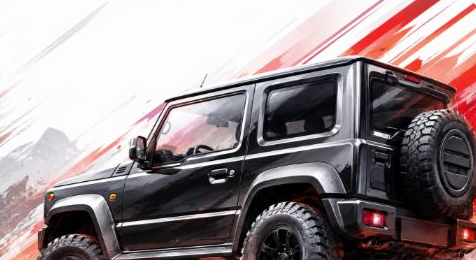
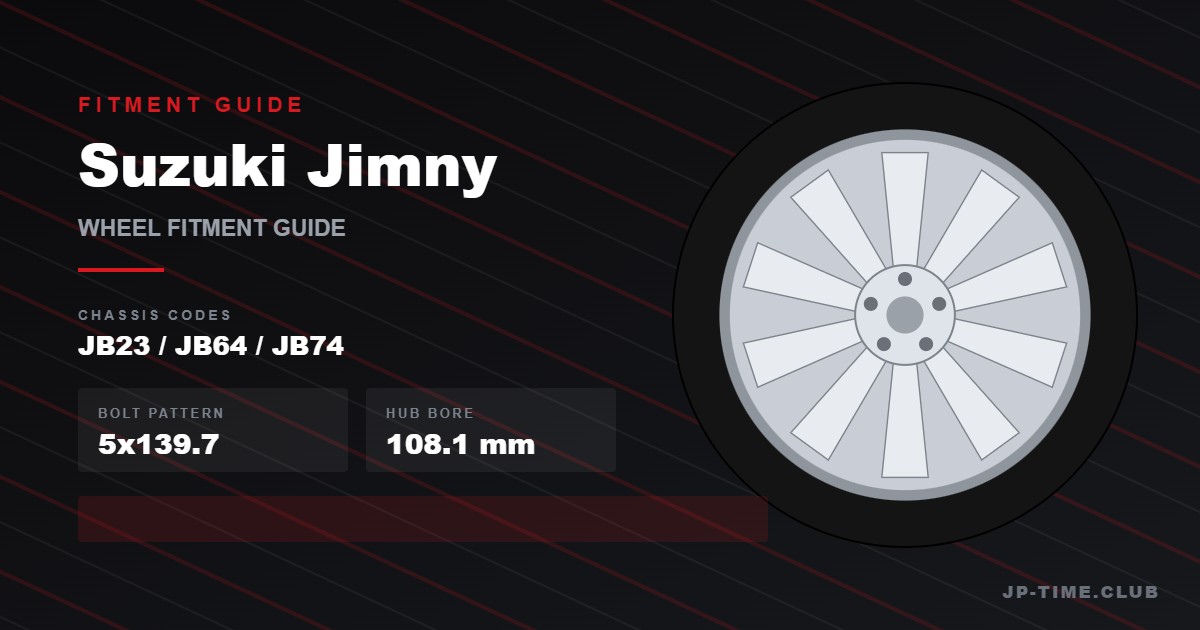
The Jimny is the smallest vehicle in this entire series and it has the largest bolt pattern. 5×139.7 — the same circle used by the Jeep Wrangler, the classic Land Rover Defender and full-size American pickups — on a car that weighs about 1,090 kg.
Add a 108.1 mm hub bore and a factory offset of ET5 and you have a fitment that has nothing in common with any other Japanese car we have covered.
Section 1: OEM Wheel Specifications
| Generation | Chassis Code | Years | Bolt Pattern | Hub Bore | Thread | OEM Wheel / Tyre |
|---|---|---|---|---|---|---|
| Jimny III | JB23 | 1998-2018 | 5×139.7 | 108.1 mm | M12x1.25 | 5.5Jx15 ET5 / 195/80R15 5.5Jx16 ET22 / 175/80R16 |
| Jimny IV | JB64 | 2018- | 5×139.7 | 108.1 mm | M12x1.25 | 5.5Jx15 ET5 / 195/80R15 5.5Jx16 ET22 / 175/80R16 |
| Jimny Sierra | JB74 | 2018- | 5×139.7 | 108.1 mm | M12x1.25 | 5.5Jx15 ET5 / 195/80R15 |
Wheel nut torque is approximately 100 Nm. The JB23, JB64 and JB74 all share the same bolt pattern, hub bore and thread — wheels interchange freely between generations.
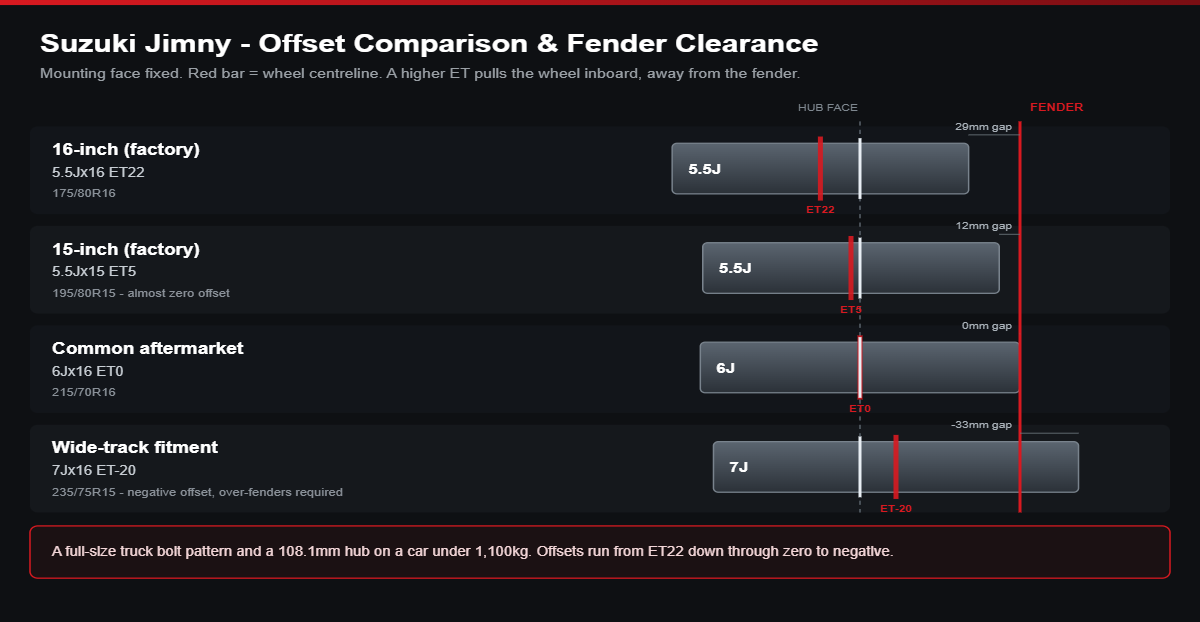
Section 2: Offset Comparison & Fender Clearance Visualization
Section 3: Why a Truck Bolt Pattern on a Kei Car
Because the Jimny is a truck. It has a ladder frame, live axles front and rear, and a low-range transfer case. The 5×139.7 pattern and the large 108.1 mm hub are what a live-axle four-wheel-drive vehicle needs to carry loads through the wheel that a monocoque car never sees.
The practical consequences:
- The aftermarket is a 4×4 aftermarket, not a JDM sports-car one. Steel wheels, beadlock-look alloys, and off-road-oriented designs dominate. Japanese brands including MLJ, WORK, Bradley and RAYS all make Jimny-specific wheels, but they are a different catalogue from the one that serves the Silvia or the Supra.
- Suzuki Samurai and Jimny wheels interchange across generations, and other 5×139.7 vehicles are dimensionally compatible on pattern — but check the hub bore. Many 5×139.7 wheels are made for larger hubs and will not centre on the Jimny’s 108.1 mm.
- Load rating is easy to satisfy for once. Wheels built for this pattern are generally designed for far heavier vehicles.
A Japanese-market JB64 on aftermarket 5×139.7 wheels and all-terrain tyres — the standard Jimny build. — via @@yu.jimny64
Section 4: The ET5 Factory Offset
An ET5 wheel sits almost exactly centred on the mounting face. For comparison, the Honda S2000 in this series runs ET65 at the rear — sixty millimetres further inboard.
The Jimny needs that low offset for the same reasons the 70 Series Land Cruiser does: track width, clearance around the steering and suspension components, and room for a tall tyre to articulate.
Common aftermarket fitments:
- 16×5.5 ET20 to ET22 — factory-equivalent. A better-looking wheel with no change in geometry.
- 16×6 ET0 with 215/70R16 — the most popular upgrade. Roughly 20 mm more track per side, still legal on standard arches in most markets.
- 16×7 ET-20 and lower with 235/75R15 — the wide-track look. Over-fenders required, and in Japan this affects the vehicle’s registered dimensions.
- 15×5.5 ET5 with 195/80R15 — the factory 15-inch, and still the best choice for genuine off-road use. Taller sidewall, better articulation, cheaper tyres.
Section 5: Two Cautions Specific to the Jimny
Offset and steering. Reducing offset increases the scrub radius, which on a live-axle vehicle with a steering damper produces noticeably heavier steering and more kickback over rough surfaces. Going from ET22 to ET-20 is a 42 mm change and it is felt, not just seen.
Width and regulations. In Japan, the Jimny’s kei classification depends on the vehicle staying within strict dimensional limits. Over-fenders and wide-offset wheels can take a JB64 out of kei class, with real consequences for tax and registration. The JB74 Sierra is already outside kei class and has more room, which is one reason it is the more common base for wide builds.
Section 6: What Does Not Fit
Essentially the entire rest of this guide series. The Jimny shares nothing with:
- Any 5×114.3 car — Supra, Silvia, Skyline, Evo, RX-7, Z.
- Any 5×100 car — GR86, BRZ, Celica.
- Any 4×100 car — Civic, CR-X, Vitz.
- The Land Cruiser, which uses 5×150 or 6×139.7 — note that 6×139.7 and 5×139.7 are different patterns despite the identical diameter.
That last point catches people regularly. The number after the “x” is only half the specification.
Related Fitment Guides
- Toyota Land Cruiser — the other Japanese live-axle 4×4
- Toyota Alphard & Vellfire — load rating and JWL
- Toyota Vitz / Yaris & GR Yaris — a small Japanese car with nothing in common
- Toyota Sienna — the other heavy Toyota in this series
Every guide in this series is built the same way: verified factory specifications, an offset diagram, and an honest account of what fits and what does not.
Seen on the road
Which wheels are you looking for? Tell us the wheel, the size and the fitment — send us a request and we will go and find it.
Wheel identification is taken from the hashtags the owner applied to their own post.
Buying Wheels for Your Jimny
5×139.7, 108.1 mm bore, and be honest about what the vehicle is for. A Jimny used off road wants a 15-inch wheel and a tall tyre. A Jimny used in town can wear whatever suits it. The mistake is buying for one and using it for the other.
Looking for a specific set? We specialise in genuine Japanese wheels — RAYS, Volk, Enkei, SSR, WORK, BBS Japan and the rare discontinued sets that never left the country. Tell us the wheel, the fitment, the year — our team searches our networks until we find it.
Specifications in this guide reflect factory equipment for Japanese-market vehicles. Trim levels, optional wheel packages and market-specific variants can differ. Always confirm the fitment against your own vehicle before purchase.