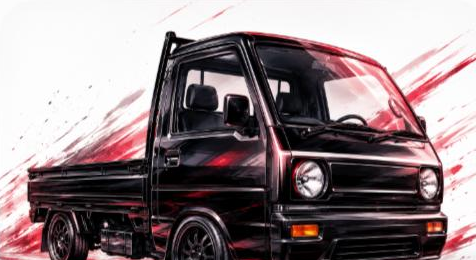
On 28 February 2012, Subaru stopped building the Sambar. What carried the badge afterwards was a Daihatsu Hijet.
That single date splits this vehicle into two entirely different machines, and it is the thing to establish before buying wheels for one. Before it: a rear-engined, four-cylinder, four-wheel-independently-sprung kei truck that Japan nicknamed 農道のポルシェ — the Porsche of the farm road. After it: a conventional front-engined cab-over with a Daihatsu three-cylinder.
They do not share a hub bore.
The Short Version
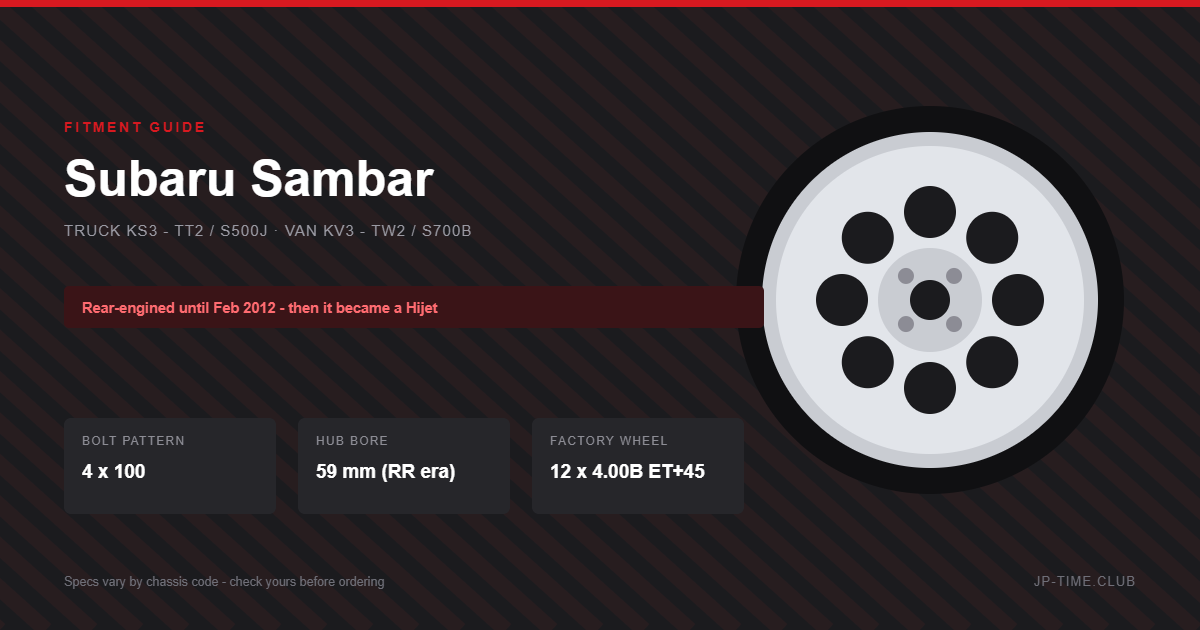
- Both eras are 4×100. That is where the similarity ends.
- Rear-engined Sambar, to Feb 2012: 59 mm hub bore, 12×4.00B at +45, on 145R12.
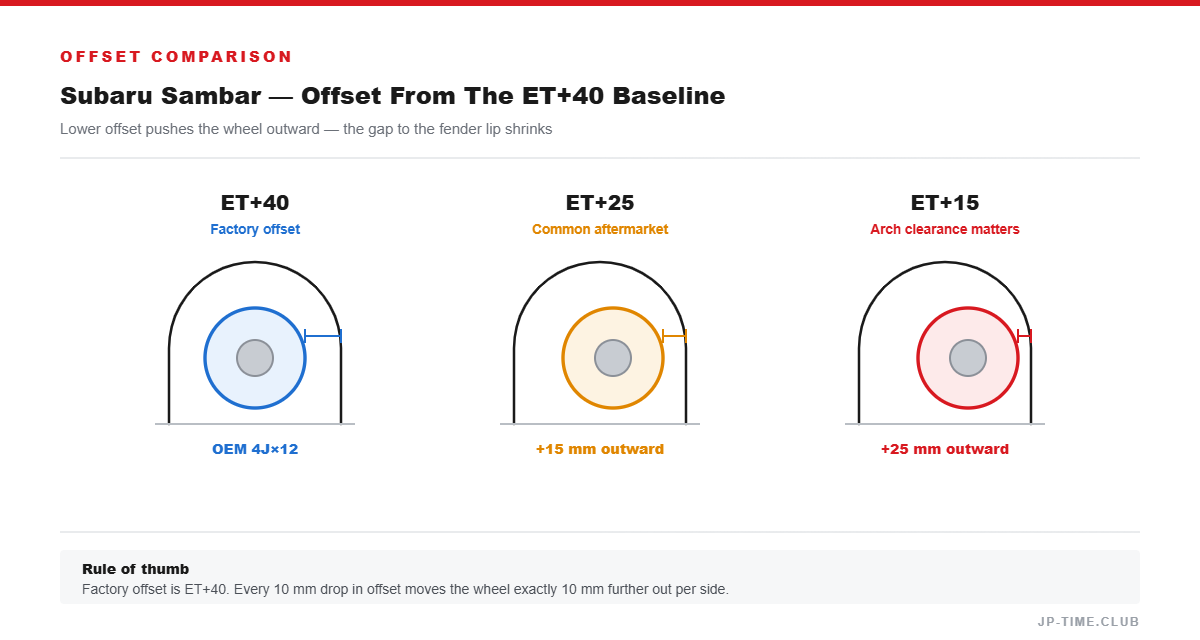
- Hijet-based Sambar, Apr 2012 on: 54 mm hub bore, 12×4.00B at +40.
- A wheel from a 2015 Sambar will not fit a 2010 Sambar. A 54 mm bore will not pass over a 59 mm hub.
- The EN07 really is a four-cylinder — 658 cc, unique in the kei truck class. Everyone else used three.
Two Vehicles, One Badge
| Chassis | Years | Layout | Engine | US 25-year status |
|---|---|---|---|---|
| KS3 / KS4 truck, KV3 / KV4 van | 1990–1998 | Rear engine, RR | EN07 four-cylinder, NA and supercharged | Eligible |
| TT1 / TT2 truck, TV1 / TV2 van, TW1 / TW2 high roof | Feb 1999 – Feb 2012 | Rear engine, RR | EN07 four-cylinder, NA and supercharged | Eligible up to July 2001 |
| S201J / S211J truck, S321B / S331B van | Apr 2012 – ~2014 | Front engine (Hijet) | Daihatsu three-cylinder | Not eligible |
| S500J / S510J truck, S700B / S710B van | ~2014 – | Front engine (Hijet) | Daihatsu KF-VE | Not eligible |
The 2012–2014 cars deserve a note. They are Hijet-based, but built on the outgoing Hijet body, before Daihatsu’s own 2014 model change. So there are effectively two Hijet-era Sambar generations, not one.
Factory Wheel Specifications
| RR era (TT / TV / TW) | Hijet era (S500J / S510J) | |
|---|---|---|
| Bolt pattern | 4×100 | 4×100 |
| Hub bore | 59 mm | 54 mm |
| Factory wheel | 12×4.00B | 12×4.00B |
| Offset | +45 | +40 |
| Tyre | 145R12 6PR | 145R12 |
| Material | Steel | Steel |
The 59 mm figure for the RR era is the number we most wanted to settle, because earlier research could not confirm it and forum posts frequently repeat 54 mm — which appears to be the Daihatsu figure being applied backwards to a vehicle Daihatsu did not build.
We now have it from two Japanese fitment databases in agreement, cross-checked against an owner post specifying a 65×59.1 mm hub-centring ring for “Sambar TT/TV/TW.” That is good corroboration, but it is not a Subaru document, so we are calling it medium confidence and recommending you measure before spending money.
Why It Was Called the Porsche of the Farm Road
The nickname is real and widely used in Japanese motoring press. It refers to the layout: engine behind the rear axle, driving the rear wheels, like a 911. On a vehicle whose job is carrying fertiliser up a track, that is an odd and rather wonderful thing to have done.
Two engineering facts sit behind it, and both check out:
The EN07 is a four-cylinder. 658 cc, 56.0×66.8 mm bore and stroke, in a class where every competitor used three cylinders to save cost and space. It ran in naturally aspirated form (EN07C carburettor, EN07V injected) and, unusually, in supercharged form (EN07Y) continuously alongside the NA engines right through to the final 2012 cars.
Four-wheel independent suspension. Documented on the Sambar back to the 1960s and carried through the entire rear-engined era, on both truck and van. That is not marketing; it is the reason the nickname stuck.
Both of these ended in 2012. The Hijet-based Sambar has a Daihatsu three-cylinder up front and, in all likelihood, a leaf-sprung rigid rear axle like every other kei truck — though we could not find a Subaru document confirming that last point, so we are not stating it as fact.
What the RR Layout Does Not Tell You
It is tempting to conclude that a rear-engined kei truck must wear its rear tyres faster, or load its rear wheels more heavily, and to write a paragraph of advice around that.
We looked, and we could not find a single manufacturer or engineering-press source documenting the front-to-rear weight split or any measured tyre wear difference. It is a plausible inference. It is not a fact we can hand you, so we are not going to.
What we can say is that the RR Sambar is mechanically unlike anything else in this class, that its suspension and running gear do not cross over from a Hijet or a Carry, and that parts support outside Japan is correspondingly thin. That matters more than any wheel question if you plan to keep one.
Dias and Dias Wagon
Dias is the passenger version of the van, not a separate chassis — it rides on the same TV1/TV2 codes. It came in naturally aspirated and supercharged “Dias SC” forms.
Used-car listings frequently describe factory alloy wheels on Dias SC 4WD trim. We could not find a manufacturer brochure confirming that as a standard or optional fitment, so treat it as unconfirmed. We found no evidence of a Dias-specific wheel size differing from the standard van.
Buying Wheels for a Sambar
Work out which Sambar you have first. Not from the year on the paperwork — from the chassis code. TT, TV or TW means rear-engined and 59 mm. S201J, S211J, S500J, S510J, S700B or S710B means Hijet and 54 mm.
If it is the Hijet-based car, shop for a Hijet. Everything in our Daihatsu Hijet guide applies directly. There is no reason to pay a Subaru premium for a Daihatsu part.
If it is the RR car, be careful with anything sold as “kei truck wheels.” 59 mm is not a common bore in this class — Daihatsu is 54, Honda 56, Suzuki around 60. A Suzuki wheel at 60 mm is close enough to be tempting and is still not a hub-centric fit. Use a proper centring ring or use the right wheel.
What We Could Not Verify
- Hub bore for the KS3 / KS4 / KV3 / KV4 generation (pre-1999). Do not assume it matches the TT/TV figure.
- The exact month in 2014 when the Sambar moved to the current Hijet body.
- Rear suspension type on the post-2012 Sambar. Almost certainly a leaf-sprung rigid axle, but unconfirmed.
- Factory alloy on the Dias SC. Listings say yes; no brochure found.
- Any documented weight-distribution or tyre-wear consequence of the RR layout.
- A Subaru primary document confirming the 59 mm bore. Two databases agree; Subaru itself publishes spec PDFs only for current models.
Related Fitment Guides
- Kei trucks and kei vans overview — the rebadging map and JWL-T
- Daihatsu Hijet — what a post-2012 Sambar actually is
- Honda Acty & Vamos — the other kei truck with an unusual layout
- Kei trucks in the USA — the 25-year rule and where each state stands
Getting Sambar Wheels From Japan
We source in Japan to order. Send us the chassis code — TT2, TV1, S510J — through the Request page, and if you have an RR-era car and a caliper, we would genuinely like your hub measurement. That figure deserves to be settled properly.