Kei trucks are being imported into the United States in numbers nobody predicted ten years ago. They are cheap, they are tiny, they will carry a pallet, and the 25-year rule has made a whole generation of them legal. What almost nobody explains in English is that the badge on the front of a kei truck often has nothing to do with who built it — and that one of the most common kei trucks in the US uses a bolt pattern that no other kei truck uses.
This guide covers what actually fits. Everything below is what we could verify; where we could not verify something we have said so instead of filling the gap.
The Short Version
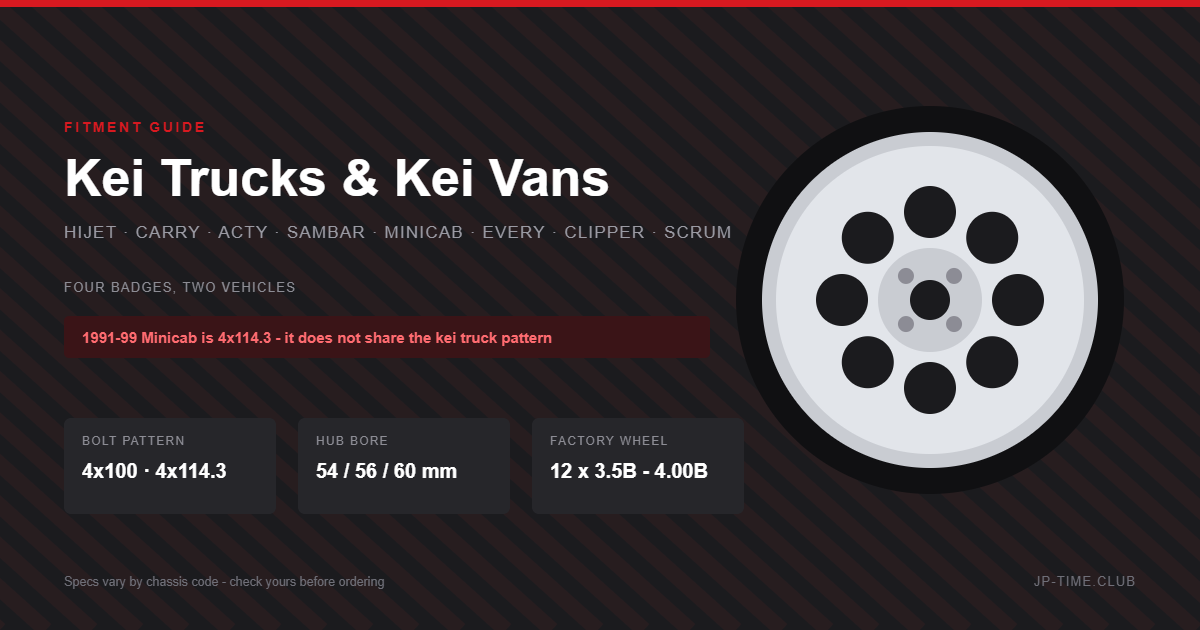
- Most kei trucks and kei vans are 4×100 with a 12-inch factory steel wheel, roughly +40 to +45 offset.
- The 1991–1999 Mitsubishi Minicab (U41T / U42T) is 4×114.3. A wheel that fits every other kei truck on this page will not bolt to it.
- Hub bores differ by maker — roughly 54 mm Daihatsu, 56 mm Honda, 60 mm Suzuki. The bolt pattern matching does not mean the wheel will sit on the hub.
- Badges lie. Since 2012 a Subaru Sambar is a Daihatsu Hijet. Since 2014 a Mitsubishi Minicab, a Nissan NV100 Clipper and a Mazda Scrum are all Suzuki.
- In Japan these are cargo vehicles, and wheels for them are normally certified to
JWL-T— a different technical standard from theJWLon a passenger car wheel.
Four Badges, Two Vehicles
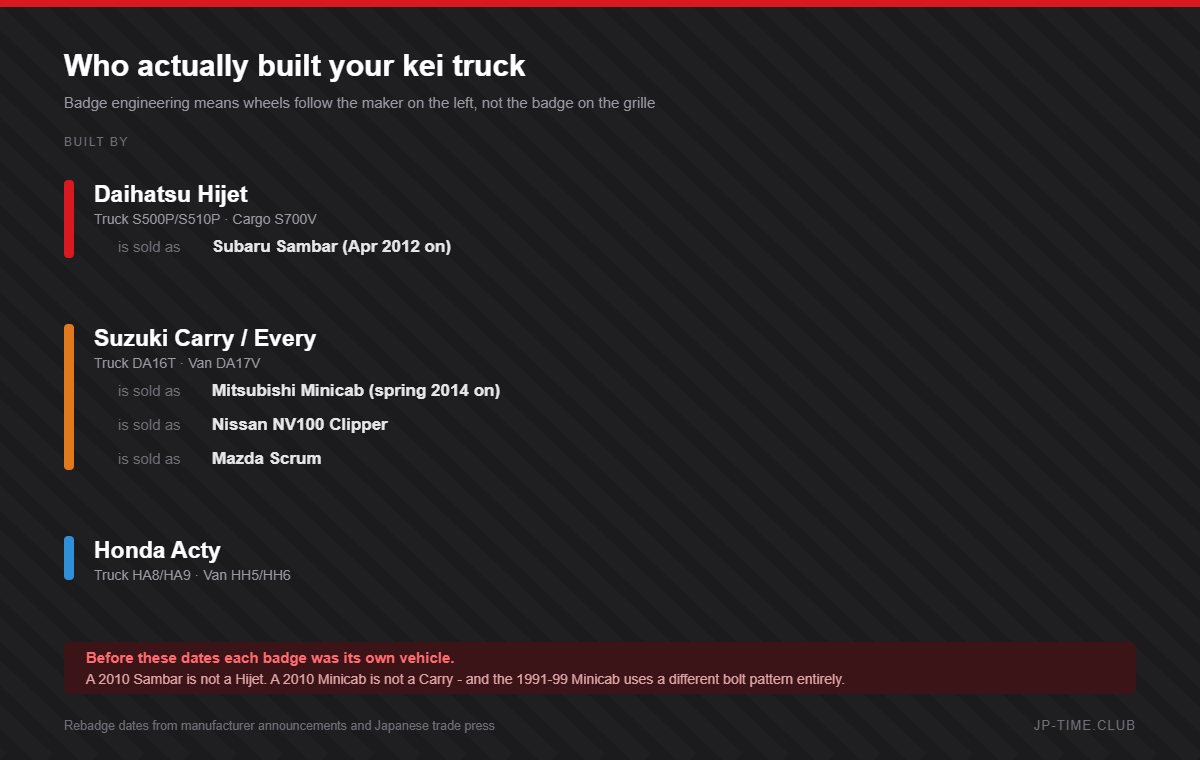
This is the first thing to establish, because it decides everything else. Japanese kei commercial vehicles are heavily badge-engineered: a handful of makers build them and the rest rebadge.
| Badge | Actually built by | From |
|---|---|---|
| Subaru Sambar (Truck & Van) | Daihatsu Hijet | April 2012 |
| Mitsubishi Minicab (Truck & Van) | Suzuki Carry / Every | Spring 2014 |
| Nissan NV100 Clipper / Clipper Van | Suzuki Carry / Every | — |
| Mazda Scrum (Truck & Van) | Suzuki Carry / Every | — |
The dates are the important part. A 2015 Subaru Sambar takes Daihatsu Hijet wheels. A 2010 Subaru Sambar does not — that is Subaru’s own rear-engined design, and we were not able to confirm that its hub bore matches the Daihatsu. A 2016 Mitsubishi Minicab takes Suzuki Carry wheels. A 2010 Minicab is a Mitsubishi.
If you are searching for wheels by the badge on your truck, you are searching for the wrong thing. Search for the vehicle that was actually built.
The One Kei Truck That Does Not Take Kei Truck Wheels
The Mitsubishi Minicab Truck U41T / U42T, built 1991–1999, uses a 4×114.3 bolt pattern. Every other kei truck in this guide is 4×100.
4×114.3 is the pattern you find on an old Silvia or a Datsun — not on a kei vehicle. We confirmed it from two independent used-parts listings quoting OEM part numbers. The change happened at the generation break in February 1999, when the U42T gave way to the U61T alongside a revision of the kei-car regulations. From that point Mitsubishi used 4×100 like everyone else, and kept it until the switch to Suzuki production in 2014.
This matters because these trucks are cheap, plentiful, and exactly the age that makes them attractive to import. If you have a 1990s Minicab, do not buy a wheel because it says “fits kei truck.” Measure the studs.
Factory Specifications
Figures below are the ones we could corroborate across at least two Japanese sources. Anything we could not confirm is marked, and you should measure rather than trust it.
| Vehicle | Chassis | Years | PCD | Hub bore | Wheel | Offset |
|---|---|---|---|---|---|---|
| Daihatsu Hijet Truck | S500P / S510P | 2014– | 4×100 | 54 mm | 12×4.00B | +40 |
| Daihatsu Hijet Truck | S200P–S211P | 1999–2014 | 4×100 | 54 mm | 12×4.00B | +40 |
| Suzuki Carry | DA16T | 2013– | 4×100 | see note | 12×3.5B | +45 |
| Suzuki Carry | DA63T | 2002–2013 | 4×100 | 60 mm | 12×4.00B | +45 |
| Honda Acty Truck | HA8 / HA9 | 2009–2021 | 4×100 | 56 mm | 12×3.50B | +40 |
| Honda Acty Truck | HA6 / HA7 | 1999–2009 | 4×100 | 56 mm | 12×3.5B | +40 |
| Subaru Sambar Truck | S500J / S510J | 2012– | 4×100 | 54 mm | 12×4.00B | +40 |
| Subaru Sambar Truck | TT1 / TT2 | 1999–2012 | 4×100 | not confirmed | 12×4.00B | +45 |
| Mitsubishi Minicab Truck | U41T / U42T | 1991–1999 | 4×114.3 | 58–59 mm | 12×3.50B | +38 |
| Mitsubishi Minicab Truck | U61T / U62T | 1999–2014 | 4×100 | not confirmed | 12×3.5B | +38 |
| Mitsubishi Minicab Truck | DS16T | 2014– | 4×100 | as Carry DA16T | 12×3.5B | +45 |
| Vehicle | Chassis | Years | PCD | Hub bore | Wheel | Offset |
|---|---|---|---|---|---|---|
| Suzuki Every | DA17V | 2015– | 4×100 | 60 mm | 12×4.00B | +45 |
| Suzuki Every | DA64V | 2005–2015 | 4×100 | 60 mm | 12×4.00B | +45 |
| Daihatsu Hijet Cargo | S700V / S710V | 2021– | 4×100 | 54 mm | 12×4.00B | +40 |
| Daihatsu Hijet Cargo | S321V / S331V | 2004–2021 | 4×100 | 54 mm | 12×4.00B | +40 |
| Honda Acty Van | HH5 / HH6 | 2015–2021 | 4×100 | 56 mm | 12×3.5B | +40 |
| Honda Vamos | HM1 / HM2 | 1999–2018 | 4×100 | 56 mm | 13×4.00B | +45 |
| Nissan NV100 Clipper Van | DR17V | 2013– | 4×100 | 60 mm | 12×4.00B | +45 |
| Mitsubishi Minicab Van | DS17V | 2014– | 4×100 | 60 mm (as Every) | 12×4.00B | +45 |
Note on the current Suzuki Carry (DA16T). Our sources disagree on the hub bore — one gives 54 mm, while the outgoing DA63T is documented at 60 mm. We are not going to print a number we cannot stand behind. Measure your hub before ordering, or ask us and we will measure a wheel here.
The pattern in these tables is worth stating out loud: the bolt pattern is nearly always the same and the hub bore nearly never is. Daihatsu sits around 54 mm, Honda around 56 mm, Suzuki around 60 mm. A 4×100 wheel off a Suzuki Every will line up with the studs on a Daihatsu Hijet and still not seat properly on the hub. Hub-centric rings solve it in one direction only — you can reduce a large bore to a small hub, never the reverse.
One clarification, because it catches people out. The figures above are vehicle hub diameters. A wheel’s centre bore is a separate number and is not always cut to match. Aftermarket wheels in particular are often machined oversized so one casting can serve several models, with a centring ring taking up the difference — normal practice, not a defect. The practical consequence is that you need both numbers: what your hub measures, and what the wheel measures. Do not take either from a listing without checking.
JWL vs JWL-T: Your Kei Truck Is a Cargo Vehicle
This is the part that does not exist in English, and it is the part most worth understanding.
Japan has two separate technical standards for light-alloy wheels, both issued under the Ministry of Transport notification of 1 October 1983 and both still current:
- Technical standard for light alloy disc wheels for passenger cars — the standard behind the
JWLmark - Technical standard for light alloy disc wheels for trucks and buses — the standard behind the
JWL-Tmark
A kei truck and a kei cargo van are registered in Japan as 貨物 (cargo) vehicles — the four-digit plate class. They are commercial vehicles, not passenger cars, and aftermarket wheels sold for them in Japan are normally certified to the truck standard and marked JWL-T.
The industry body that administers the marking, NAPAC/JAWA, publishes the required markings for a Japanese alloy wheel. There are five, and JWL or JWL-T is one of them:
| 1 | Manufacturer name, trademark or abbreviation |
| 2 | Date of manufacture |
| 3 | JWL or JWL-T mark |
| 4 | VIA mark |
| 5 | For limited-application wheels, a vehicle code or a load rating |
Items 3 and 4 must be placed where they can be read with the wheel mounted on the vehicle. That is a deliberate design requirement, and it is why you can inspect a wheel in a car park without taking it off.
There is one more detail that is genuinely useful and that we have never seen in English. When a wheel is certified to both standards, the load rating is prefixed to say which certification it belongs to: VIA-P for the passenger-car figure and VIA-T for the truck figure. So a dual-certified kei truck wheel can read something like VIA-T 450KG. If you are looking at a wheel offered for a kei truck and the only thing stamped on it is a bare VIA with no -T and no JWL-T, it was certified as a passenger car wheel.
What we could not pin down: several Japanese consumer sites state that a 2014 rule change permits JWL-only wheels on light cargo vehicles, with JWL-T remaining the recommendation for vehicles that actually carry load. We could not verify that against a ministry document, so we are reporting it as a claim rather than as the rule. If you are loading your truck, buy the JWL-T wheel.
Load Rating: What 350 kg of Payload Means at the Wheel
The Japanese kei truck standard payload is 350 kg. That number describes the bed, not the wheel.
The load figure that matters on a wheel is defined as half the axle weight at gross vehicle weight — what one wheel actually carries. It is stamped as a kilogram figure next to the VIA mark. For context, the 145R12-6PR tyre fitted as standard to kei trucks is rated at 450 kg per tyre.
We could not find a single published per-wheel rating that applies to all kei truck wheels, because there is not one — it is a property of the individual wheel, not of the vehicle class. So the only reliable check is the number stamped on the wheel you are actually buying. If nobody can tell you what it says, that is your answer.
Going Bigger Than 12 Inches
The factory wheel on almost every kei truck and kei cargo van in this guide is a 12-inch steel wheel. Alloy was a grade option, not the default. That is why a used JDM kei truck usually arrives on steels.
Inch-up to 13, 14 or 15 inches is common in Japan and there is a real aftermarket for it. Three things change when you do it:
- Load rating falls as the wheel gets prettier. Lightweight aftermarket wheels are designed around passenger cars. On a vehicle whose entire purpose is carrying weight over its rear axle, the rating on the wheel is not a detail.
- Offset has very little room. Factory is +38 to +45 on a track roughly 1.3 m wide. Kei trucks have the wheel arch cut into the cab floor, and there is not much space to move the wheel outward before it fouls.
- Tyre choice collapses. 145R12 and 145/80R12 are commercial sizes with plenty of load-rated options. Move to 14 or 15 inches and you are choosing from passenger tyres.
None of this is an argument against inch-up. It is an argument for knowing what you gave up.
What We Could Not Verify
- Hub bore for the current Suzuki Carry DA16T. Sources give 54 mm and 60 mm. Unresolved.
- Full specs for 1980s and early-1990s chassis codes — Daihatsu S80–S83, Suzuki DA51T/DB51T, Subaru KS3/KS4. Bolt pattern is consistently reported as 4×100 but widths, offsets and bores are not confirmed.
- Hub bore for the pre-2012 Subaru Sambar (TT1/TT2) and for the Mitsubishi Minicab U61T/U62T and U61V/U62V.
- Stud thread pitch for everything except Daihatsu, which is consistently documented as M12×1.5. Do not assume Honda, Suzuki, Subaru and Mitsubishi match it.
- The 2014 JWL-T relaxation for light cargo vehicles, described above.
If you own one of these and can photograph the stamp on the back of your wheel, we would like to see it — that is how this page gets more accurate.
FAQ
Will wheels from a Suzuki Every fit a Daihatsu Hijet?
The studs will line up — both are 4×100. The hub bore will not: Suzuki is around 60 mm, Daihatsu around 54 mm. A 60 mm wheel will not seat on a 54 mm hub the wrong way round. Going the other direction, a 54 mm wheel simply will not go over a 60 mm hub at all.
My truck says Subaru. Do I search for Subaru wheels?
If it is 2012 or later, search for Daihatsu Hijet. If it is older, it really is a Subaru and the specs are different.
Is JWL-T actually required?
In Japan these are cargo-registered vehicles and JWL-T is the standard written for them. Whether a JWL-only wheel is legally permitted on a light cargo vehicle after a 2014 change is something we could not confirm from a primary source. If the truck carries load, buy JWL-T.
Can I fit 14-inch wheels?
Physically yes, and it is common in Japan. Check the load rating stamped on the wheel and accept that your tyre options narrow considerably.
Are kei truck wheels interchangeable with kei car wheels?
Sometimes on paper — many kei passenger cars are also 4×100. But a kei passenger car wheel is certified JWL, not JWL-T, and is designed around a much lighter rear axle load. That is a genuine difference, not a formality.
Sources
The wheel marking requirements, the two separate technical standards, and the VIA-P / VIA-T load-marking convention are taken from NAPAC (Japan Auto Parts & Accessories Aftermarket Promotion Association) / JAWA, read in the original Japanese. Rebadging dates are from manufacturer announcements and Japanese trade press. Factory wheel specifications are compiled from Japanese fitment databases and retailer fitment tables, cross-checked between at least two sources where marked as confirmed. Everything we could not confirm is listed above rather than filled in.
Related Fitment Guides
- Daihatsu Hijet — 4×100, 54 mm hub, and the generation that is not import-legal yet
- Suzuki Carry & Every — 60 mm hub, four badges, one disputed measurement
- Honda Acty & Vamos — 56 mm hub, and the only mid-engined kei truck
- Kei trucks in the USA — the 25-year rule and where each state stands
- Suzuki Jimny — a kei-class 4×4 that uses a full truck bolt pattern
- Toyota Alphard & Vellfire — the other place load rating decides the answer
- Toyota Vitz / Yaris — small Japanese car, 4×100, completely different requirements
- How to read the markings on a Japanese wheel — JWL, VIA, load ratings and serials, photographed from our own stock
Buying Kei Truck and Kei Van Wheels From Japan
We are a Japanese exporter. Most of what we ship is sourced in Japan after an order — which for kei commercial wheels is the honest way to do it, because the good used sets move quickly and locally.
If you tell us the chassis code — not the badge, the chassis code stamped on the plate — and what you use the truck for, we will look for it here. That is what the Request page is for. Photographs of the stamp on your existing wheel help more than anything else you can send.