
Honda stopped building the Acty in April 2021 and left the kei truck market. For forty-four years it had been doing something none of its competitors did: putting the engine in the middle.
The Acty is a genuine mid-engined, rear-drive vehicle — engine ahead of the rear axle, not under the seats like a Hijet or a Carry, and not hung out behind the axle like the old Subaru Sambar. Japan nicknamed it the NSX of the farm road. That is a joke about layout, and the layout is real.
The Short Version
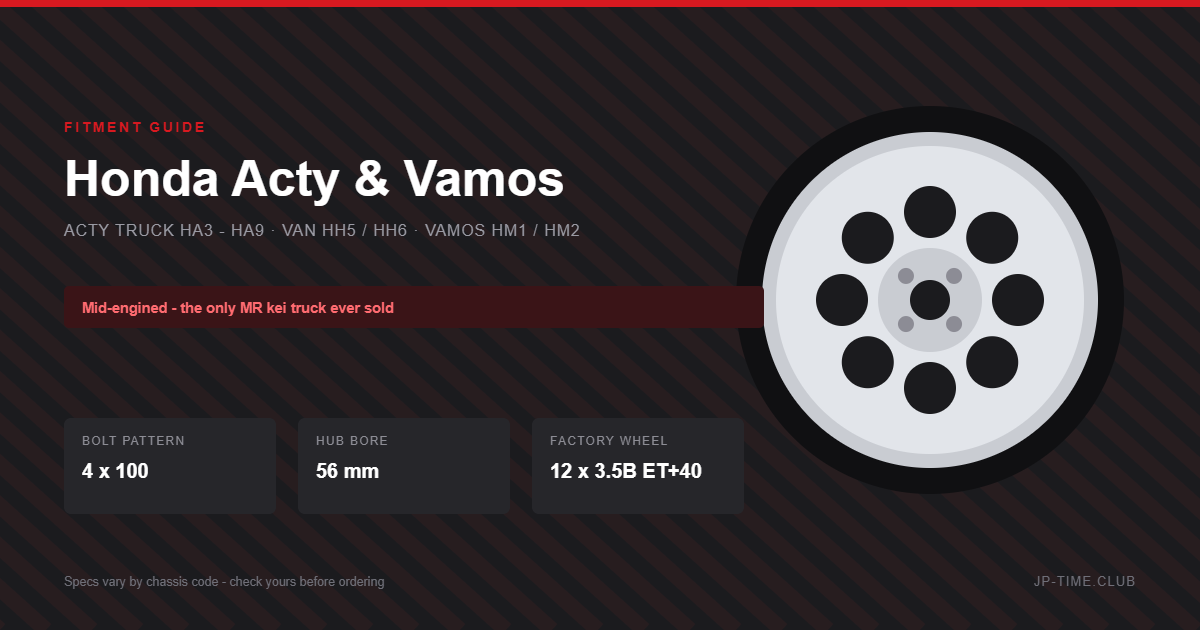
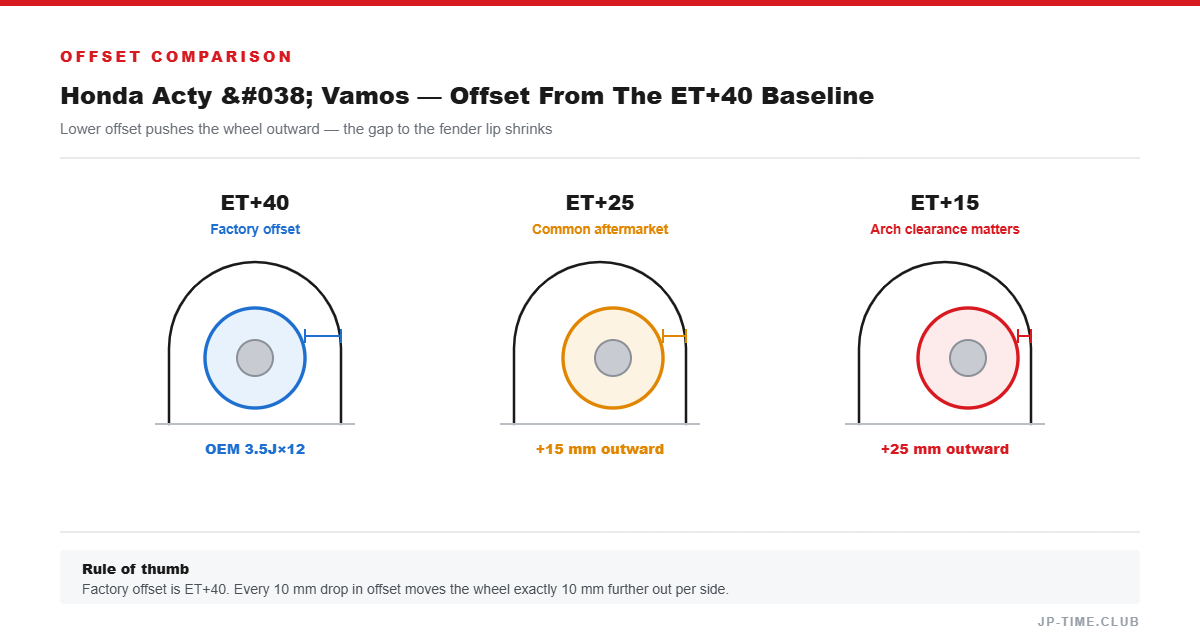
- 4×100, 56 mm hub bore, 12×3.5B at +40. Consistent across Acty Truck and Acty Van generations we could confirm.
- The Vamos is different: 13×4.00B at +45, on 155/70R13.
- 56 mm sits between Daihatsu (54) and Suzuki (60). All three are 4×100. None of the hubs match.
- No factory alloy on any Acty Truck we could find — steel only, even on the special editions. The Vamos is the exception.
- Honda never offered an automatic on a 4WD Acty Truck, in the entire production run.
Which Acty Do You Have
| Chassis | Years | Engine | US 25-year status |
|---|---|---|---|
| Acty Truck HA3 / HA4 | 1990–1999 | E05A / E07A 660 cc | Eligible |
| Acty Truck HA6 / HA7 | 1999–2009 | E07A, PGM-FI | Eligible up to July 2001 |
| Acty Truck HA8 / HA9 | 2009–2021 | E07Z | Not eligible |
| Acty Van HH5 / HH6 | 1999–2018 | E07A | Eligible up to July 2001 |
| Vamos HM1 / HM2 | 1999–2018 | E07Z, NA and turbo to 2010 | Eligible up to July 2001 |
As with the other makers, odd numbers are 4WD: HA4, HA7, HA9, HH6, HM2.
The Acty Van HH5/HH6 is unusual in that a single chassis code covers the entire 1999 to 2018 run, through major facelifts. That makes the code useless for dating the vehicle, and it means the 25-year question has to be answered from the build plate rather than the model designation.
Factory Wheel and Tyre
| Acty Truck / Van | Vamos | |
|---|---|---|
| Bolt pattern | 4×100 | 4×100 |
| Hub bore | 56 mm | 56 mm |
| Factory wheel | 12×3.5B | 13×4.00B |
| Offset | +40 | +45 |
| Tyre | 145R12 | 155/70R13 75S |
| Material | Steel | Steel; 13-inch alloy on AT grades from Feb 2000 |
| Stud thread | Not confirmed | Not confirmed |
The 56 mm hub bore is the practical headline. Every kei truck in this class is 4×100 and none of them share a hub: Daihatsu around 54, Honda 56, Suzuki around 60. A wheel off a Hijet has a 54 mm bore and will not go over a 56 mm Honda hub. A wheel off an Every has a 60 mm bore and will go on, but will not be centred by the hub — it will be held by the studs alone unless you fit a ring.
On a vehicle designed to carry weight, that is not a detail worth being relaxed about.
What Mid-Engine Actually Changes
We want to be careful here, because it is easy to over-claim.
What is documented: the engine sits ahead of the rear axle, driving the rear wheels. This is why the Acty ran a De Dion rear axle rather than a simple beam, and why the drivetrain runs down the centre of the vehicle rather than under the cab floor. The layout is confirmed across the entire production run, HA1 through HA9.
What we are not going to claim: that this produces a specific, measurable front-to-rear tyre wear difference. It is a plausible consequence of the weight distribution, and we have seen it asserted, but we found no source that documents it. If you own an Acty and have measured it, we would like to know.
What it means when buying: the Acty is mechanically the odd one out in this class. Suspension and running gear do not cross over from a Hijet or a Carry, even where wheels physically will. Parts availability outside Japan is correspondingly thinner, which matters more than the fitment question if you plan to keep the truck for years.
The Sambar Comparison
The other kei truck with an unusual layout was the Subaru Sambar, which was genuinely rear-engined — engine behind the rear axle — until 2012. Japan called it the Porsche of the farm road, which is the same joke told about a different layout.
That ended in April 2012, when the Sambar became a rebadged Daihatsu Hijet with a conventional front-engine layout. So from 2012 onward there is exactly one mechanically unusual kei truck left, and Honda discontinued it in 2021. If layout is why you want the vehicle, the Acty is now the only one you can buy.
Attack, Town and the Grades That Matter
Attack is the agricultural grade — a four-speed manual with ultra-low forward and ultra-low reverse gearing, plus a rear differential lock. If you are buying an Acty to work rather than to look at, this is the specification worth finding.
Town is the comfort grade. The 2018 Town Spirit Color Style was a 55th-anniversary edition; its wheels were painted steel, not alloy, which is consistent with everything else we found about this vehicle.
No 4WD Acty Truck was ever offered with an automatic transmission, across the whole 1988 to 2021 run. The 4WD Van got one back in 2001; the truck never did. If a listing claims a 4WD automatic Acty Truck, something is wrong with the listing.
What We Could Not Verify
- Factory tyre sizes for HA3/HA4 (1990–1999) and for the Acty Van across its full run.
- Whether any Acty Truck ever had a factory alloy option. We found none, including on special editions, but absence of evidence is not a manufacturer statement.
- Stud thread pitch for any Honda in this family.
- Any documented front-to-rear tyre wear asymmetry from the mid-engine layout.
- Precise build-date split for HH5/HH6 against the 25-year line, given the single chassis code spans 1999 to 2018.
Related Fitment Guides
- Kei trucks and kei vans overview — rebadging, the Minicab bolt pattern trap, JWL-T
- Daihatsu Hijet — 54 mm hub
- Suzuki Carry & Every — 60 mm hub, four badges
- Honda / Acura NSX — the other Honda where the engine is in the middle
Getting Acty Wheels From Japan
The Acty is out of production and the aftermarket for it was never large, so used is where the good sets are. We source in Japan to order — send us the chassis code and a photograph of the back of your current wheel via the Request page.