

The Short Version
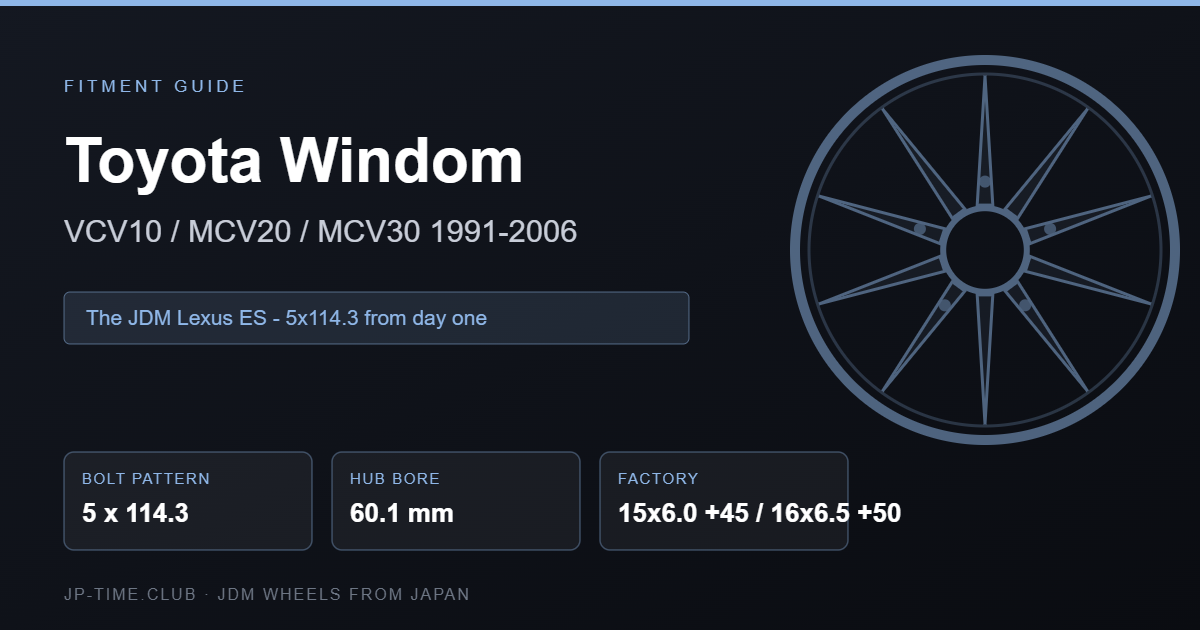
- The Windom has always been 5×114.3. Not 5×100. Not at any point. The Japanese factory table lists 5×114.3 on the very first VCV10 in October 1991 and on every grade through to the end of MCV30 production in March 2006.
- Hub bore is 60 mm in the factory table — 60.1 mm in the usual industry notation — across all three generations.
- Factory wheels: 15×6.0 +45 for the first two generations, stepping to 16×6.5 +50 on the MCV30.
- The Windom is the JDM Lexus ES. Same car, same fitment. ES wheels fit a Windom and vice versa.
- Import note: the MCV30 is the generation currently crossing the US 25-year line, month by month, from August 2026.
Killing the 5×100 Myth First
There is a persistent claim in English-language wheel listings that early Windoms used a 5×100 bolt pattern and that Toyota switched to 5×114.3 in 1996. We went looking for the source of it and could not find one. What we did find was the Japanese factory wheel database’s complete Windom table, every grade from 1991 to 2006, and it shows 114.3 in the PCD column on every single row.
The likely origin of the confusion is that plenty of other Toyotas of the same era genuinely are 5×100 — and that the second-generation Windom (MCV20, from August 1996) is the first one many overseas buyers ever encountered, so a real 1996 event in the car’s history got attached to an imaginary bolt-pattern change. Whatever the cause, do not buy 5×100 wheels for any Windom.
The 60 mm bore has an independent confirmation that we like: the hub-ring fitment table published by a Japanese wheel-hardware manufacturer lists the Windom, alongside the Lexus ES, in its 60 mm hub-bore group. That is a company whose business depends on the number being right.
Factory Specification by Generation
| Generation | Chassis | Years | Factory wheel | PCD | Holes | Bore |
|---|---|---|---|---|---|---|
| 1st | E-VCV10 | 1991.10–1993.08 | 15×6.0 +45 | 114.3 | 5 | 60 |
| 1st | E-VCV11 | 1993.08–1995.08 | 15×6.0 +45 | 114.3 | 5 | 60 |
| 2nd | E-MCV20 / MCV21 | 1996.08–1999.08 | 15×6.0 +45 | 114.3 | 5 | 60 |
| 2nd (late) | GF-MCV20 / MCV21 | 1999.08–2001.08 | 15×6.0 +45 (16×6.0 on Cruising Edition) | 114.3 | 5 | 60 |
| 3rd | TA-MCV30 | 2001.08–2006.03 | 16×6.5 +50 | 114.3 | 5 | 60 |
Which Windom Is Which Lexus ES
Toyota sold this car in Japan as the Windom and in North America as the Lexus ES. The generations line up cleanly:
| Windom | Years | Sold in the US as |
|---|---|---|
| VCV10 / VCV11 | 1991–1996 | Lexus ES 300 (XV10) |
| MCV20 / MCV21 | 1996–2001 | Lexus ES 300 (XV20) |
| MCV30 | 2001–2006 | Lexus ES 300 / ES 330 (XV30) |
This matters for two reasons. First, if you are in the US and want JDM Windom wheels, you almost certainly already own the same hub — an ES of the matching generation takes them without adapters. Second, it means the used-wheel pool is much bigger than “Windom wheels” suggests, because anything listed as fitting a Lexus ES of the right generation fits.
Offsets, and Why the MCV30 Is Different
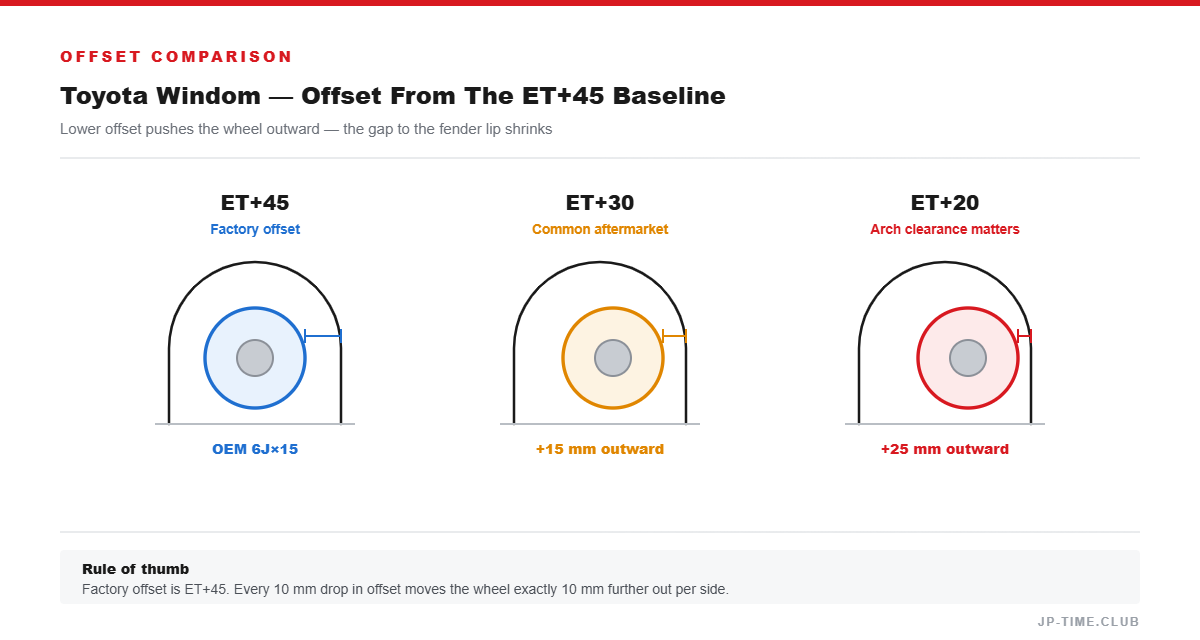
The first two generations sit at +45 on a 6.0J rim. The MCV30 moves to +50 on a 6.5J rim, which is a real change rather than a rounding difference: half an inch more width pushed half an inch further inboard. If you are moving wheels between an MCV20 and an MCV30 you will notice it at the arch.
For aftermarket sizing, the ES/Windom platform is forgiving. 17×7 to 17×7.5 in the +40 to +50 range is the common upsize and generally clears without modification on the MCV20 and MCV30. Going below about +35 starts to put the tyre into the front arch liner at full lock. The 60.1 mm bore means hub-centric rings are almost always required with Japanese aftermarket wheels, which are usually bored much larger.
Importing to the United States
The first two generations are far past the 25-year mark and can be imported without argument. The interesting one is the MCV30.
MCV30 production began in August 2001. Under the 25-year rule the clock runs on the month the car was built, not the model year, so the earliest MCV30s become eligible in August 2026 and the rest follow month by month through to 2031. If someone offers you an MCV30 as “a 2001, so it is legal”, ask for the build plate. A car assembled in July 2001 — if any exist — and a car assembled in September 2001 are a month apart on paper and a year apart in practice.
Wheels, of course, have no such restriction. You can buy JDM Windom wheels for a US-market ES today regardless of what generation the car is.
What We Could Not Verify
- Factory tyre sizes per grade. The wheel table we used does not carry tyre data, and we would rather leave the column out than fill it from memory.
- Whether any base-grade VCV10 shipped a narrower 15×5.5 wheel. Some secondary listings hint at it; the factory table does not show it.
- The exact source of the 5×100 claim, so we cannot tell you which listings to distrust — only that the claim itself does not survive contact with the factory table.
Seen on the road
Which wheels are you looking for? Tell us the wheel, the size and the fitment — send us a request and we will go and find it.
Wheel identification is taken from the hashtags the owner applied to their own post.