
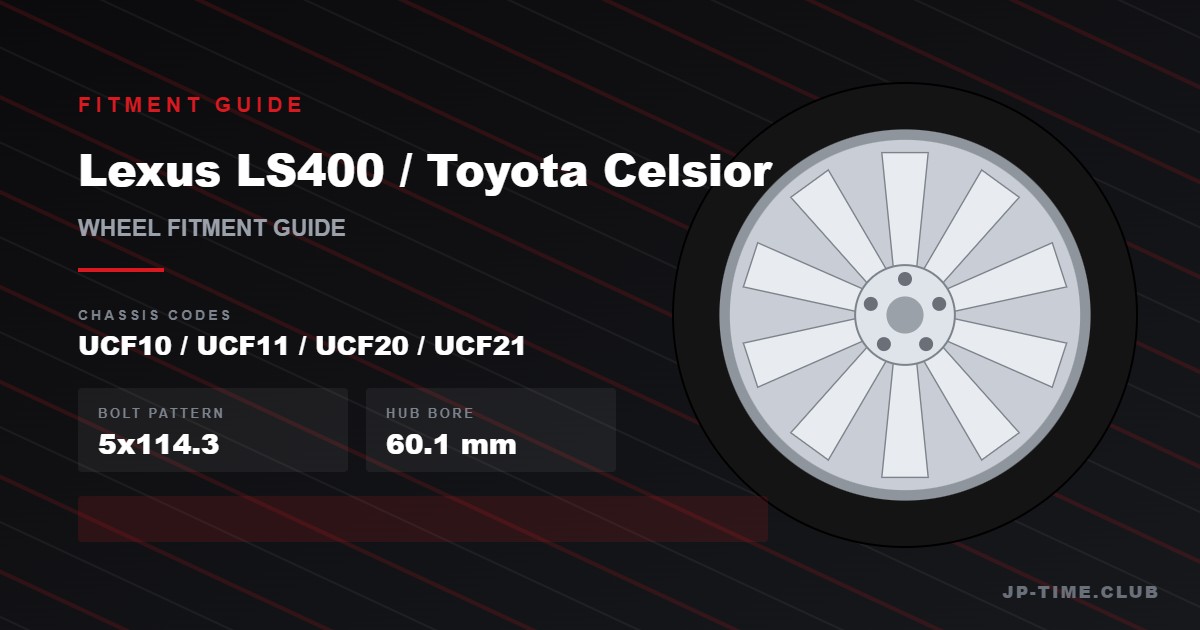
The LS400 left the factory on a 7Jx16 ET45 wearing a 225/60R16 — a wheel so modest that a modern family hatchback would look aggressive next to it. That specification did not change for eleven years, across both generations, in either market.
And yet the LS400 is arguably the single most important car in the history of Japanese wheel culture, because it is where VIP style began. Understanding the LS400’s fitment means understanding the distance between where Toyota put the wheel and where owners decided it should go.
Section 1: OEM Wheel Specifications
| Generation | Chassis Code | Years | Bolt Pattern | Hub Bore | Thread | OEM Wheel / Tyre |
|---|---|---|---|---|---|---|
| First generation | UCF10 / UCF11 | 1989-1994 | 5×114.3 | 60.1 mm | M12x1.5 | 7Jx16 ET45 / 225/60R16 |
| Second generation | UCF20 / UCF21 | 1994-2000 | 5×114.3 | 60.1 mm | M12x1.5 | 7Jx16 ET45 / 225/60R16 |
| LS430 (successor) | UCF30 / UCF31 | 2000-2006 | 5×114.3 | 60.1 mm | M12x1.5 | 7.5Jx17 ET45 (see separate guide) |
The Toyota Celsior is the Japanese-market twin of the LS400 and shares its fitment exactly. The LS430 that followed kept the same bolt pattern and bore — see our LS430 / Celsior guide.
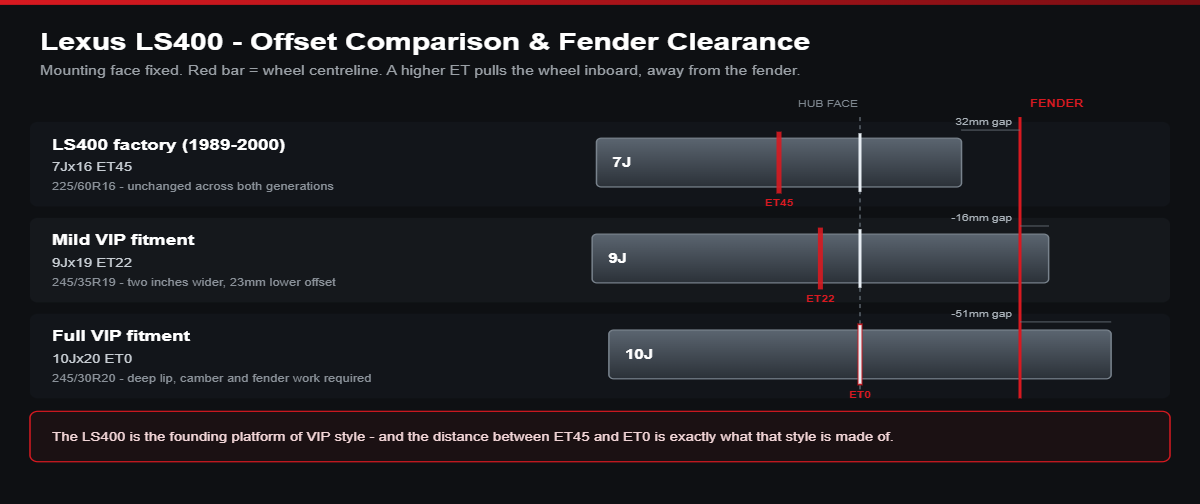
Section 2: Offset Comparison & Fender Clearance Visualization
Section 3: Why the LS400 Became the VIP Car
Three things made it the obvious choice:
- Enormous arches with a tiny wheel in them. A 16-inch rim at ET45 inside an executive saloon’s bodywork leaves a huge amount of visible space. That space is an invitation.
- Air suspension on many cars. The factory height-adjustable system on higher-specification LS400s made ride-height experimentation possible without fabricating anything.
- Depreciation. By the early 2000s, an LS400 in Japan cost a fraction of what it had, while remaining beautifully engineered and quiet.
The result was a culture built around large-diameter, deep-lipped, low-offset multi-piece wheels — WORK, SSR, AME, Weds, Junction Produce — run with negative camber and the arch rolled or pulled.
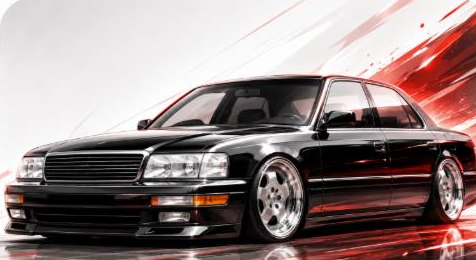
A Japanese-market LS400 on polished multi-piece wheels — the fitment culture the platform created. — via @@ls400_yucf
Section 4: What Actually Fits
The LS400 is technically undemanding. It is 5×114.3 with a 60.1 mm Toyota bore and M12x1.5 studs, which is the largest and most available fitment pool in the Japanese market.
- Supra, Chaser, MR2, Celica and Lexus IS wheels all fit directly. See our Chaser guide and Lexus IS guide.
- Nissan wheels (66.1 mm) fit with hub-centric rings. The bore is larger than the hub, so a 66.1–60.1 ring is all that is required.
- Evo and RX-7 FD wheels (67.1 mm) fit with rings.
- The LS460 does not share this fitment. It moved to 5×120 with M14x1.5 studs and a much higher torque figure — see our LS460 guide.
Section 5: Realistic Fitment Guidance
What the car will take, in order:
- 18×8 ET35 / 19×8.5 ET35 — a clean, unmodified upgrade. Fills the arch, no body work, no camber. This is what most people actually want.
- 19×9 ET22 / 19×9.5 ET15 — the mild VIP look. Fender roll, mild negative camber, lowered on coilovers or air.
- 20×10 ET0 and beyond — full VIP. Pulled arches, significant camber, and a car that is now a project rather than a saloon.
Watch the weight. An LS400 weighs around 1,800 kg. Large-diameter multi-piece wheels are heavy, and a 20-inch three-piece with a wide lip can easily exceed 15 kg per corner. Check the load rating, not just the look — and look for the JWL and VIA stamps on any used Japanese wheel.
Section 6: Tyre Diameter
Going from a 16-inch wheel with a 60-series tyre to a 20-inch wheel means a dramatic drop in sidewall. To keep the rolling diameter close to factory — which matters for the speedometer, the suspension geometry and the ride — you are looking at roughly:
- 18-inch: 235/45R18 or 245/40R18
- 19-inch: 245/35R19 or 235/35R19
- 20-inch: 245/30R20 or 225/30R20
At 20 inches you have almost no sidewall left. On Japanese roads that is a considered trade; on rougher surfaces it is an expensive one.
Related Fitment Guides
- Lexus LS430 / Celsior — the successor
- Toyota Century — the same wheel on Toyota’s flagship
- Lexus SC / Toyota Soarer — the coupe of the same era
- Toyota Alphard & Vellfire — where VIP style went next
Every guide in this series is built the same way: verified factory specifications, an offset diagram, and an honest account of what fits and what does not.
Seen on the road
Which wheels are you looking for? Tell us the wheel, the size and the fitment — send us a request and we will go and find it.
Wheel identification is taken from the hashtags the owner applied to their own post.
Buying Wheels for Your LS400
Mechanically the LS400 asks almost nothing of you. The decision is aesthetic, and the constraint is weight and arch work — not fitment.
Looking for a specific set? We specialise in genuine Japanese wheels — RAYS, Volk, Enkei, SSR, WORK, BBS Japan and the rare discontinued sets that never left the country. Tell us the wheel, the fitment, the year — our team searches our networks until we find it.
Specifications in this guide reflect factory equipment for Japanese-market vehicles. Trim levels, optional wheel packages and market-specific variants can differ. Always confirm the fitment against your own car before purchase.