The Short Version
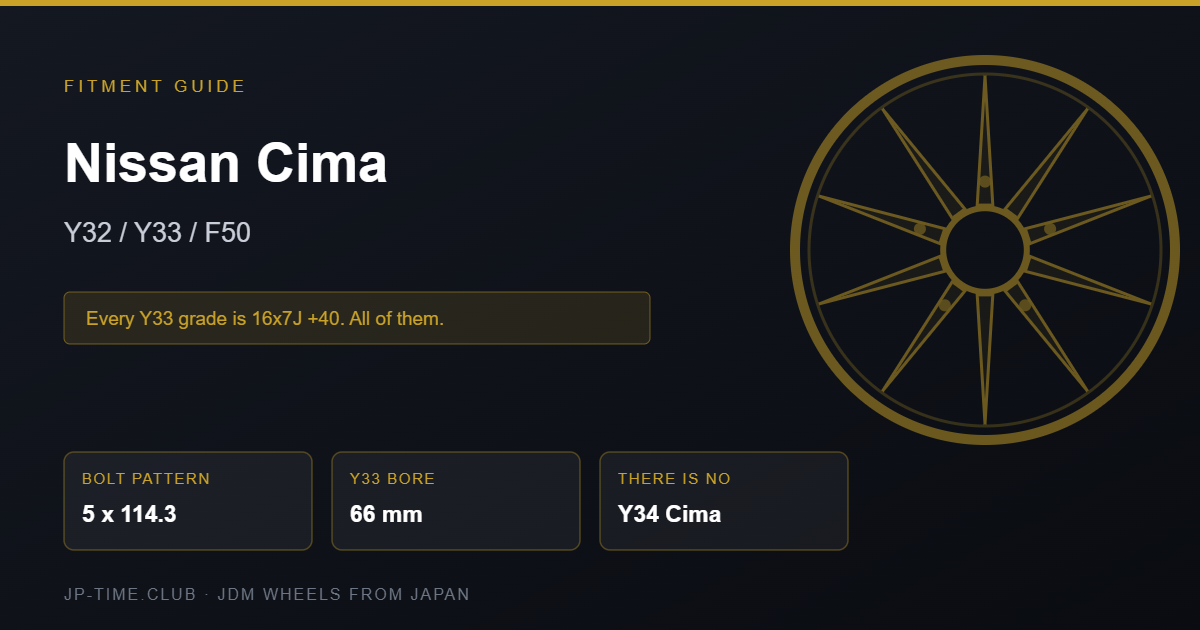
- Y33 Cima: 5×114.3 with a 66 mm hub bore, and 16×7J at +40 on every single grade — 41LX, 41LV, 41TR-X, 30TR, 30L, the four-wheel-drive S-FOUR. No exceptions.
- The Y32 before it runs 15×6.5J at +40, again uniform across grades.
- There is no Y34 Cima. The car that followed the Y33 is the F50. If a listing says Y34, it is guessing.
- Y31 is not in the Japanese wheel database at all. Coverage starts in August 1991.
One Wheel Fits the Whole Range
The Cima is a VIP-scene car, which means most buyers are looking for the factory baseline in order to move away from it. That baseline is unusually easy to state.
Across the entire Y33 range — the 4.1-litre V8 grades, the VQ30DET twin-turbo 30TR, the base 30L, and the four-wheel-drive S-FOUR — the Japanese factory database gives the identical figure: 16×7J at +40, front and rear. Nissan did not differentiate the wheel by grade on this car.
The 30TR grade page also gives the full hub line: PCD 114.3, five holes, 66 mm bore. That 66 mm is worth noting because it is not the 60 mm you find on much of the Toyota luxury range, and it is not the 66.1 mm figure often quoted for later Nissans either — it is what the table says.
Factory Specification
| Generation | Chassis | Period | Wheel | Tyre | PCD / Holes / Bore |
|---|---|---|---|---|---|
| Y32 | FGY32 / FGDY32 / FGNY32 / FPY32 | 1991.08–1996.06 | 15×6.5J +40 | — | not confirmed this pass |
| Y33 | FHY33 (30TR, VQ30DET) | 1996.06–2001.01 | 16×7J +40 | 215/60R16 | 114.3 / 5 / 66 |
| Y33 | all other grades incl. S-FOUR | 1996.06–2001.01 | 16×7J +40 | — | as above |
| F50 | GF50 / HF50 | 2001.01–2010 | 16×7.5J +40 (VIP, XL), 17×7.5J +40 (XV) | — | not confirmed this pass |
The Y34 That Does Not Exist
Overseas listings frequently describe the 2001–2010 Cima as a Y34. It is an F50. We found no Y34 Cima anywhere in the Japanese database index.
The confusion is understandable — Y34 is a real Nissan chassis code, but it belongs to the Cedric and Gloria of the same era, not to the Cima. If you are buying wheels described as fitting a Y34, establish what car the seller actually means.
Sizing for a VIP Build
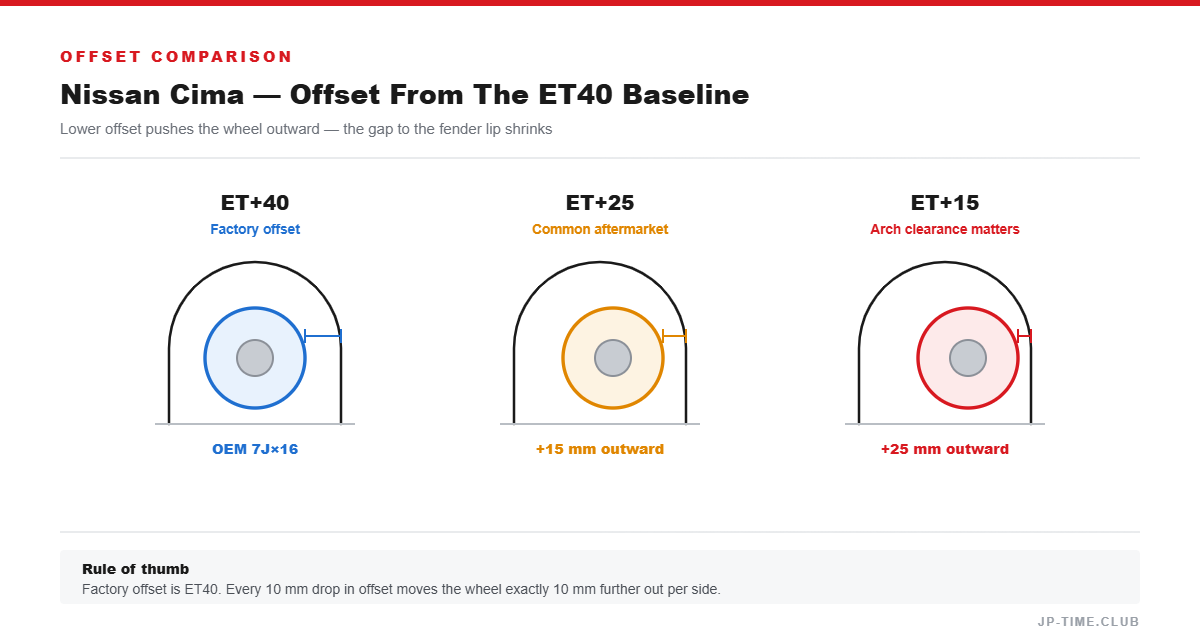
The factory 16×7J at +40 is the number to work from. VIP builds typically go to 19 or 20 inches in the 8.5J to 9.5J range at +15 to +35, sometimes considerably lower with camber. That is a 20 to 50 mm move outboard from stock, which is the point.
Two practical notes. First, the Cima is a heavy car — check the load rating of anything you fit, and be aware that most Japanese wheel makers do not publish one. Second, 66 mm hub rings will be needed with most aftermarket wheels, which are commonly bored at 73 mm.
President, Q45 and the Family
The Cima sits in a cluster of related Nissan flagships, and the relationships change by generation. Broadly: the F50-generation Cima shared its platform with the Nissan President, and Cima-derived bodies were sold overseas as later-generation Infiniti Q45s. The earlier Y31 Cima was closer to the Y31 Cedric and Gloria.
We have that from a secondary Japanese encyclopaedia entry rather than from a manufacturer document, so treat the model-year boundaries as provisional. What we did not do is verify that any of those cars share the Cima’s wheel specification, so do not assume a Q45 wheel is a Cima wheel without checking.
Importing
Y32 and Y33 are fully eligible for US import — Y33 production ended in January 2001, comfortably inside the window. The F50 launched in January 2001, so only cars built between then and August 2001 are eligible now, with the rest following month by month through to 2035.
The Y33 is the sweet spot: fully importable, plentiful in Japan, and the generation the VIP scene actually wants.
What We Could Not Verify
- Y31 Cima entirely. The Japanese wheel database has no entries before August 1991. This is a confirmed absence, not a missed lookup.
- Bolt pattern and hub bore for the Y32 and F50. We read their wheel dimensions from the grade index but did not open a PCD detail page for either.
- Whether the President or Infiniti Q45 share the Cima’s wheel specification.